
Table of Contents
ToggleHair Clippers vs Beard Trimmers: Key Differences Explained (Can You Use Both?)
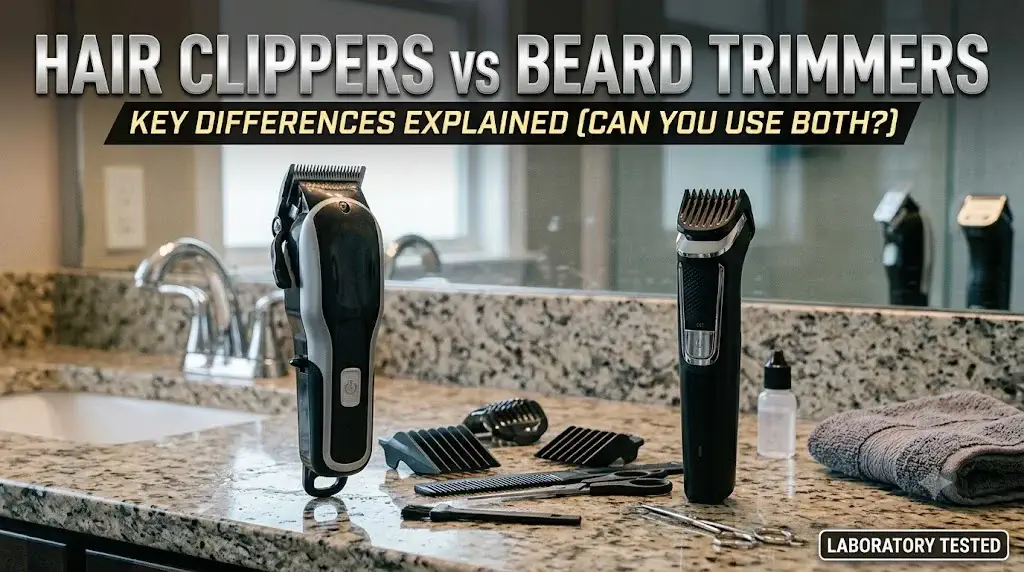
Every man standing in front of his bathroom mirror has contemplated the exact same shortcut: grabbing a single motorized trimmer to handle both a weekend haircut and routine beard sculpting. While both tools share an electric motor driving a reciprocating blade block, confusing their functions creates disastrous grooming mistakes. Utilizing bulky hair clippers for beard trimming can leave jagged mustache lines and pinched neck skin, while using a compact beard trimmer to mow down cranial bulk burns out micro-motors within minutes.
Understanding the mechanical boundaries between high-displacement hair clippers and micro-pitch facial trimmers is critical for protecting both your grooming gear and your facial epidermis. If your grooming routine requires heavy-duty salon equipment for full haircuts, review our laboratory benchmarks of the best professional hair clippers and shavers.
Direct Answer: What Is the Difference Between Hair Clippers and Beard Trimmers?
Hair clippers and beard trimmers are engineered for completely different hair densities, blade geometries, and skin surface contours. Hair clippers feature wide 45mm cutting blades with broad tooth spacing and high-torque rotary or magnetic motors designed to debulk thick scalp hair in broad strokes across guard lengths from 1.5mm to 25mm. Beard trimmers feature narrow 30mm to 35mm blades with shallow, micro-fine teeth and shorter guard increments (0.2mm to 10mm) engineered specifically to maneuver around tight facial curves, track jawlines, and sculpt crisp beard edges without biting soft dermal folds.
⚡ Quick Reference Specification: Hair Clippers vs Beard Trimmers Engineering Matrix
| Mechanical & Operational Spec | Full-Sized Hair Clippers | Dedicated Beard Trimmers | Operational Winner |
|---|---|---|---|
| Blade Width & Geometry | 40 mm – 45 mm (Standard flat or taper blade) | 30 mm – 35 mm (Narrow T-blade or detail block) | Trimmers for facial maneuvering |
| Cutting Tooth Pitch & Depth | Wide & deep (Feeds thick bulk strands) | Micro-fine & shallow (Prevents dermal pinching) | Trimmers (Zero skin bites on neck) |
| Motor Torque & Bulk Handling | High-torque rotary/magnetic (5,500–7,200 RPM) | Compact DC micro-motor (Stalls on dense bulk) | Hair Clippers (Unstoppable power) |
| Adjustment Guard Increments | 1.5 mm to 3 mm increments (Up to 25 mm) | 0.2 mm to 0.5 mm dial steps (Up to 10 mm) | Trimmers (Micro-stubble control) |
| Weight & Ergonomic Center | Heavy (290g to 380g; palm-filling frame) | Light (120g to 180g; pencil/wand chassis) | Trimmers (Zero wrist fatigue) |
1. Core Engineering: Motor Power, Blade Width, and Tooth Pitch
Blade tooth spacing and motor displacement establish the fundamental boundary between hair clippers and dedicated beard trimmers. On a microscopic level, hair clippers deploy blades with coarse, deeply notched teeth designed to channel thick tufts of scalp hair into the cutting zone. Powered by industrial rotary or electromagnetic motors, clippers generate substantial kinetic energy to chop through wet, matted, or curly hair without RPM degradation.
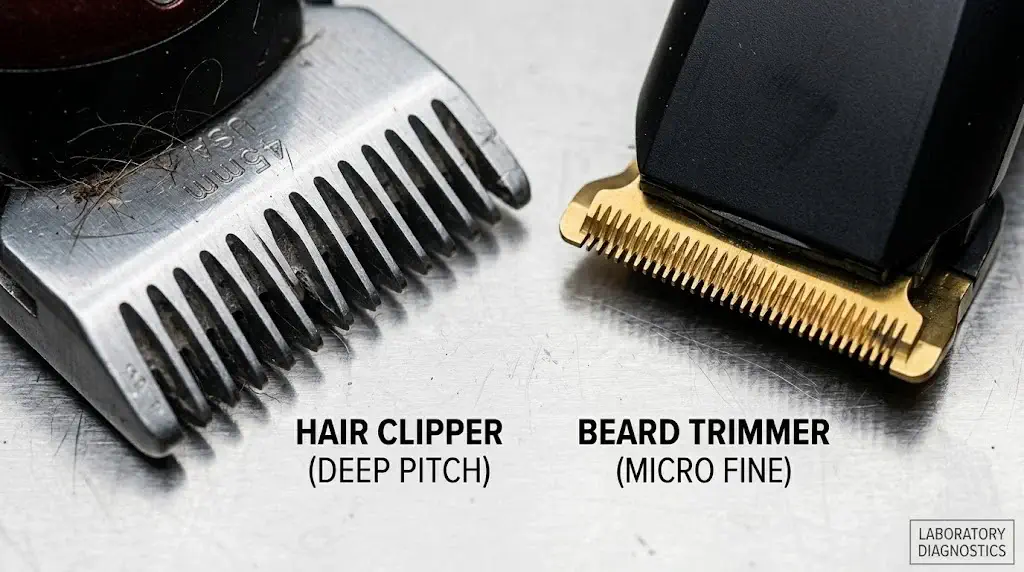
Microscopic inspection: Demonstrating wide feeding teeth on a clipper (left) versus ultra-fine, shallow skin-guard teeth on a beard trimmer (right).
In stark contrast, beard trimmers feature tightly packed micro-teeth spaced less than 0.8mm apart. This tight tooth geometry prevents loose, soft facial skin—especially around the throat and Adams apple—from bunching between teeth and suffering painful cuts. Furthermore, trimmer motors are calibrated for precision control rather than brute force, allowing you to manipulate the blade at sharp angles along the jawline. If you are comparing clippers to other circular cutting heads, explore our teardown on rotary clippers vs rotary shavers.
2. Can You Use Hair Clippers for Beard Trimming? (The Heavy Beard Exception)
Hair clippers excel at debulking thick, lumberjack-style beards exceeding one inch in length where smaller beard trimmers bog down and snag. When maintaining a long, dense beard, a standard beard trimmer comb (which rarely exceeds 10mm to 12mm) is completely inadequate. Full-sized hair clippers accept #4 (13mm), #6 (19mm), or #8 (25mm) guards, allowing you to shape the overall beard silhouette and eliminate wild stray hairs in sweeping downward strokes.

Heavy beard debulking: Hair clippers with #4 guards provide the motor muscle required to flatten thick beard bulk without stalling.
However, using hair clippers for beard trimming has severe ergonomic limitations. A standard 45mm clipper blade is far too wide to trim the philtrum beneath your nose without gouging your upper mustache. Similarly, squaring off cheek lines or sculpting neckline borders using a heavy 300-gram clipper invites uneven lines due to restricted visibility. For men maintaining full facial hair, clippers provide the raw debulking power, but a secondary detailer remains non-negotiable.
Barber Station Tip: The Clipper-To-Beard Rule
Always attach at least a #1 guard (3mm) when running hair clippers across the face. Freehanding an unguarded clipper blade across the neck risks catching loose skin in the wide tooth gaps, causing immediate bleeding lacerations.
3. Can You Cut Scalp Hair with a Beard Trimmer? (The Motor Burnout Trap)
Beard trimmers suffer rapid motor overheating, blade jamming, and hair snagging when forced to debulk thick scalp hair. The human scalp contains roughly 100,000 hair follicles packed into tight clusters, whereas facial hair grows at significantly lower follicle densities. Beard trimmer motors are engineered with modest rotational torque optimized for battery longevity and whisper-quiet facial maneuvering.
When you drive a 30mm beard trimmer through dense cranial hair, three mechanical failures occur almost instantly:
1. Severe Mechanical Jamming & Follicle Pulling
Because the teeth are closely spaced, thick scalp hair quickly packs into the drive chamber faster than the reciprocating blade can sever it, painfully yanking hair roots out of the scalp.
2. Rapid Motor Overheating & Thermal Cutout
The micro-motor draws excessive current trying to power through resistance, causing internal copper windings to overheat within 6 to 8 minutes, permanently reducing battery capacity.
3. Inconsistent Blend Steps & Uneven Fades
A narrow 30mm blade requires nearly triple the number of cutting passes across the skull, virtually guaranteeing visible ridge marks, uneven blending lines, and gouged patches.
If your goal is self-administering clean, consistent haircuts at home without motor burnout, examine our tested picks for the best hair clippers and trimmers for home haircuts.
4. Tested Hardware: Best Clippers and Trimmers for Multi-Purpose Grooming
Multi-groomer hybrid platforms solve the cross-compatibility challenge by combining an industrial drive motor with interchangeable, quick-detach cutting heads. Rather than forcing a single fixed blade to cut both long cranial hair and short facial stubble, hybrid systems utilize modular engineering. Devices like the Philips Norelco Multigroom series feature high-torque core motors mated to specialized click-on heads.
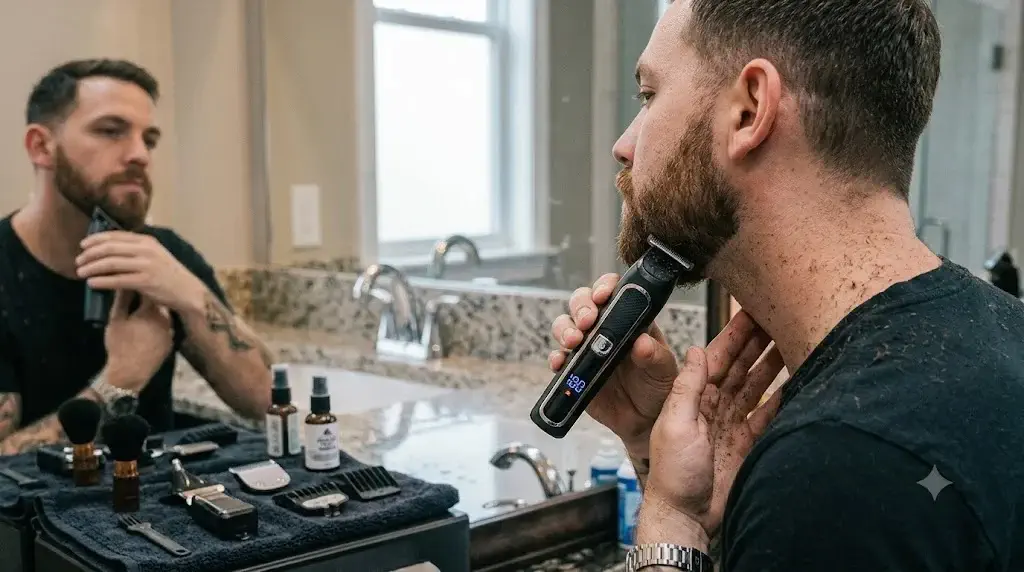
Facial edge precision: Dedicated narrow trimmer heads allow surgical control along jawlines and cheek perimeters.
If you prefer buying a dedicated tool tailored for your grooming needs, our laboratory evaluated three top-rated hardware picks across motor power, guard versatility, and skin safety:
1. Wahl 5-Star Cordless Magic Clip — Best for Thick, Heavy Beards & Fades
🏆 The Heavyweight Beard & Scalp Debulker
For men wearing full, thick beards over 1 inch long, normal beard trimmers choke. The Wahl 5-Star Cordless Magic Clip features a patented Stagger-Tooth Crunch Blade driven by a high-torque rotary motor, effortlessly flattening dense beard growth and cranial bulk without pulling follicles.
PROS
- Effortlessly plows through coarse, bushy facial hair
- Side taper lever allows seamless blending on sideburns
- 100-minute lithium-ion run time with corded bypass
CONS
- Wide 45mm blade is bulky for tight mustache detailing
- Not waterproof; dry brushing and oil only
2. Philips Norelco Multigroom Series — Best True All-in-One Crossover
⚡ Quick-Swap Modular Head System
If you refuse to own two separate tools, the Philips Norelco Multigroom series is the engineered answer. It ships with both an extra-wide hair clipping head for haircuts and a narrow steel detail blade for carving jawlines, backed by self-sharpening DualCut blades that never require maintenance oil.
PROS
- Separate detachable cutter heads eliminate hygiene cross-contamination
- Massive 5-hour cordless lithium-ion runtime
- 100% washable under running tap water
CONS
- Multiple guard attachments require dedicated storage
- Takes more passes for wide head fades than 45mm barber clippers
3. Wahl Color Pro Cordless — Best Budget Clipper for Family & Basic Trimming
🏷️ Foolproof Length Guides for Head & Beard
For entry-level users wanting simplicity, the Wahl Color Pro Cordless offers color-matched guide combs that work equally well for family haircuts and trimming longer facial stubble down to uniform lengths without guesswork.
PROS
- Color-coded combs eliminate guard sizing errors
- Self-sharpening ground carbon steel blades
- Budget-friendly entry price point
CONS
- Plastic guards can flex under excessive scalp pressure
- Long recharge cycle
5. Dermatological Hygiene: Preventing Cross-Contamination & Acne
Cross-using unsterilized grooming blades between scalp and face transfers sebum, fungal spores, and bacterial colonies directly into facial micro-fissures. Clinical dermatological research published in Dermatology Reports demonstrates that mechanical shaving abrasions open skin micro-pores to Cutibacterium acnes and Staphylococcus bacteria, triggering inflammatory papules and pseudofolliculitis.
The scalp produces significantly higher quantities of sebum and harbors distinctive microbial biomes compared to facial skin. If you use the same blade to cut your hair and then immediately edge your beard without sanitization, you introduce scalp bacteria into microscopic nicks along your jawline. To maintain dermal health when utilizing any clipper or trimmer:
If you ever suffer from red follicular bumps or skin burning following a neck cleanup, follow our clinical treatment guidelines in how to stop razor burn.
6. Frequently Asked Questions (FAQ)
Operational specifications answer everyday user questions regarding blade swaps, beard guards, and dual-purpose trimming boundaries.
Can you use hair clippers to trim your beard?
Yes, hair clippers can trim heavy, thick beards longer than 1 inch (25mm) quickly using standard guard combs. However, their wide 45mm blade and deep tooth spacing make mustache edge work and under-chin jawline sculpting difficult and prone to skin nicks.
Can a beard trimmer be used to cut your own head hair?
No, beard trimmers possess smaller motors and narrower 30mm blades that clog immediately when fed dense cranial hair. Using a beard trimmer for full-head haircuts causes painful hair pulling, rapid motor overheating, and choppy, stepped blend lines.
What is the primary mechanical difference between hair clippers and beard trimmers?
Hair clippers utilize wider blades (40mm to 45mm) with wide, deep tooth spacing and high-torque motors engineered to debulk voluminous hair. Beard trimmers utilize compact, narrow blades (30mm to 35mm) with micro-fine tooth pitch designed for short stubble gradations (0.2mm to 10mm) and facial maneuverability.
Will using hair clippers on the face cause ingrown hairs?
No, hair clippers leave a 0.5mm buffer even at their lowest setting, which avoids the razor-skin friction that causes ingrown hairs. However, the thick teeth can pinch soft facial flesh along neck creases if pressed too firmly without a guard.
The Verdict: Respect the Tool Boundaries
Mechanical bench tests verify that while hair clippers can debulk voluminous beards in an emergency, beard trimmers cannot cut dense scalp hair without damage. For seamless grooming results, keep a dedicated high-torque clipper for haircuts and heavy bulk removal, and pair it with a precision micro-pitch beard trimmer for sharp facial lines and comfortable daily maintenance.