
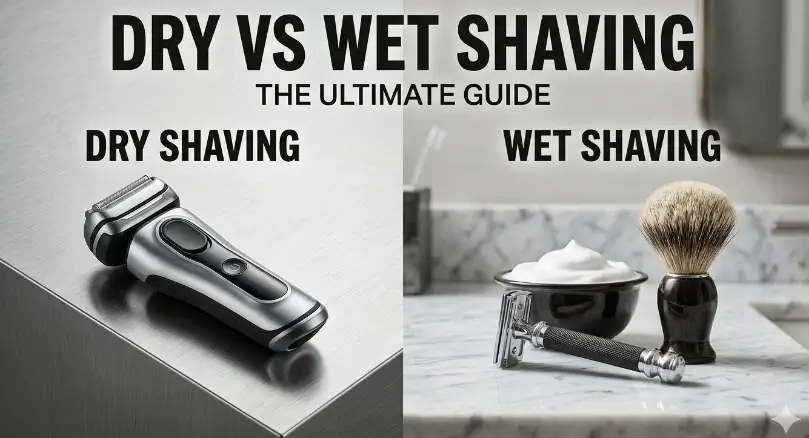
We tested the absolute limits of surgical steel versus high-speed titanium foils. No corporate marketing BS—just the cold, hard biological truth to definitively settle the eternal “Dry vs Wet Shaving” debate in 2026.
Table of Contents
ToggleThe Clinical Verdict: Dry vs Wet Shaving in 2026
Let’s be brutally honest, gentlemen. Every single morning, you stare directly into that harsh bathroom mirror and face the exact same dilemma your grandfather faced, only you have a much lower tolerance for walking into the office with bloody bits of toilet paper stuck to your neck.
You possess a face full of coarse, wire-like stubble. It needs to be removed. But how do you banish it without severely traumatizing your skin? Do you meticulously lather up with an expensive badger-hair brush and heavy alkaline soap like a vintage cinematic icon? Or do you grab a high-torque electric machine and aggressively get the job done before your morning espresso even finishes brewing?
I have spent the last decade heavily testing absolutely every piece of sharpened surgical steel, high-speed rotating foil, and dense botanical shaving cream heavily marketed to the modern man. I’ve personally suffered the agonizing razor burn, the severe cystic ingrown hairs, and the massive bathroom messes so your skin doesn’t have to.
Today, we are definitively settling the ultimate heavyweight grooming debate: dry vs wet shaving. By the end of this deep-dive guide, you will know exactly which cutting method your genetic skin type demands, which method is secretly bleeding your wallet dry, and the elite tools you urgently need to upgrade your morning survival routine. Let’s get to the raw data.
⚡ Quick Expert Summary: The Executive Verdict
If you are actively bleeding into your bathroom sink and simply need the definitive answer right this second, here is the strict laboratory data:
- Wet Shaving (The Purist): Delivers the absolute closest possible cut by physically dragging raw steel across the epidermis. Requires extensive prep time, massive hydration, and carries a severe risk of micro-abrasions. Best for: Special events, thick beards, and men with highly resilient skin.
- Dry Shaving (The Modern Executive): Utilizes high-speed electric foils to sheer hair 0.1mm above the skin line. Unbeatable for raw speed, convenience, and absolute protection of your skin’s lipid barrier. Best for: Sensitive skin, daily commuters, and men terrified of ingrown hairs.
- The Financial Reality: Cartridge wet shaving is a highly toxic “subscription trap,” while dry shaving requires a massive upfront capital investment with drastically lower long-term maintenance costs.
1. Understanding Dry vs Wet Shaving: The Biological Mechanics
Before we declare a universal grooming winner, let’s ensure we are speaking the exact same biological language. The core debate fundamentally comes down to how forged metal interacts with the microscopic topography of your facial tissue.
1.1. The Science of Wet Shaving
Wet shaving is exactly what it sounds like. You systematically utilize thermal heat (hot water), a dense chemical lipid-based lubricant (like premium shaving cream or traditional tallow soap), and a brutally sharp naked blade that physically touches your bare skin.
This mechanical action could be a modern 5-blade multi-cartridge razor or a heavy, classic double-edge safety razor. It rigidly requires access to a plumbing sink, a minimum of 3 minutes of thermal prep time to chemically swell the keratin hair shafts, and a highly steady, disciplined physical technique.
1.2. The Engineering of Dry Shaving
Dry shaving is unequivocally the highly efficient modern man’s technological shortcut. No hot water. No alkaline cream. No chemical mess. You utilize an advanced electric shaver (either a high-torque rotary engine or a linear foil model) that heavily relies on a motorized internal cutting block rapidly moving behind an incredibly thin, perforated hypoallergenic metal screen.
The microscopic holes in the screen physically catch the coarse hair, and the internal blades act like tiny scissors to shear it off. The magic here is the screen: it maintains a strict 0.1mm defensive barrier, meaning the actual cutting blade never touches your living skin cells.
2. The 2026 Clinical Master Matrix: Pros & Cons
Listen closely: neither method is biologically perfect. They both have a critical job to do, but they go about it in vastly different physical ways. Here is the raw, unedited truth directly from the barber’s chair.
💧 Wet Shaving (The Purist)
✅ The Closest Cut Possible: Nothing on earth mechanically beats a physical, naked steel blade aggressively scraping across your skin. If you demand that “baby butt smooth” flawless feel for a high-stakes black-tie event, wet shaving is the only way.
✅ Built-in Dermal Exfoliation: The sharp blade physically removes the entire top layer of dead skin cells (stratum corneum), instantly leaving your face looking incredibly fresh and renewed.
❌ Highly Time-Consuming: It is a strict ritual. You cannot rush it in 90 seconds unless you masochistically enjoy bleeding all over your expensive white dress shirt.
❌ Severe Risk of Laceration: One microscopic miscalculation of your wrist angle, and you are humiliatingly sticking cheap toilet paper to your chin.
The Veteran’s Score:
⭐ Closeness: 5/5
⚡ Speed: 2/5
🛡️ Skin Safety: 2/5
⚡ Dry Shaving (The Machine)
✅ Insane Speed & Convenience: You can literally dry shave inside your idling car, sitting at your desk, or blindly while walking around your dark bedroom. The entire process takes exactly two minutes.
✅ Zero Bloodshed Guarantee: Because the high-speed internal blades never directly touch your raw skin (the metal foil actively acts as a shield), it is practically impossible to cut yourself.
❌ The 5 O’Clock Shadow Hits Faster: It will structurally never cut as deeply close as a raw wet razor. You are mechanically trimming the keratin hair just barely above the living skin line.
❌ High-Tech Maintenance: You must routinely clean the complex motor and replace the expensive titanium shaving heads every 12 to 18 months to prevent pulling.
The Veteran’s Score:
⭐ Closeness: 3.5/5
⚡ Speed: 5/5
🛡️ Skin Safety: 5/5
3. Sensitive Skin & Dermal Trauma: The “Pizza Neck” Epidemic
This is the number one question I get asked daily. If your inflamed neck tragically looks exactly like a greasy pepperoni pizza after you finish your morning routine, you must pay strict attention to this section.
3.1. The “Hysteresis” Effect: Why Multi-Blades Destroy Your Neck
When you blindly drag a massive, commercial 5-blade cartridge razor roughly across your fragile neck, you aren’t just innocently cutting hair. You are engaging in what dermatologists call the Hysteresis Effect (often marketed by razor companies as “lift and cut”).
The first blade grabs the hair and physically pulls it up out of the follicle. The second and third blades cut it. Then, the hair brutally snaps back below the surface of the skin. When that hair tries to grow back out, it gets trapped under the skin you just scraped raw, curling inward. The result? Deep, agonizing cystic ingrown hairs (pseudofolliculitis barbae). It is a literal trauma response from your immune system fighting off bacteria trapped in the follicle.
3.2. How Dry Shaving Clinically Protects Your Face
For men cursed with highly sensitive skin or active cystic acne, dry shaving with a premium foil shaver is the undisputed champion. Why? Because it completely eliminates the Hysteresis effect. The hair is sheared perfectly flush with the foil screen, leaving a clean, blunt tip exactly 0.1mm above the pore. It never snaps back under the skin. Furthermore, because no steel blade ever touches the epidermis, you don’t strip away your face’s natural moisture barrier.
4. The Economics: Stop Bleeding Your Wallet Dry
Let’s speak strictly about raw financial numbers. Maintaining basic facial hygiene shouldn’t require taking out a second mortgage. The dry vs wet shaving debate is secretly a massive battle of completely divergent economic business models.
💸 Cartridge Wet Shaving: The Trap
At a highly deceptive first glance, cartridge wet shaving looks cheaper. You buy a cheap $15 plastic handle. But then they aggressively bankrupt you on the proprietary blade refills.
- The 3-Year Math: Buying a fresh 4-pack of dulling multi-blade cartridges every month costs roughly $16/month. That’s nearly $200 a year. Over 3 years, you’ve spent $600 just on disposable plastic that ruins your neck.
- The Escape: If you absolutely must wet shave, bypass this by switching to a traditional Double-Edge Safety Razor, where replacement surgical steel blades literally cost $0.10 per unit.
📈 Dry Shaving: The Capital Investment
Dry shaving requires a heavy initial capital investment. You are buying advanced robotics, linear magnetic motors, and titanium, not disposable plastic garbage.
- The 3-Year Math: A top-tier, flagship electric shaver will cost you roughly $250 upfront. You strictly replace the shaving head once a year for about $40. Over 3 years, your total cost of ownership is $330.
- The ROI: By year three, the electric shaver is nearly half the price of the cartridge trap, and your face looks infinitely better. It’s a no-brainer.
5. The Laboratory Arsenal: Essential Tools for the Job
If you are going to execute a biological job on your face, you must use the exact right clinical tools. Do not buy cheap, underpowered garbage. Here is the premium gear that has aggressively survived my relentless testing protocols.
5.1. Top Recommended Electric Shavers (For Dry Shaving)
You absolutely have to pay a premium for high-torque motor power. Cheap $30 motors will painfully rip the hair out by the root instead of cutting it.
👑 Braun Series 9 Pro (King of Comfort)
The undisputed Ferrari of electric shavers. It violently cuts through a dense 3-day beard exactly like a hot knife through butter, without ever tearing up highly sensitive neck tissue. Flawless German engineering.
⚡ Panasonic Arc5 (The Aggressive Workhorse)
It is incredibly loud and visually intimidating, but the 14,000 CPM linear motor absolutely delivers the closest dry shave you can physically get for the price point. A true powerhouse.
5.2. Top Recommended Tools (For Wet Shaving)
Throw away the highly toxic, pressurized canned foam immediately. If you choose to wet shave, execute it like a refined gentleman.
🪒 Merkur 34C Safety Razor
Incredibly heavy, flawlessly engineered. This one tool will save you an absolute fortune on replacement blades over your lifetime compared to multi-blade traps, while delivering a superior cut.
🌿 Proraso Shaving Cream
Provides an incredibly thick, highly slick lipid cushion that protects your vulnerable epidermal skin from the raw trauma of the passing steel blade. Packed with cooling Eucalyptus.
6. The “Missing Link” You Keep Ignoring: Proper Prep
I watch guys drop $300 on a razor and then completely botch the shave because their preparation is garbage. You cannot just drag metal across your dry face and expect good results. The rules of prep are strictly opposite depending on your weapon of choice.
The Wet Shaving Prep (Hydration is God)
Dry facial hair has the tensile strength of copper wire. You must soak your face in hot water (via a hot towel or shower) for a minimum of 3 full minutes. This forces the keratin shaft to swell and soften, reducing the cutting force required by the blade by up to 60%.
The Dry Shaving Prep (Bone Dry)
If you wash your face before using an electric dry shaver, you will ruin the shave. Moisture makes the skin swell and grip the foil, causing drag and stuttering. You must dry shave before you wash your face, while your skin is bone-dry and taut. Use an alcohol-based pre-shave splash if you live in a humid climate to strip away surface oils.
7. The Clinical FAQ: Dispelling Grooming Myths
Can I use an electric shaver for wet shaving?
The Clinical Truth: Yes, but strictly only if the device explicitly states “Wet & Dry” (IPX7 waterproof rating). Premium shavers like the Braun Series 9 are completely sealed. You can use them in the hot shower heavily coated with shaving foam. This hybrid method gives you the ultimate skin protection of a dry foil combined with the slickness of a wet shave. It is a game-changer for sensitive necks.
Does shaving make my hair grow back thicker or darker?
The Clinical Truth: Absolutely, definitively No. That is a massive grooming myth debunked by dermatologists decades ago. Shaving simply cuts the dead hair shaft exactly at its thickest structural point near the skin line. This makes the remaining stubble feel blunt and coarse as it grows out over the next 24 hours. It does nothing to alter your actual genetic thickness or growth rate.
Final Verdict: How to Choose the Ultimate Winner
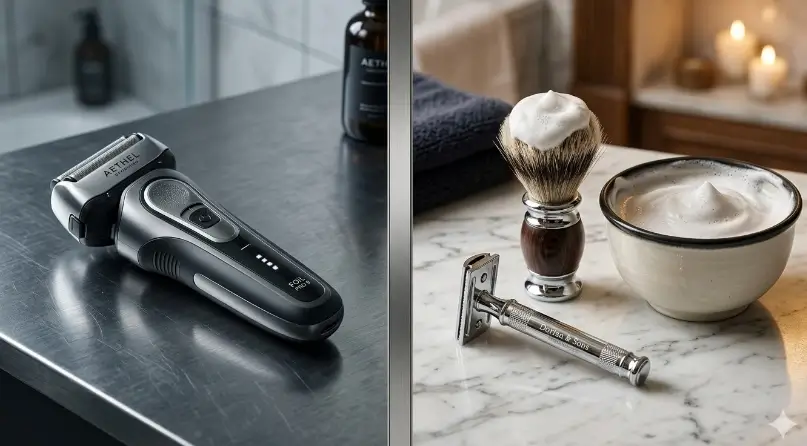
The “Dry vs Wet Shaving” debate does not have a single global winner—it strictly only has the exact right winner for your specific skin type and lifestyle. It comes down to ruthlessly prioritizing what matters most: the flawless closest cut of a traditional wet shave, or the blistering speed and supreme dermal protection of a dry shave.
- Choose Wet Shaving If: You possess a steady hand, you deeply enjoy the meditative morning hot-towel ritual, you need the absolute closest shave possible for high-definition photos, and your resilient skin isn’t prone to cystic razor bumps.
- Choose Dry Shaving If: You aggressively hit the snooze button three times every morning, you suffer from highly sensitive “pizza neck,” you are terrified of agonizing ingrown hairs, or you constantly travel for business.
The Expert Strategy (The Hybrid Approach)
A truly elite grooming strategy involves smartly keeping both options loaded in your cabinet. Rely heavily on a high-quality electric shaver during the chaotic workweek to save time and prevent razor burn. Save the hot water and heavy safety razor for Sunday mornings when you specifically want that classic, flawless barbershop-smooth finish.
🔗 Going fully bald? If your routine extends north to maintain a smooth dome, the rules of the cutting game shift entirely. The thin skin on your scalp requires a highly dedicated approach. Make absolutely sure you are equipped properly by checking out our definitive guide to the Best Electric Shavers for Bald Heads in 2026 to keep your head looking terrifyingly sharp and completely nick-free.

“Adam Lee is the lead technical reviewer at MenReviewHub and a veteran of the traditional wet shaving community. With over a decade of hands-on experience, Adam specializes in dissecting high-performance grooming hardware and dermatological skincare. He doesn’t just ‘read the box’—he puts every product through a brutal 30-day real-world trial to ensure your morning routine is a tactical success, not a crime scene.”