
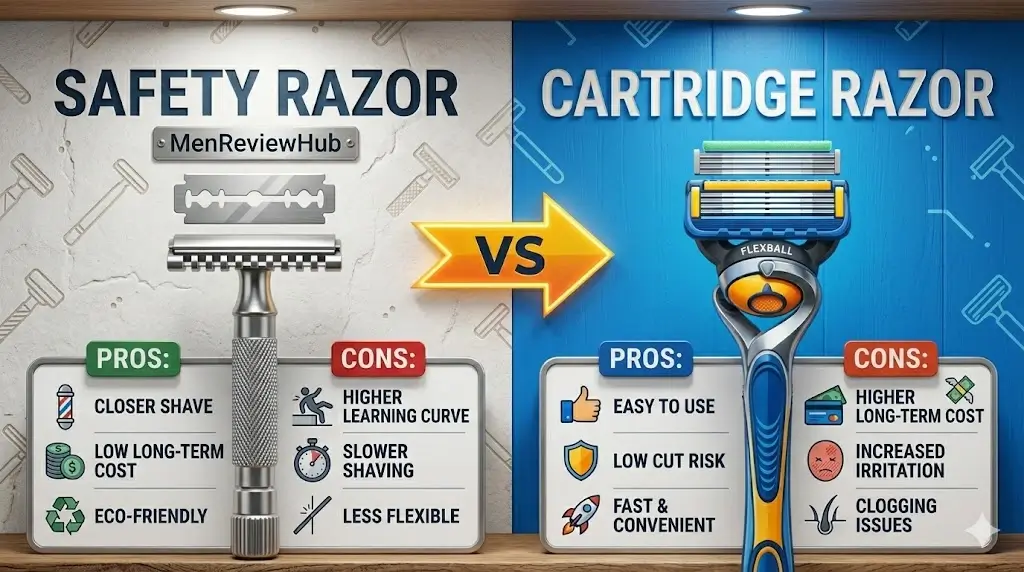
Safety Razor vs Cartridge Razor: The 2026 Skin Science & Economic Verdict
Choosing between a traditional single-blade double-edge (DE) safety razor and a modern multi-blade cartridge system comes down to balancing daily speed against long-term skin barrier integrity and recurring costs. While commercial advertisements push multi-blade setups for “closer shaves,” dermatological observations show that dragging up to six blades over delicate skin triggers barrier degradation, razor bumps, and severe folliculitis.
⚡ Quick Verdict: Which Should You Choose?
Choose a Safety Razor if:
- You suffer from ingrown hairs (pseudofolliculitis barbae), razor burn, or sensitive skin.
- You want to eliminate plastic waste and drastically reduce long-term grooming expenses.
- You appreciate precision grooming with engineered metal hardware (e.g., Merkur 34C, Henson AL13, Rockwell 6S).
Stick with a Cartridge Razor if:
- You need a 3-minute, zero-technique shave during busy weekday mornings.
- You travel frequently with TSA carry-on luggage only.
- You require automated dynamic swiveling for body or scalp shaving (e.g., Gillette SkinGuard, ProGlide).
Looking for specific brand rankings? Check out our overall guide to the best razors for men.
1. Mechanical Engineering: Blade Gap, Exposure, and Architecture
Understanding the modern safety razor vs cartridge razor debate requires analyzing how tool geometry impacts facial tissue. Double-edge safety razors secure a single, ultra-thin stainless steel blade between a weighted top cap and guard plate. Multi-blade cartridges use three to six parallel blades suspended on small plastic springs, paired with rubber tension bars and lubricated strips.
In precision razor manufacturing, two variables dictate how a razor behaves against your facial skin: Blade Gap (the distance between the blade edge and the safety bar) and Blade Exposure (how far the blade extends past the tangent line between cap and guard). Safety razors give users control over these exact metrics, whereas cartridge razors standardize them into fixed plastic enclosures.
A. The Double-Edge Safety Razor Frame
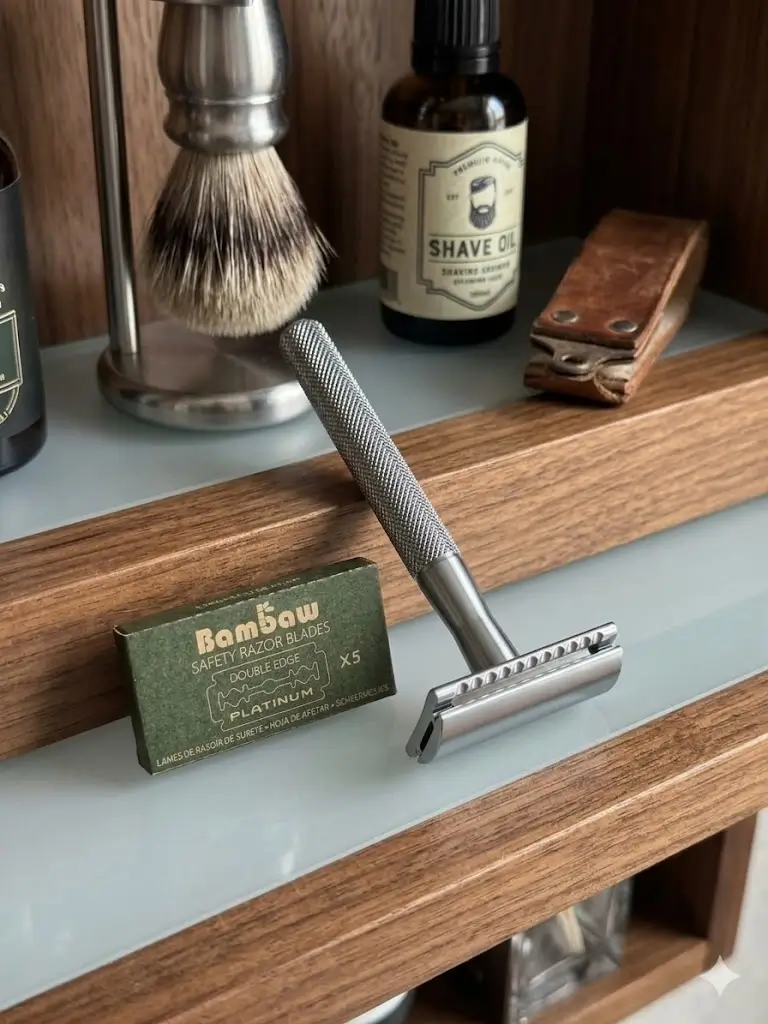
Safety razors clamp the steel blade tightly across a curved geometry to lock its cutting position. This rigidity eliminates “blade chatter”—microscopic flex and vibration that leads to skin scraping, uneven cutting, and severe razor burn.
- Single-Level Slicing: Cuts hair cleanly flush with the skin line without disturbing the follicle root underneath.
- Weighted Metal Handle: Heavy solid brass, zinc alloy, or stainless-steel handles let gravity provide natural cutting force, eliminating the urge to press down manually.
- Open-Channel Rinsing: Pass-through channels allow lather, coarse hair clippings, and heavy oils to flush out instantly under warm water.
B. The Multi-Blade Cartridge System
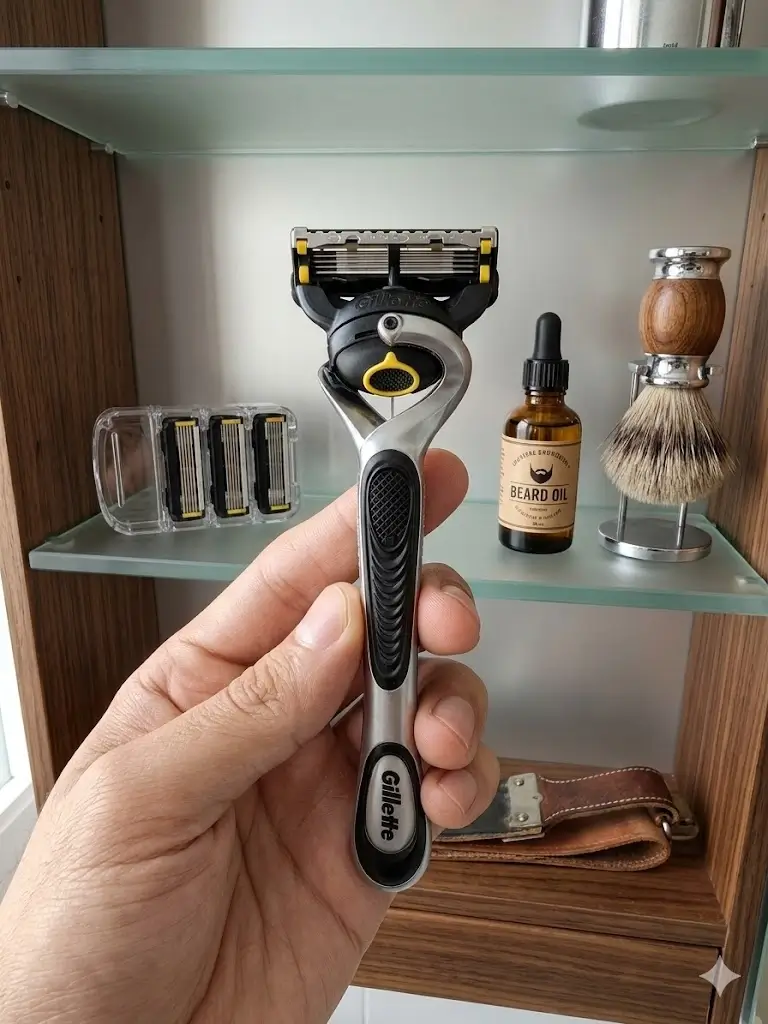
Cartridge systems use composite plastic heads mounted on pivoting ball joints to automate blade angle alignment across jawlines and chin contours.
- Pivoting Dynamic Hinge: Swivels along facial curves automatically, drastically cutting down the initial learning curve for beginners.
- Cumulative Friction Exposure: Passing a 5-blade head across a single spot twice exposes the epidermis to 10 distinct blade passes, removing protective skin lipids.
- Narrow Blade Spacing: Extremely tight gaps between parallel blades trap hair debris and thick shaving creams, degrading blade sharpness prematurely.
2. Dermatology & Skin Barrier Integrity: The Hysteresis Principle
Clinical data from the American Academy of Dermatology (AAD) confirms that pseudofolliculitis barbae (razor bumps) occurs primarily when cut hair ends retract below the outer stratum corneum layer, curling back into adjacent follicle tissue. This reaction is directly tied to the mechanical process called Hysteresis (commonly marketed as “Lift and Cut”).
Multi-Blade Hysteresis Action
The leading blade catches the hair shaft and pulls it upward out of the follicle canal. Before the hair spring-retracts, subsequent trailing blades slice the extended shaft. Once tension releases, the remaining hair shaft tip snaps back sub-surface beneath the skin line, where coarse or curly beard hair frequently pierces surrounding tissue to form inflamed papules.
Safety Razor Single-Edge Action
A safety razor presents one clean, rigid cutting edge. It severs hair flush at the skin surface without exerting upward tension on the follicle. Because the follicle root remains undisturbed, hair emerges along its natural growth path without causing localized epidermal inflammation.
Impact on Transepidermal Water Loss (TEWL) & Acne
Every blade pass removes a delicate layer of corneal cells along with sebum protection. Multi-blade cartridges increase Transepidermal Water Loss (TEWL), leaving skin dry, tight, and vulnerable to bacterial entry. For acne-prone skin, multi-blade systems can slice open existing pimples, spreading Cutibacterium acnes bacteria across the face. A single safety blade rides smoothly over skin elevations without rupturing active lesions.
3. Pre-Shave Preparation & Lather Chemistry
Dry facial hair possesses the tensile resistance of copper wire of equivalent thickness. Hydrating beard hair expands the hair shaft and softens the internal keratin matrix, reducing required blade cutting force by up to 65%.
The Science of Lather: Canned Foam vs Artisan Shaving Soap
Most cartridge users rely on aerosol canned foams. However, canned foams contain synthetic propellants (isobutane, propane) and drying alcohol surfactants that strip moisture from the epidermal layer. Traditional wet shaving uses a dedicated shaving brush paired with glycerine- or tallow-based soaps.
❌ Aerosol Canned Gel / Foam
Uses chemical blowers to create quick foam. Offers low slickness (cushion), dries out mid-shave, and accelerates razor burn.
✅ Brush-Whipped Artisan Lather
Rich in stearic acid and natural butter/oils. Creates slick micro-lather that hydrates skin and lifts flat whiskers vertically.
4. Mastering Technique: The Barber-Grade 3-Pass Method
Cartridge razors encourage bad technique: users push down firmly while dragging the swiveling head across large sections of skin. Safety razors rely on progressive beard reduction—gradually shortening stubble across controlled passes without skin trauma.
Pass 1: WTG (With The Grain)
Map your beard direction first. Shave in the exact direction hair grows. Reduces bulk hair growth by ~70% with near-zero skin stress.
Pass 2: XTG (Across The Grain)
Re-apply warm lather and shave perpendicular (90 degrees) to hair growth direction. Cleans up remaining stubble smoothly.
Pass 3: ATG (Against Grain – Optional)
Only recommended for tough, non-sensitive skin types. Delivers a baby-butt-smooth (BBS) finish when executed with a light touch.
The 3 Golden Rules of Safety Razor Shaving:
- 1. Zero Manual Pressure: Let the weight of the metal handle pull the blade across your face.
- 2. Maintain a 30-Degree Angle: Tilt the handle until the blade edge just touches skin.
- 3. Take Short, Controlled Strokes: Limit strokes to 1–2 cm rather than sweeping long lines.
5. Head-to-Head Comparison & Tested Gear Guide
| Evaluation Criteria | Safety Razor (DE Blade) | Multi-Blade Cartridge |
|---|---|---|
| Shave Closeness | Flush with skin surface; smooth, uniform regrowth. | Sub-surface cut; ultra-close initially, variable regrowth. |
| Learning Curve | Moderate (Requires maintaining 30° angle & zero pressure). | Instant (Pivoting head compensates for technique). |
| Skin Irritation Index | Very Low (Single blade surface exposure). | High (Multiple passes trigger micro-abrasions). |
| Blade Replacement Cost | Ultra-Low (Pennies per blade) | High (Premium recurring expense) |
| Clogging Resistance | High (Rinses instantly under tap). | Low (Gunk builds up between tight blades). |
| TSA Travel Rules | Loose blades banned in Carry-On bags. | Fully TSA Approved for Carry-On. |
🏆 Tested Gear Recommendations (2026 Picks)
Selected options from our round-up of the best razors for men comparison:
Best Beginner Safety Razor:
Merkur 34C Heavy Duty or Henson AL13 (features CNC aerospace aluminum machining with locked blade tolerance).
Best Premium Adjustable Safety Razor:
Rockwell 6S Stainless Steel (includes 6 interchangeable gap plates for custom aggressiveness).
Best Sensitive Cartridge Razor:
Gillette SkinGuard (utilizes raised bridge guards between blades to absorb pressure).
Top Double-Edge Replacement Blades:
Astra Superior Platinum (smooth balance) or Feather Hi-Stainless (ultra-sharp Japanese steel).
6. Financial Breakdown: 1, 3, and 5-Year Cost Amortization
Cartridge razor brands rely on the classic “razor-and-blades” business model—selling handles at a discount while charging high margins on plastic replacement cartridges. The economic audit below tracks relative household expenses assuming 3 shaves per week (156 shaves/year):
| Timeframe | Cartridge System (ProGlide / Hydro) | Safety Razor Setup (Merkur / Henson) | Relative Cumulative Value |
|---|---|---|---|
| Year 1 | High Initial & Refill Spend | Moderate Hardware / Ultra-Low Refill | Immediate Break-Even |
| Year 3 | Compounding Refill Overhead | Near-Zero Maintenance Cost | Major Expense Reduction |
| Year 5 | Peak Continuous Expenditure | Minimal Total Outlay | Up to 80% Cost Reduction |
💡 Cost Efficiency Metric: Cartridge refills represent a continuous high-margin recurring expense per shave session. In contrast, double-edge safety blades cost a fraction of a single cartridge pass. Over a decade, switching yields substantial financial savings.
7. Troubleshooting Guide: Fixing Common Shaving Mistakes
Problem: Persistent Neck Irritation
The Fix:
Neck hair often grows in swirling circular patterns. Map your neck grain direction carefully using a finger test, and strictly avoid shaving Against The Grain (ATG) on your lower neck.
Problem: Micro-Nicks or Weepers
The Fix:
Small bleeding dots mean you are either applying manual downward pressure or holding the handle at too steep an angle (>45 degrees). Lighten your grip and let the metal weight do the work.
Problem: Blade Tugging or Dragging
The Fix:
Tugging means your blade has dulled, your hair lacks proper thermal hydration, or your lather is too dry. Add small drops of water to your shave brush to build slick micro-foam.
8. Hygiene, Maintenance & Environmental Life-Cycle
Plastic razor cartridges combine rubber fins, steel strips, and glue strips—making them non-recyclable in standard municipal recycling facilities. According to EPA estimates, over 2 billion disposable razors end up in U.S. landfills annually.
In contrast, double-edge safety razor blades are made of 100% uncoated or platinum-plated stainless steel. Used blades should be stored safely in a metal blade bank. Once filled over 1-2 years, the entire metal tin can be dropped off at local scrap metal recycling centers, making safety razors a zero-waste grooming solution.
Safety Razor Maintenance Essentials:
- Rinse & Dry: Loosen the razor head slightly after each shave and rinse thoroughly under hot water. Shake off excess moisture to prevent mineral scale build-up.
- Monthly Deep Clean: Disassemble the 3-piece handle and scrub internal threads with an old toothbrush and mild dish soap.
- Blade Storage: Never wipe steel blade edges with a towel; this bends the microscopic cutting edge and removes factory platinum coatings.
Frequently Asked Questions
Which razor is better for body grooming or manscaping?
Cartridge razors are significantly safer for full-body grooming across soft, contoured skin like the chest, arms, or groin. Their flexible swiveling heads automatically absorb uneven pressure and prevent nicks on loose skin.
Why do beginners experience small nicks with safety razors?
Nicks usually result from applying manual downward pressure—a habit developed from using lightweight plastic razors. Safety razors require zero manual force; let the natural handle weight glide over skin.
Is a single-blade safety razor better for acne-prone skin?
Yes. Dragging multi-blade cartridges over inflamed acne papules cuts open skin blemishes and spreads bacteria. A single DE blade slides gently over raised skin texture without popping active lesions.
How often should double-edge safety blades be changed?
Standard DE safety blades last between 4 to 7 shaves depending on hair coarseness and density. Because replacement blades are so affordable, changing them weekly ensures peak sharpness without stretching your budget.
Can safety razor blades be packed in TSA carry-on luggage?
No. TSA regulations ban loose safety razor blades in carry-on bags. You must either check your luggage or purchase replacement DE blades upon arriving at your destination.
What is the best safety razor blade for sensitive skin?
Mild to medium-sharp blades like Astra Superior Platinum or Personna Platinum are ideal for sensitive skin. They deliver clean cutting efficiency without the aggressive skin bite of ultra-sharp blades like Feather.
Why does canned shaving gel cause dry skin and razor burn?
Canned aerosol gels use chemical propellants (isobutane, propane) and synthetic surfactants that strip the skin barrier of natural moisture, causing blade friction and redness during shave passes.
Upgrade Your Grooming Setup Today
Choose the hardware designed specifically for your skin profile and daily routine priorities: