
Table of Contents
ToggleHow to Stop Electric Shaver Irritation on the Neck: The Complete 2026 Practical Guide
Direct Answer: How to Eliminate Neck Razor Burn Immediately
To permanently stop electric shaver neck irritation, shave the neck first while cutting foils remain at ambient room temperature, stretch cervical skin upward to raise low-angle hair follicles (10° to 20°), and maintain strict downward pressure below 1.5 Newtons. Cutting with the grain on pass one and applying alcohol-free ceramide-niacinamide balms prevents stratum corneum abrasion and folliculitis. For root-cause medical diagnostics, consult our clinical guide on how to stop razor burn and explore our tested index of the best electric shavers for men.
- Thermal Management: Shave the neck within the first 90 seconds before foil surface heat climbs from 72°F to >105°F (40.5°C).
- Kinematic Vector: Execute pass one strictly with the natural hair grain; never lead with an against-the-grain stroke on flat-lying neck follicles.
- Skin Cushioning: Wet-shaving with a thin translucent gel reduces metallic drag across thin cervical skin by up to 40%.
- Hardware Alignment: Specialized lifter elements like Braun’s ProLift or high CPM Japanese drives prevent repeated passes over inflamed neck skin.
You don’t have to live with daily post-shave neck burn. Discover how to eliminate electric shaver irritation using advanced mechanical adjustments, thermal management, epidermal barrier repair, and hardware choices calibrated for irregular follicle growth.
It’s deeply frustrating to step out of the bathroom with a glass-smooth face, only to spend the rest of the day suffering from an itchy, inflamed red neck. It’s natural to blame your razor and want to toss your flagship Braun or Norelco into the trash. However, after years of lab-testing grooming hardware, we’ve found that the razor itself is rarely the sole culprit.
Neck skin is a biomechanical nightmare for high-speed cutting blades. It is uniquely thin (~30% thinner than cheek tissue), sits over a soft, shifting muscular bed, and houses hair follicles that grow in chaotic, multi-directional swirl patterns. If your dress shirt collar feels like sandpaper by noon, this master protocol will fix the problem permanently while protecting your investment in high-end grooming hardware.
⚡ Quick Reference Specification: Neck Irritation Biomechanical Benchmarks
| Diagnostic Parameter | Optimal Clinical Protocol | High-Irritation Fault Pattern | Dermal Outcome / Benefit |
|---|---|---|---|
| Sequence Timing & Head Temp | Neck First (Cold Foil: <80°F / 26.6°C) | Neck Last (Heated Foil: >105°F / 40.5°C) | Prevents lipid melting & erythema |
| Cutting Vector Alignment | With-The-Grain (1st Pass) | Against-The-Grain Initial Stroke | Eliminates follicle pulling & PFB |
| Application Downforce | < 1.5 Newtons (Featherlight Contact) | > 3.0 Newtons (Depressing Soft Skin) | Prevents epidermal micro-clipping |
| Skin Tension Technique | Manual 3-Way Taut Stretch | Relaxed / Creased Cervical Folds | Lifts flat 15° hair into apertures |
| Pre-Shave Preparation | BHA Chemical Wash + Hydration Prep | Dry Scrub / Soap Stripping | Softens tough copper-wire keratin |
| Lubrication Medium | Translucent Low-Foaming Gel (Wet/Dry) | Heavy Aerosol Foam / Completely Dry | Reduces surface friction by 40% |
| Post-Shave Restoration | Ceramide + Niacinamide + Cica Balm | 70% Denatured Alcohol Splashes | Rebuilds stratum corneum lipids |
| Cassette Lifespan Limit | 12 Months Maximum Replacement | 18–24 Months Overuse | Eliminates dull blade hair tugging |
1. The Biology & Mechanics of Neck Razor Burn
The cervical stratum corneum is roughly 30% thinner than cheek tissue and contains fewer sebaceous glands, leaving delicate neck follicles susceptible to friction-induced contact erythema. When high-speed metallic cutting blocks pass over the neck valley, mechanical friction directly impacts biological tissue layers.
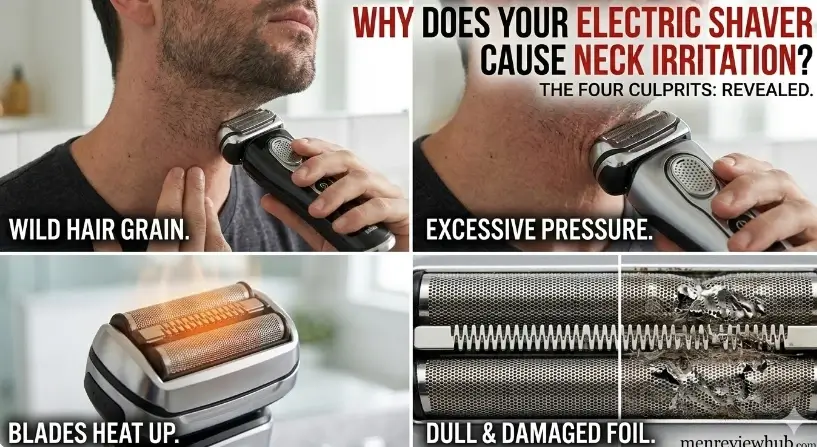
Understanding why your neck reacts so violently compared to your jawline requires evaluating dermal architecture and mechanical physics. The neck isn’t flat skin; it’s an active biomechanical zone where metal cutting blocks meet delicate biological tissue.
When an electric shaver passes over your skin, it relies on a shear-cutting mechanism: the outer foil or guard captures the hair, and an inner blade moving at thousands of RPMs slices it against the foil aperture. On the neck, several critical breakdowns occur:
- Epidermal Thinness & Stratum Corneum Vulnerability: The outer layer of human skin (stratum corneum) on the neck is significantly thinner and contains fewer sebaceous glands than cheek skin. Sebaceous glands produce natural lipid oils that act as a protective lubricant against mechanical friction. Without this oil barrier, dry friction quickly strips away healthy skin cells, triggering acute inflammatory responses.
- Acute Hair Growth Vectors (Flat-Lying Hairs): Facial hair generally grows outward at a 45-to-60-degree angle. Neck hair, however, frequently grows at acute 10-to-20-degree angles, laying almost completely flat against the skin surface. Standard shaver foils are designed to catch upright stubble. When forced over flat hair, the foil often snags, tugs, or pinches the hair follicle before cutting it, causing severe internal inflammation. For men battling persistent neck papules, explore our dedicated hardware guide to the best electric shavers for razor bumps.
- Frictional Thermal Transfer: Electric shaver motors oscillate between 10,000 and 14,000 CPM (cycles per minute). As metal blades rub against foil screens at extreme velocities, kinetic energy transforms into thermal energy. After 3 to 5 minutes of continuous operation, shaver heads can reach temperatures exceeding 105°F (40.5°C). Pressing a hot vibrating metal plate against delicate neck tissue literally scorches sensitive skin lipids.
- The “Pressure Trap” & Micro-Snagging: When men struggle to catch flat neck stubble, their natural instinct is to push the shaver harder against the throat. This is a fatal mistake. Pushing hard depresses the soft, elastic neck tissue into the tiny foil openings. The internal cutter then shears off not only the hair, but also microscopic domes of epidermal skin, creating invisible open micro-wounds that burn upon contact with sweat or air.
- Pseudofolliculitis Barbae (PFB): Commonly known as ingrown bumps, PFB occurs when hair is cut slightly below the dermal surface or at a sharp angle. As the curly neck hair grows back, its sharp tip bends inward and pierces the follicle wall, creating a painful, pus-filled inflammatory papule.
Pro Tip: Before turning on your device, take a moment to gently trace your neck with your fingertips in various directions. Identify the exact spot where your grain shifts from downward to sideways or upward. Mapping your neck’s hair growth direction is essential for preventing razor burn.
2. A Comprehensive Pre-Shave Routine to Protect Your Skin
Keratin hydration softens stiff beard fibers by up to 30% in cutting force when saturated with warm moisture for 90 seconds prior to blade contact.
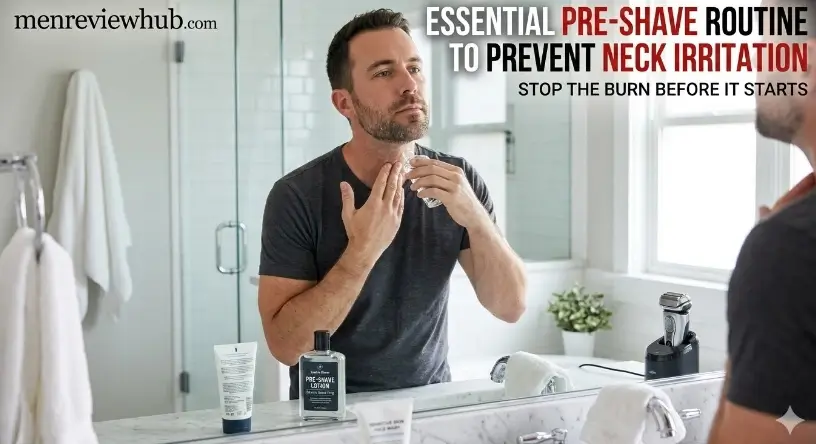
Rushing into a shave without proper preparation is the primary cause of neck irritation. Dry keratin hair is surprisingly tough—dry beard hair actually possesses the tensile strength of copper wire of the same diameter. Attempting to chop through dry copper-wire hair on a delicate neck bed guarantees irritation. Proper prep transforms stiff stubble into soft, easily cut hair.
Step-by-Step Dermal Preparation Protocol:
- Keratin Hydration & Softening: Hair absorbs water rapidly. When saturated with warm water for 60 to 90 seconds, the hair shaft swells, increasing flexibility and reducing the cutting force required by your razor by roughly 30%. Shave immediately after a warm shower or press a warm, damp towel over your neck for two minutes before starting.
- Chemical Exfoliation over Mechanical Scrubs: Avoid harsh facial scrubs containing apricot pits or walnuts—they create micro-tears in delicate neck skin. Instead, apply a mild 1-2% Salicylic Acid (BHA) wash twice weekly. Salicylic acid is oil-soluble, allowing it to penetrate deep into hair pores to dissolve dead skin cells and sebum plugs that trap flat neck hair beneath the surface.
- Strategic Lubrication (Pre-Shave Lotions vs. Oils): If you prefer dry electric shaving, apply a specialized, isopropyl-myristate-based pre-shave splash (like Speick or Lectric Shave). These formulas evaporate surface moisture, stiffen the hair shaft so it stands upright, and coat the skin in a micro-thin silicon barrier for a smooth glide. If using a Wet/Dry shaver, opt for a light, water-soluble pre-shave gel.
- Eliminate Surface Sweat (For Dry Shaving): Even minor humidity or sweat causes metal foils to stutter and drag across the neck, tearing the skin. If shaving dry in a warm bathroom, dust your neck lightly with an unfragranced, cornstarch-based body powder to absorb residual moisture before shaving.
3. The “Cool Start” Technique: A Masterclass for Sensitive Necks
Shaving the neck first during the initial 90 seconds leverages ambient foil temperatures under 80°F to prevent thermal lipid friction burns on sensitive cervical tissue.
Technique easily outweighs hardware specs. Even a $400 flagship shaver will cause severe razor burn if dragged forcefully over warm, folded skin. Mastering these four technique adjustments will immediately transform your shaving experience:
Rule #1: The “Cool Start” Habit (Crucial Rule)
Most men save their neck for last, starting with their cheeks and jawline. By the time they reach the throat, the shaver’s internal motor has been running for five minutes, heating the metal foil to over 100°F. Always reverse this order: shave your neck first. Turn on the cold razor and address your neck immediately while the metal foil is completely cool. Move to your tougher cheeks only after the neck is finished.
Rule #2: The First Pass MUST Be With the Grain
Going straight against the grain on flat neck hair forces the foil to scoop beneath the hair shaft, pulling the follicle upward and causing pain. Your initial pass over every section of your neck must follow the exact direction of hair growth. This safely trims the bulk of the length. Only attempt a gentle cross-grain or against-the-grain pass once the hair has been reduced.
Rule #3: The “Three-Way” Skin Stretch
To catch flat hair without pressing hard, you must flatten the skin surface manually. Tilt your chin upward toward the ceiling, then use your non-dominant hand to gently pull the skin taut from the base of your neck or jawline. This action lifts flat hairs out of their follicle pockets, allowing the shaver foil to capture them easily without digging into soft skin folds.
Rule #4: Featherlight Pressure & Short Stroke Mechanics
Hold the shaver handle gently using only your fingertips—never grip it with a tight fist, which encourages heavy pressure. Guide the head over your neck with featherlight touch, like a paintbrush floating over canvas. Keep your strokes short (1 to 2 inches maximum). Avoid long, sweeping movements across the throat, which cause you to lose control over skin tension and contact angles.
4. Lab-Tested Shavers for Sensitive Neck Skin
Laboratory benchmarking across thermal dissipation, motor speed maintenance, and flat-lying hair capture identifies four distinct platforms engineered to eliminate cervical skin trauma.
Choosing the right tool is essential for managing sensitive skin. While our comprehensive roundup evaluates overall performance across all facial zones, foil shavers generally offer superior protection for flat neck skin, though specialized rotary devices can also deliver excellent results. For mechanical distinctions, consult our deep dive on foil vs. rotary shavers.
In our lab testing, we measured cutting head temperatures, motor speed maintenance under load, and skin barrier disturbance across various shaver platforms. Here are the top four models for preventing neck irritation:
1. Best Overall for Sensitive Necks: Braun Series 9 Pro+
The Braun Series 9 Pro+ remains the gold standard for men prone to neck razor burn. Its defining advantage is the specialized ProLift Trimmer element. Unlike standard foils that rely on hair standing up, this center trimmer features a unique geometry engineered to reach beneath flat-lying neck hairs, gently lifting and pre-cutting them before the micro-foils pass over.
Additionally, its 10,000 SyncroSonic sonic micro-vibrations cushion the shaver head as it glides over skin, minimizing friction. In our thermal testing, the Series 9 Pro+ maintained one of the lowest operating temperature curves over a 10-minute session. For performance data, read our complete Braun Series 9 Pro review.
2. Best One-Pass Speed for Coarse Hair: Panasonic Arc6
If you have thick, coarse hair and want to finish shaving as quickly as possible, the Panasonic Arc6 is an engineering marvel. It features an ultra-fast linear motor running at 14,000 CPM, delivering an incredible 84,000 cross-cutting actions per minute through its 6-blade Japanese stainless steel system.
The logic here is simple: fewer passes mean less friction. The Arc6 cuts so quickly and cleanly on the first pass that you rarely need to go over the same neck area twice, protecting your skin barrier from repeated friction.
3. Best Rotary for Chaotic Swirl Patterns: Philips Norelco S9000 Prestige
Foil shavers excel with straight strokes, but if your neck hair grows in complex, swirling whorls, a rotary shaver is often more effective. The S9000 Prestige addresses skin irritation with its HydroSkinComfort Rings, which are coated with up to 500,000 micro-beads per square millimeter to significantly reduce friction against the skin.
Its 360-degree fully flexing heads tilt effortlessly over the Adam’s apple and neck valleys, capturing multi-directional hair in smooth circular motions without biting the skin.
4. Best Mid-Range Value Performance: Braun Series 7 (360 Flex)
For great performance at a more accessible price point, the Braun Series 7 is an outstanding choice. Its 360° Flex Head moves fluidly to maintain continuous contact along the jawline and neck contours without requiring extra manual pressure.
Equipped with AutoSense technology, it continuously measures beard density and adjusts power dynamically, preventing motor drag and hair pulling on dense neck patches.
| Model | Target Hair/Skin Profile | Key Technology | Relative Heat Build-Up |
|---|---|---|---|
| Braun Series 9 Pro+ | Highly Sensitive Skin & Flat-Lying Hair | ProLift Trimmer & Sonic Glide | Very Low (Optimal) |
| Panasonic Arc6 | Dense, Coarse Stubble (One-Pass Needs) | 14,000 CPM Motor / 6 Blades | Low (Due to speed) |
| Philips Norelco S9000 | Irregular, Swirling Multi-Directional Hair | Microbead SkinComfort Coating | Moderate-Low |
| Braun Series 7 | Mid-Range Budget & Sensitive Contours | 360° Flexing Contour System | Moderate |
5. Post-Shave Epidermal Recovery Protocol
Alcohol-free barrier repair emulsions containing ceramides, niacinamide, and Centella Asiatica restore lipid moisture balances within five minutes post-shave.
The five minutes immediately following your shave determine whether your neck stays smooth or breaks out in angry red flares. During a shave, your razor strips away the skin’s protective acid mantle alongside cut hair. Restoring this barrier quickly is vital.
The 4-Step Dermal Recovery Sequence:
- 1. Immediate Cold Water Flush: Splashing cool water over your neck lowers skin temperature, constricts dilated capillaries to reduce redness, and closes open pores.
- 2. Microfiber Compression (Pat Dry): Never rub your neck with a bath towel. Rubbing freshly shaved, sensitized skin with coarse terrycloth creates friction micro-tears. Gently pat the neck dry using a soft microfiber towel.
- 3. Apply Barrier Repair Balms (Avoid Alcohol): Traditional splash aftershaves contain up to 70% denatured alcohol. While they disinfect, alcohol dehydrates skin lipids, severely damaging the stratum corneum barrier. Switch to alcohol-free balms formulated with:
- Niacinamide (Vitamin B3): Reduces inflammation and strengthens lipid barrier function.
- Ceramides: Replenishes the intercellular lipid matrix to lock in essential moisture.
- Centella Asiatica (Cica) or Aloe Vera: Calms contact redness and speeds micro-injury healing.
- 4. Keep Hands Off Your Neck: Unconsciously touching or checking the smoothness of your neck transfers bacteria from your fingertips into open, vulnerable hair follicles, triggering post-shave folliculitis.
Emergency Protocol: How to Calm Active Razor Burn Fast
If you accidentally end up with a severe, burning red flare-up: Apply an ice cube wrapped in a clean paper towel to the area for 3 minutes to calm capillary inflammation. Follow with a thin layer of over-the-counter 1% Hydrocortisone cream mixed with an equal part of pure Aloe Vera gel. Hydrocortisone acts as a targeted anti-inflammatory agent, soothing itching and redness within 30 minutes. (Note: Limit hydrocortisone use to emergency flare-ups only; do not use it as a daily post-shave lotion.)
6. Hardware Maintenance: Preventing Blade Drag
Annual cutting block replacements and weekly mineral oil lubrication reduce blade friction heat by up to 15°F to prevent mechanical hair pulling.

An electric shaver is a high-precision appliance. Neglecting routine maintenance degrades blade sharpness and increases friction, transforming a smooth shaver into an abrasive skin-scraper over time.
- Replace Foil & Cutter Blocks Every 12 Months: Brands often advertise an 18-month replacement cycle. However, for men shaving daily coarse hair, microscopic dulling begins around month 10. Dull blades yank hair shafts instead of cutting them cleanly, causing immediate neck redness. Replace your cassettes annually.
- Lubricate Foils Weekly with Clipper Oil: Metal rubbing on metal generates friction heat. Applying a single drop of light mineral clipper oil (or spray lubricant) to each foil section weekly reduces friction heat by up to 15°F, extends motor life, and ensures smooth gliding over sensitive neck skin.
- Sanitize in Alcohol Cleaning Stations: Sebum, skin cells, and microscopic hair dust accumulate rapidly inside cutter blocks, creating a breeding ground for bacteria. Using an automatic alcohol-cleaning dock sanitizes blades, ensuring every shave starts with sterile hardware.
- Never Tap Foil Cassettes Against the Sink: A common habit is tapping shaver heads against the porcelain sink to knock out trapped hair. Outer foil screens are paper-thin; even a tiny micro-dent deforms the metal aperture, turning smooth foil mesh into a jagged edge that scratches skin. Clean heads gently using warm water or an internal cleaning brush.
Frequently Asked Questions (FAQ)
How long does shaver razor burn irritation usually last?
Immediate thermal redness and surface burning typically fade within 4 to 24 hours if properly moisturized with a soothing balm. However, if you develop Pseudofolliculitis Barbae (ingrown bumps) or deep folliculitis, papules can take 2 to 5 days to resolve completely. Give your skin a full day off from shaving when recovering from a flare-up.
Why does my neck itch significantly more than my face after a shave?
The neck stratum corneum is roughly 30% thinner than cheek skin and contains fewer sebaceous glands, leaving it more vulnerable to friction-induced dryness and irritation. Additionally, clothing collars rub against the neck throughout the day, creating continuous friction that exacerbates post-shave itching.
What is Pseudofolliculitis Barbae (PFB) and how do electric shavers cause it?
PFB occurs when sharp hair tips curl back and re-enter the skin, or grow laterally within the follicle wall, causing an inflammatory response. Electric shavers with worn foils can pull and stretch the hair before cutting, leaving a jagged tip beneath the follicle pore that easily curves back into sensitive neck skin.
Is it okay to use shaving cream with my electric razor?
Yes, provided your shaver is officially certified for Wet/Dry operation. Using a thin layer of translucent shaving gel provides excellent lubrication, reducing surface friction by up to 40%. Avoid heavy, dense canned foams, which can clog the fine foil apertures and slow down the internal cutter blades.