
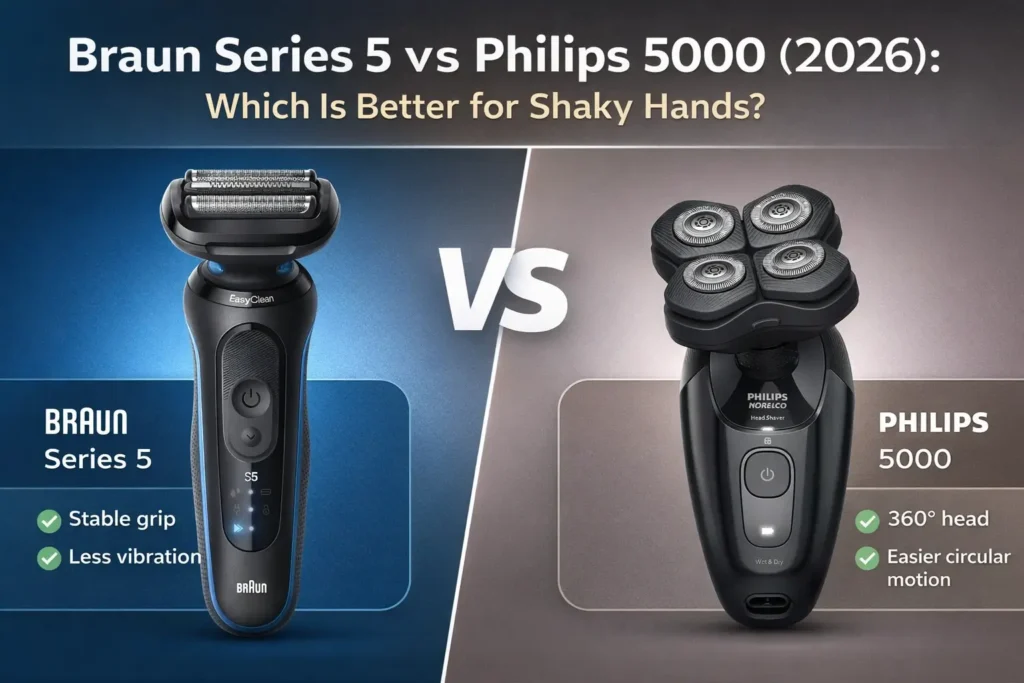
1. The Core Specifications: A Practical Breakdown
The functional differences between the Braun Series 5 and Philips 5000 go well beyond aesthetics; they fundamentally change how the razor glides across your hair follicle map. Here is a straightforward comparison of what the latest models bring to your counter.
| Grooming Feature | Braun Series 5 (Foil Design) | Philips Norelco 5000 (Rotary Design) |
|---|---|---|
| Cutting Technology | 3 Flexible Foil Elements (Linear Up/Down Motion) | 360° Pivoting Rotary Heads (Circular Motion) |
| Primary Advantage | Excellent stratum corneum protection and clean closeness | Effortlessly catches multi-directional hair growth |
| Cleanup Architecture | EasyClean Conduit (No need to remove the head) | One-Touch Pop Open (Hinged flip-top head) |
| Battery Life | 50 Minutes of Cordless Use (Lithium-Ion) | 60 Minutes of Cordless Use (Lithium-Ion) |
| Charging Type | Proprietary Braun 2-Pin Connector | Universal USB-A to USB-C Cable Interface |
2. Finding Your Flow: Shaving Motions with Shaky Hands
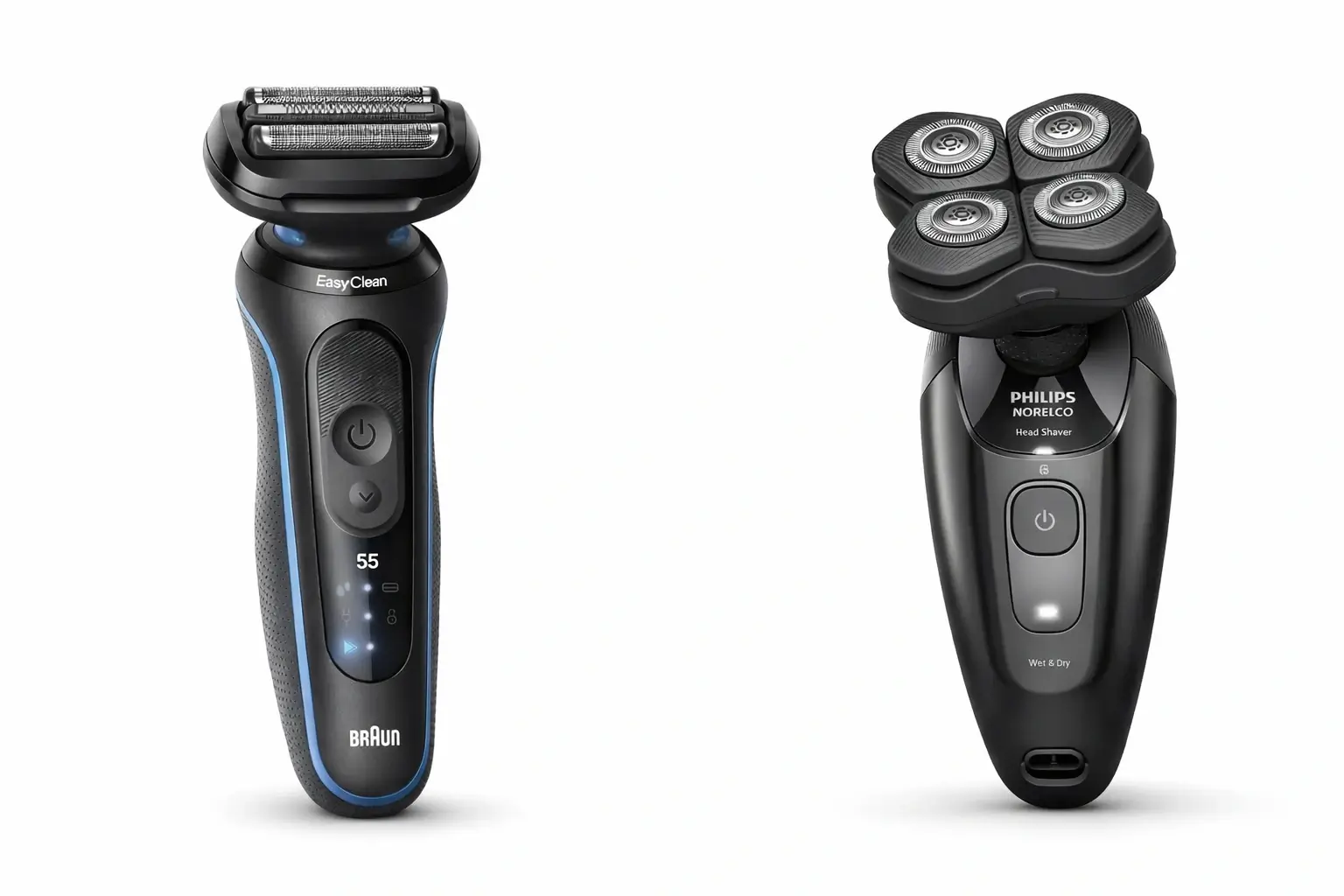
The core movement difference: The Braun Series 5 (left) relies on steady linear lines, while the Philips 5000 (right) utilizes sweeping circular patterns.
To truly resolve the Braun Series 5 vs Philips 5000 debate when dexterity is limited, it is incredibly helpful to explore the actual physical movements each design expects from your body.
The Linear Path (Braun Series 5)
The Braun Series 5 features a thin, perforated foil mesh protecting the cutting elements. Because it expects straight up-and-down lines, it operates much like a traditional razor. If your hands experience heavy tremors, keeping a completely steady, perfectly aligned path can sometimes cause the razor head to skip slightly. However, the immense safety of the foil means that even if your hand trembles, the underlying blades driven by the linear oscillating core will never break your skin barrier.
The Orbital Circles (Philips 5000)
The Philips Norelco 5000 utilizes three circular grooming heads that shift smoothly as you move. It guides you to use broad, overlapping circular sweeps via rotary drive power. For many men managing tremors, this movement can feel significantly more forgiving. It utilizes the larger muscle groups in your arm and shoulder rather than requiring strict, fine-motor coordination in the wrist. The flexing heads comfortably stay in contact with your face, even if your grip shifts unevenly.
3. Pressure Mitigation & Epidermal Defense
When the hand grip isn’t perfectly steady, it can naturally be difficult to judge exactly how much downward force you are applying. It is incredibly common to lean in a bit too firmly in an anxious attempt to stabilize the razor handle. Let’s look at how both systems protect your skin from excess pressure.
The Braun Series 5 Protection Cushion
If you happen to press the Braun Series 5 a little too firmly into the skin, the three cutting elements independently spring downward to absorb the impact. This flexible cushion keeps the sharp moving parts isolated from your skin. For anyone whose skin easily flares up with redness or razor bumps, the linear foil mesh system of the Braun provides a very comforting level of built-in reassurance.
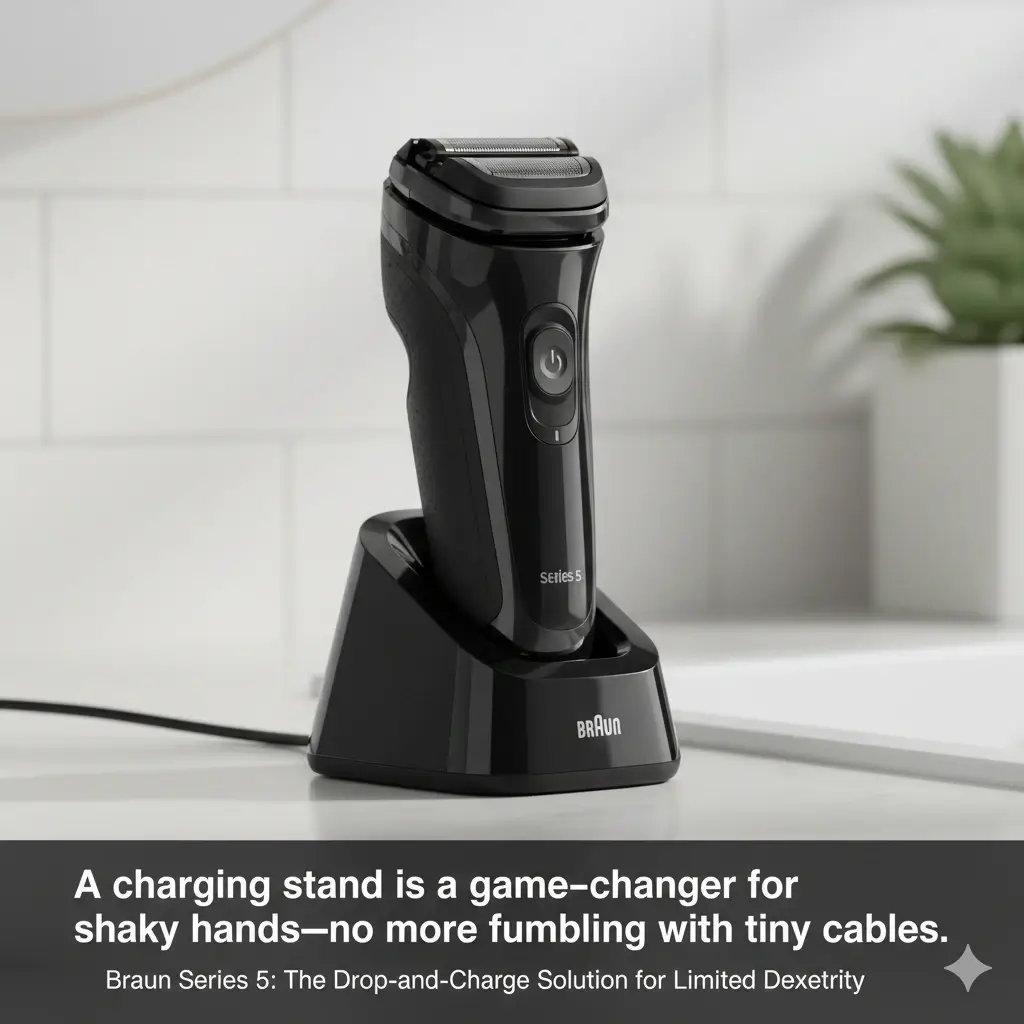
The Braun Series 5 features independent moving foils that compress to prevent skin friction.
The Philips 5000 Fluid Glide
The Philips Norelco 5000 similarly features flexing heads designed to ease the pressure on your face. However, because a rotary requires circular motions, adding heavy force can create a bit of extra friction against delicate skin. To help with this, modern iterations include specialized smooth rings to make the glide seamless. It simply asks for a slightly lighter, more relaxed touch over delicate areas compared to the Braun.
4. Maintenance & Ergonomics: Making Daily Care Simple
In the real world of limited dexterity, post-shave care is often where the real challenge lies. Fiddling with tiny plastic hooks or delicate parts over a hard sink can easily result in dropped or damaged accessories. Let’s look at how both brands try to make life simpler.
The Braun EasyClean Openings
The most thoughtful accessibility feature on the Braun Series 5 is its EasyClean conduit system. There is a built-in water channel that passes straight through the shaver head. You simply hold the running device under the warm tap, and the water flows right through, rinsing out hair dust effortlessly. For anyone with shaky hands, this completely removes the daily chore of pulling apart tiny, delicate cutting blocks.
The Philips Tapered Handle
The Philips 5000 relies on a clean One-Touch Open button. Pressing it pops the shaving head up on a sturdy hinge, letting you wash out the internal chambers. It’s very intuitive, though closing it simply requires a solid squeeze until it clicks. On the handling side, the Philips body is beautifully wide and tapers into the palm, which feels more secure and comfortable to hold than the slimmer profile of the Braun.
5. Charging Convenience & Upkeep Costs
Investing in a new shaver means joining its long-term ecosystem. Keeping the blades fresh and applying proper clipper oil is vital to maintaining a smooth, pull-free routine over time.
- The Cable Experience: Modern Philips 5000 units offer a wonderful upgrade by moving to a universal USB port configuration. Lining up a small proprietary 2-pin Braun plug can occasionally be frustrating when your hand isn’t perfectly steady, whereas a reversible cable interface fits easily on the first try.
- Braun Blade Refresh: The Braun 53B replacement cassette should be swapped roughly every 18 months. It is a single, solid piece—you simply click the old one off and pop the new one on, which is incredibly accommodating for limited hand strength.
- Philips Blade Refresh: The Philips SH71 self-sharpening system easily lasts up to 24 months. However, replacing the parts requires twisting a small plastic locking ring and dropping three separate circular cutters into place. For an individual with heavier arthritis, this specific biannual task is best handled with a little help from a loved one or caregiver.
6. Expert FAQs: Real Answers for Real Struggles
For an elderly man with thin skin and mild tremors, which razor is safer?
The Braun Series 5 is an incredibly safe option for thin, delicate skin. The uniform foil mesh design keeps the moving blades fully insulated from your skin surface, making nicks practically impossible no matter how your hand shifts. A rotary model requires repetitive circular sweeps, which can sometimes invite extra friction on fragile skin layers around the lower neck area.
I prefer to shave only twice a week. Will tremors make long stubble a problem?
If you like to leave 3 to 4 days between shaves, the Philips 5000 is likely your best partner. Foil shavers work beautifully on short hair but can struggle to feed longer, flat-lying hairs into the small foil holes, which can lead to uncomfortable pulling. The spacious slots on the Philips rotary heads excel at gathering and trimming multi-directional growth with simple, smooth movements.
Can these electric razors be used safely in the shower?
Yes, absolutely. Both options are completely waterproof with an IPX7 rating and designed for wet or dry use. For guys with shaky hands, applying a bit of gentle, non-foaming gel in the shower adds an extra layer of slick protection, heavily reducing the chance of skin burn. Plus, both models feature high-quality rubber grips to keep the razor handle resting securely in your hand when wet.
Which machine has a quieter, smoother feel in the hand?
The Philips 5000 is noticeably quieter and gentler. The linear motor core in the Braun Series 5 produces a quick, energetic buzz that transmits a solid amount of vibration down into your palm, which can sometimes tire out a shaky hand. The Philips rotary motor hums softly and keeps the physical haptic vibration in your hand to an absolute minimum.
The Final Verdict: Choosing with Confidence
Looking at the Braun Series 5 vs Philips 5000 comparison through the lens of accessibility shows us that both razors are superb tools that simply support different mobility styles.
Choose Braun Series 5 If…
Your main priorities are protecting thin, sensitive skin, a tendency to lean heavily on the razor, or a desire for a tool with an EasyClean channel that requires zero fiddling to rinse out under the tap.
Choose Philips 5000 If…
You prefer broader arm movements over wrist control, appreciate a whisper-quiet motor with low vibration, and often shave through longer, multi-day stubble growth.