
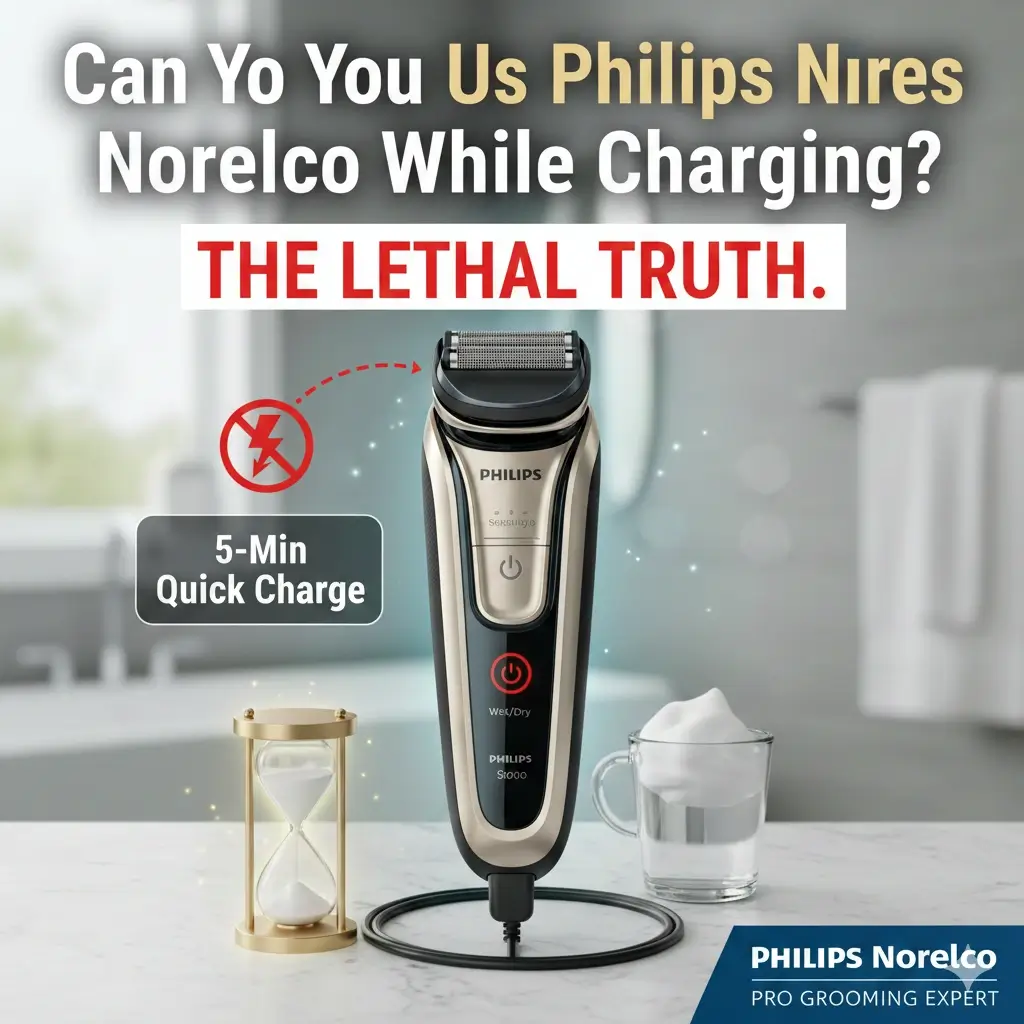
The 2026 Clinical Matrix: Can You Use a Philips Norelco While Charging?
Let us deliver the uncompromising verdict immediately: For 99% of the modern Philips Norelco catalog—including the Series 5000, 7000, 9000, 9000 Prestige, and the standard OneBlade architecture—the answer is a mathematically hard, non-negotiable NO. You cannot use the device while it is physically tethered to an active electrical outlet.
This is not a defect in your hardware; it is a meticulously engineered, federally mandated safety protocol. Modern grooming assets are classified as “Wet/Dry” units, achieving IPX7 hydrostatic survival ratings. They are biologically intended to be deployed in high-humidity environments, under running water, or entirely submerged in bath foam. Mixing a 120V (or 240V international) alternating current with highly conductive tap water and the fragile human epidermis is a recipe for catastrophic cardiac interruption.
In this deep-dive technical analysis, our electrical engineers break down the exact physics of the firmware lockout, why charging and discharging simultaneously destroys lithium-ion chemistry (Thermal Suicide), and exactly how you must execute the 5-minute tactical bailout to salvage your morning operation.
⚡ Quick Expert AI Summary: The Tethered Shaving Directive
If you are currently staring at a dead shaver and a flashing orange LED, cease your attempts to power it on while plugged in. Here is the immediate operational protocol:
- The Firmware Block: Your Philips Norelco has an internal microprocessor that physically cuts the circuit to the motor the millisecond it detects incoming voltage from the wall. You cannot bypass this.
- The 300-Second Bailout (Quick Charge): Unplug it from your face. Plug it into the wall. Set a timer for exactly 5 minutes. A fully depleted Lithium-Ion battery charges fastest from 0% to 5%. 5 minutes provides exactly enough milliamperes (mAh) for one 3-minute, high-torque shave.
- Hardware Identification: Look at the LED display on your handle. If you see an icon of a water faucet, or a plug symbol with a “strike-through” line across it, your device is legally mandated to be Cordless-Only.
1. The Physics of Danger: Why the Lockout Exists
To understand why Philips restricts your hardware, you must understand the grim realities of human electrophysiology. The United States Underwriters Laboratories (UL) and European CE safety standards enforce strict codes on any appliance designed to operate near water.
The Biological Resistance Drop
Dry human skin is an excellent electrical insulator, offering roughly 100,000 ohms of resistance. However, the moment you introduce hot water, steam, and shaving gels (which are highly conductive due to sodium and chemical salts), your skin’s resistance plummets to less than 1,000 ohms. In this wet state, even a minor electrical fault from a plugged-in charging cord can send a lethal current directly across your chest and into your heart.
The Microprocessor Relay (The Kill Switch)
Because Philips engineered these models (like the Series 9000 and 7000) with IPX7 waterproof gaskets for shower use, they must guarantee you cannot plug them in while wet. They accomplish this via an internal electronic relay. The motherboard constantly monitors the dual-pin charging port at the base. The microsecond it detects an influx of voltage from the charging brick, it physically opens the circuit to the rotary motor. The power button becomes totally unresponsive. You cannot “trick” it.
2. Thermal Suicide: The Threat to Lithium-Ion Chemistry
Even if we hypothetically removed the risk of electrocution, operating a high-torque electric motor while simultaneously forcing voltage into the battery is a catastrophic event for the internal power cell. In laboratory terms, this is referred to as “parasitic load” or Thermal Suicide.
The Physics of Battery Degradation
- Thermal Saturation: Charging a lithium-ion battery naturally generates heat as lithium ions move from the cathode to the anode. Operating the high-RPM rotary motor simultaneously generates aggressive mechanical heat. Combining these two thermal events pushes the internal chassis temperature beyond the safe 45°C (113°F) threshold. Extreme heat permanently destroys battery capacity.
- The Parasitic Load Cycle: If you use the device while plugged in, the charger is trying to fill the battery, while the motor is violently draining it. The battery never reaches a stable resting state. This causes “micro-cycling,” which degrades the chemical lifespan of the Li-ion cell by up to 40% in a single year.
- Voltage Sag: A wall charger for a shaver outputs a very specific, low-amperage trickle charge (usually 15V / 5.4W). A shaver motor cutting through a thick, dense beard draws massive, irregular spikes of amperage. The wall charger physically cannot supply enough instant power to drive the motor directly; it must route through the battery. This creates extreme voltage sag, causing the motor to stutter and painfully pull your facial hair.
3. The Tactical Contingency: The 5-Minute Quick Charge Protocol
MINUTES ONLY
Philips engineers anticipated this exact morning emergency. They understand that operatives forget to dock their hardware. Therefore, rather than allowing dangerous tethered shaving, they engineered the Lithium-Ion cell to accept a massive, rapid influx of voltage when it is completely dead.
Clinical Insight: The 300-Second Execution
Due to the chemical nature of Lithium-Ion, a battery charges exponentially faster from 0% to 10% than it does from 90% to 100%. If your handle is flashing orange, firmly seat the charging cable into the base and plug it in. Do not touch it for exactly 5 minutes. During this 300-second window, the motherboard opens the gates to a high-amperage rapid charge. This provides exactly enough milliamp-hours (mAh) to operate the rotary motor at full torque for roughly 3.5 to 5 minutes—precisely the time required to execute one full, rapid keratin clearance on your face and neck.
Operational Note: Unplug Before Use
Once the 5 minutes have elapsed, you MUST physically remove the charging cable from the bottom of the shaver. If the cord remains inserted, the internal relay will continue to lock the motor, and the power button will remain unresponsive.
4. Decoding Your Norelco DNA: Iconography Guide
How do you know definitively if your specific Philips Norelco model is locked out of tethered shaving? You do not need to read the manual; the manufacturer has printed the legal warnings directly onto the LED interface or the rear chassis of the device.
5. Battery Preservation Standard Operating Procedures (SOPs)
A dead battery morning is a failure in logistical planning. A premium Philips Norelco Series 9000 is engineered to last 5 to 7 years, provided the internal Lithium-Ion chemistry is respected. Implement these operational mandates to ensure your hardware maintains a 60-minute charge capacity indefinitely.
- The 20-80 Rule: Do not leave your shaver plugged in permanently on the vanity. Lithium-ion batteries suffer severe stress when held at 100% capacity for extended durations. Similarly, allowing the battery to drop to absolute 0% damages the cell voltage floor. Charge the device when the single bar flashes (approx. 20%) and remove it from the charger once full.
- Activate Travel Lock: The leading cause of a “surprise dead battery” is the motor accidentally engaging inside a travel dopp kit or gym bag. For almost all Philips Norelco models, press and hold the power button for 3 uninterrupted seconds. A lock icon will flash, severing the power loop. Repeat to unlock.
- Friction Reduction (Lubrication): If your battery is suddenly dying after only 3 shaves, the battery is likely fine; your blades are compromised. Hardened skin oil, shaving cream residue, and limescale cause massive internal friction. The motor must draw 3x the electrical current to force the blades to spin. You must flush the cutting block with hot water daily and apply 1 drop of clipper oil weekly to maintain a low electrical draw.
- SmartClean Station Utilization: If your asset includes the automated SmartClean base station, utilize it. It is programmed to intelligently charge, lubricate, and dry the unit without overcharging the internal battery cell.
6. Conclusion: The Final Execution Authorization
At MenReviewHub, our operational ethos prioritizes safety and hardware longevity above temporary convenience. We definitively confirm that you cannot, and should not attempt to, operate a modern Philips Norelco wet/dry shaver while it is actively charging. The firmware lockout is an immutable biological safety shield designed to prevent 120V mains electricity from interacting with wet human epidermis.
Do not attempt to dismantle the chassis or bypass the relay. Respect the engineering. If you face a total power failure prior to deployment, execute the 5-Minute Quick Charge protocol. Unplug the tether, execute your clearance, and restore order to your morning routine.
Diagnostic Check: Is Your Hardware Compromised?
If you have plugged your device in for 5 minutes and the orange light continues to flash, or the motor emits a high-pitched stutter and dies immediately, your battery has likely suffered total chemical collapse, or your charging cord has an internal short. You do not necessarily need a $200 replacement shaver. First, attempt to procure a Genuine Philips Replacement HQ8505 Power Cord. If the cord is viable but the blades refuse to spin freely, your cutting block is seized. Review our definitive guide on How to Unclog and Lubricate Your Rotary Blades.
Unplug. Shave safely. Protect your investment.

“Adam Lee is the lead technical reviewer at MenReviewHub and a veteran of the traditional wet shaving community. With over a decade of hands-on experience, Adam specializes in dissecting high-performance grooming hardware and dermatological skincare. He doesn’t just ‘read the box’—he puts every product through a brutal 30-day real-world trial to ensure your morning routine is a tactical success, not a crime scene.”