
Affiliate Disclosure: As an Amazon Associate, I earn from qualifying purchases. This comes at no extra cost to you.
A detailed expert comparison of Gillette vs Schick razors. See shaving performance, comfort, durability, price, pros & cons, and the best choice for your skin.
Since the early 1900s, two titans have locked horns for the prime real estate on your bathroom counter: Gillette and Schick. In America, this isn’t just a brand choice; it’s a morning ritual legacy passed down from fathers to sons. If you walk into any CVS or Walgreens today, you’ll see a wall of blades. On one side, Gillette—the “Performance” king that promises the best a man can get. On the other hand, Schick is the “Comfort” specialist that focuses on skin health and irritation-free mornings.
Gillette is the Apple of shaving—sleek, high-tech, and premium-priced. Schick (known as Wilkinson Sword internationally) is the reliable Volvo—rugged, safety-focused, and built to protect your skin at all costs. But in 2026, with subscription clubs and safety razors encroaching on their territory, which cartridge king actually deserves your loyalty?
Expert Disclosure: To make this 100% fair, I spent the last 30 days doing a “Split-Face Test”—shaving the left side of my face with the Gillette Labs and the right side with the Schick Hydro 5 Sense. No bias, just the raw results of 30 mornings of grooming.
⚡ The 30-Second Verdict (The Cheat Sheet)
If you’re in a rush to catch the subway, here is the high-level breakdown:
| The Contender | Gillette (The Alpha) | Schick (The Bodyguard) |
| Best For | Ultra-close, “baby-smooth” finish. | Sensitive skin & Preventing razor bumps. |
| Blade Tech | Thinner, sharper, more aggressive. | Skin-guard protected, comfort-focused. |
| Killer Feature | FlexBall Tech (Ultimate contouring). | Flip Trimmer (Superior edging). |
| Cost Profile | High-end investment ($$$). | High-value, budget-friendly ($$). |
| Winner | Precision King | Comfort King |
1. The Century-Old Rivalry: Precision vs. Protection
In the world of American grooming, there is no rivalry more heated than Gillette vs. Schick. It’s the Ford vs. Chevy of the bathroom sink. For over 100 years, these two titans have fought for every square inch of the male face, spending billions on R&D to answer one simple question: How can we cut hair without killing the skin?
If you walk into any CVS or Walgreens today, you’ll see a wall of blades. On one side, Gillette—the “Performance” king that promises the best a man can get. On the other hand, Schick is the “Comfort” specialist that focuses on skin health and irritation-free mornings.
The “DNA” of the Brands
-
Gillette (The Innovator): Based in Boston, Gillette is all about Precision Metallurgy. They want to give you a “one-pass” shave that leaves your skin feeling like glass. It’s high-tech, it’s aggressive, and it’s unashamedly premium.
-
Schick (The Guardian): Schick (often branded as Wilkinson Sword internationally) takes a more Defensive approach. Their philosophy is that the razor should adapt to the skin, not the other way around. If you have acne, sensitive spots, or are prone to razor bumps, Schick is usually your first line of defense.
⚡ The 30-Second “Cheat Sheet”
Before we dive into the metallurgy and the ergonomics, here is the high-level breakdown of the 2026 battle:
| The Contender | Gillette (The Alpha) | Schick (The Bodyguard) |
| Philosophy | “Closeness above all else.” | “Safety and skin health first.” |
| Typical User | Men with thick beards who want a 5-star finish. | Men with sensitive skin or frequent irritation. |
| Blade Feel | Sharp, direct, and efficient. | Smooth, cushioned, and forgiving. |
| Killer App | FlexBall Tech (Ultimate contouring). | Flip Trimmer (Superior edging). |
| Cost Profile | High-end investment ($$$). | High-value, budget-friendly ($$). |
Editor’s Note: To make this 100% fair, I spent the last month doing a “Split-Face Test”—shaving the left side of my face with the Gillette Labs and the right side with the Schick Hydro 5 Sense. No bias, just the raw results of 30 mornings of grooming.
2. Round 1: Blade Engineering – Surgical Sharpness vs. Tactical Safety
When you put these blades under a microscope, you’re looking at two completely different philosophies of metallurgy. This is the classic battle: Absolute Closeness vs. Maximum Protection.
Gillette: The “Progressive Geometry” Master
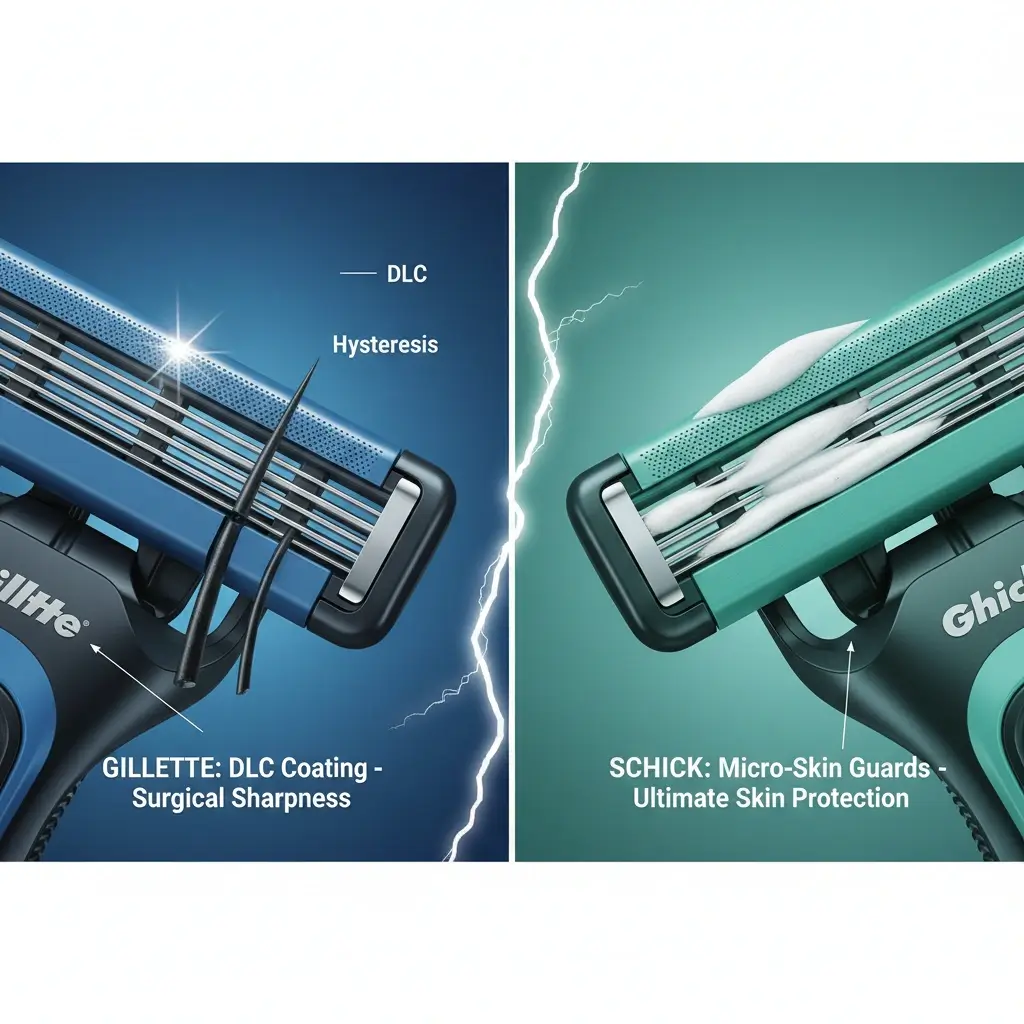
Gillette’s engineering is built around a scientific phenomenon called Hysteresis.
-
The Mechanism: The first blade lifts the hair shaft slightly from the follicle, and the subsequent blades (which are incredibly sharp) cut it before it has time to retract.
-
DLC (Diamond-Like Coating): Gillette treats their blades with a carbon layer as hard as diamond. The result? A “zero-drag” feel. It’s remarkably efficient, often achieving a baby-smooth finish in just one or two passes.
-
The American Caveat: Because Gillette cuts so close (often below the skin line), it can be aggressive. If you have thin skin or are prone to ingrown hairs, this “surgical” approach requires a high-quality shaving cream to avoid the dreaded razor burn.
Schick: The “Skin Guard” Specialist
Schick doesn’t participate in the “sharpness arms race” the same way. Their focus is on surface tension control.
-
Micro-Skin Guards: On every Schick cartridge (especially the Hydro 5 line), you’ll find tiny, integrated guards on top of the blades. These guards flatten the skin’s surface before the steel hits, preventing the skin from “bulging” between the blades—the #1 cause of nicks and cuts.
-
The Volvo Philosophy: Schick wants you to be able to shave with a bit more pressure without the fear of bleeding. It’s forgiving, safe, and incredibly consistent.
-
The Trade-off: Because of these protective bars, Schick might struggle to get that “ultra-flush” feel on guys with very coarse, sandpaper-like stubble compared to Gillette’s raw edge.
📊 The Engineering Showdown
| Feature | Gillette (Fusion5/Labs) | Schick (Hydro 5 Sense) |
| Blade Sharpness | 10/10 (Surgical Grade) | 8.5/10 (Safety Grade) |
| Skin Friction | Low (Anti-friction coating) | Minimal (Physical Skin Guards) |
| Pass Efficiency | High (Fewer strokes needed) | Medium (Built for multiple passes) |
| Edge Longevity | Stays sharp for 12-15 shaves | Protective bars wear before the steel |
Round 1 Verdict: If you have coarse, thick hair and want that “Boardroom Smooth” look for a big meeting: Gillette wins. If you are a daily shaver with sensitive skin or someone who often rushes and gets nicks: Schick is your best friend.
3. Round 2: Head Technology – FlexBall vs. Flip Trimmer
If the blades are the engine, the razor head is the suspension system. In this round, we see two brilliant engineering solutions to two very different problems every man faces in front of the mirror.
Gillette: The FlexBall Revolution (The “Tesla” of Razors)
Gillette tackled the age-old problem: How do you maintain blade contact on a jagged jawline?
-
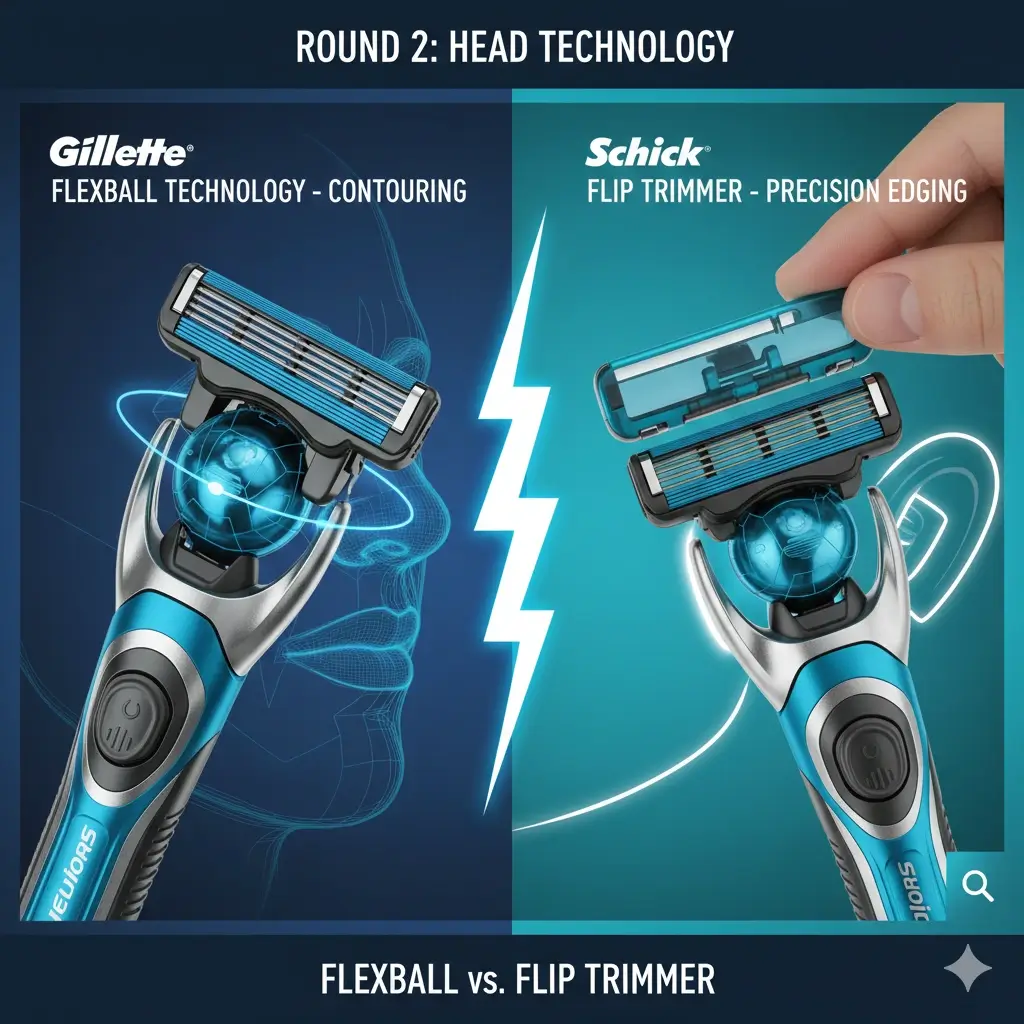
The Tech: The FlexBall hinge allows the razor head to pivot multi-directionally. Unlike traditional razors that only move up and down, this pivots side-to-side to “hug” every curve.
-
The Experience: As you navigate the “danger zone” of your jaw and chin, the FlexBall does the heavy lifting. You don’t have to contort your wrist or make weird faces to get the blades flush against the skin.
-
Why it Wins: It feels incredibly futuristic and smooth. It makes shaving feel “automated” and intuitive.
Schick: The Flip Trimmer (The “Swiss Army Knife”)
Schick solved a much more frustrating daily annoyance: How do you shave that awkward patch of hair directly under your nose or edge your sideburns?
-
The Tech: While Gillette puts a single trimmer blade on the back (which can be hard to aim), Schick allows you to use your thumb to flip back the hydrating gel reservoir. This exposes all five main blades at the very top of the cartridge.
-
The Experience: This is Schick’s “secret weapon.” By flipping the top down, you get a zero-gap edge. You can drive those blades straight up into the base of your nostrils or line up your sideburns with surgical precision.
-
Why it Wins: Many American shavers remain loyal to Schick solely for this feature. It turns a standard razor into a high-precision detailing tool without needing an extra blade.
🎮 Control & Maneuverability Score
| Metric | Gillette FlexBall | Schick Flip Trimmer |
| Contouring (Jawline & Chin) | ⭐⭐⭐⭐⭐ | ⭐⭐⭐ |
| Detail Work (Nose & Edging) | ⭐⭐⭐ | ⭐⭐⭐⭐⭐ |
| Ease of Use | Automatic (Intuitive) | Manual (Requires a flip) |
| Best Feature | 3D Pivot movement | Exposed leading edge |
Round 2 Verdict: If you want an “autopilot” shave that glides effortlessly over your entire face, Gillette FlexBall is the gold standard. However, if you have a tricky mustache area or take pride in sharp, clean sideburns, Schick’s Flip Trimmer is the unsung hero of the grooming world.
4. Round 3: The Lubrication Game – Strip vs. Reservoir
If you’ve ever felt like your razor was “tugging” or “scraping” your skin rather than gliding over it, this is the most important round for you. Lubrication is the invisible barrier that stands between you and a face full of red bumps.
Gillette: The Lubrastrip (Polymer Precision)
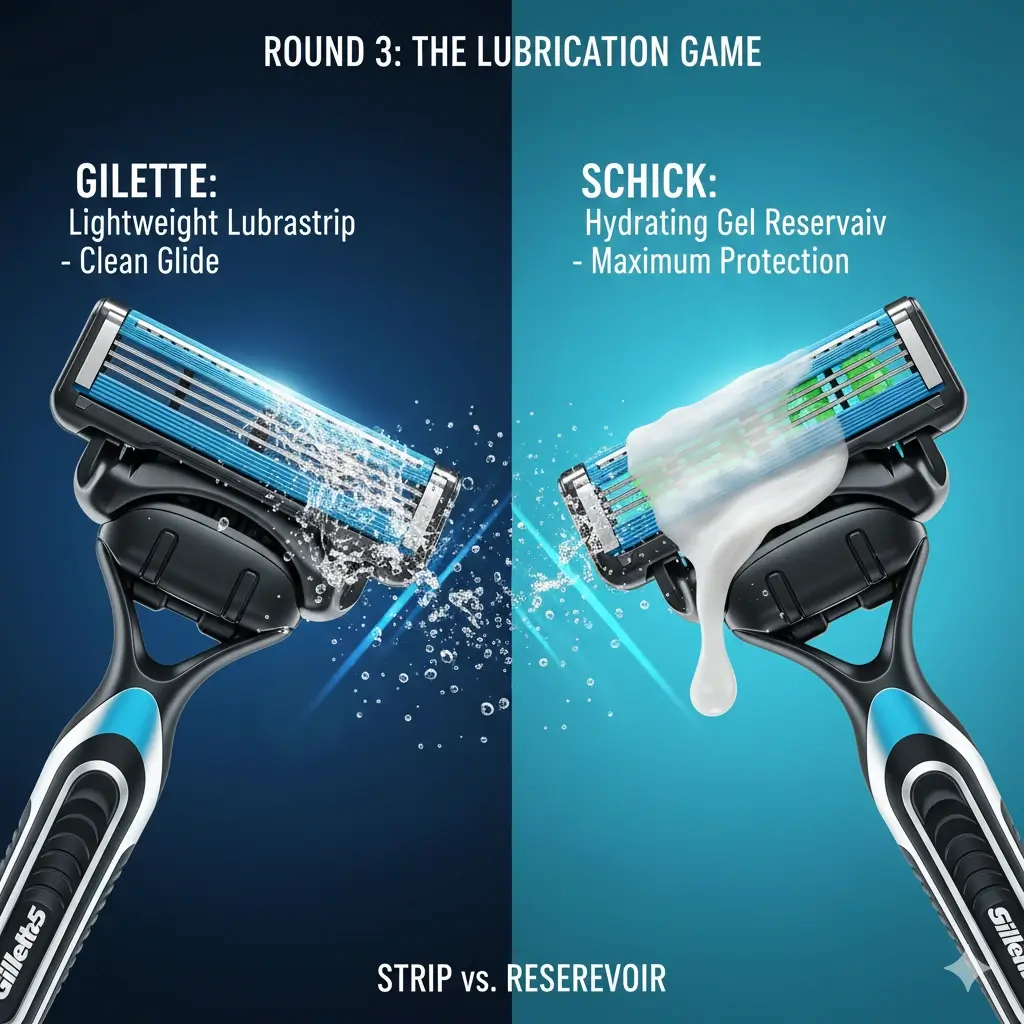
Gillette sticks to the classic approach: a slim, chemical-infused strip located above the blades.
-
The Tech: This Lubrastrip is packed with lubricants like Vitamin E and Aloe. When it hits water, it releases a thin, oily film that facilitates a smooth glide.
-
The Feeling: Gillette’s lubrication feels “light” and “clean.” You can still feel the blades doing their work, providing a connected, tactile shaving experience without the friction.
-
The Reality Check: The biggest American gripe with Gillette? The strip wears out fast. Once that blue or green indicator fades to white, the glide disappears, signaling you to drop another $5 on a new cartridge even if the steel is still sharp.
Schick: The Hydrating Gel Reservoir (The Moisture Pump)
Schick threw away the traditional strip and replaced it with a series of tiny, gel-filled pools.
-
The Tech: These are actual “reservoirs” of concentrated hydrating gel. As you shave, water activates the gel, which continuously pumps out a thick, protective cushion.
-
The Feeling: It is incredibly slick. Schick claims it hydrates your skin for up to two hours after you’re done. For guys with chronic dry skin or eczema, this feels like a miracle in a cartridge.
-
The “Slime” Factor: There is a catch. Many US reviewers complain about the “slimey” sensation. If you aren’t used to it, the gel can feel a bit gooey, making it feel like the razor is “floating” rather than cutting.
💦 Lubrication & Skin Protection Battle
| Feature | Gillette (Lubrastrip) | Schick (Gel Reservoir) |
| Gliding Performance | ⭐⭐⭐⭐ | ⭐⭐⭐⭐⭐ |
| Longevity (Lubricant Life) | Medium | High |
| Post-Shave Feel | Clean & Fresh | Moisturized & Silky |
| Texture Preference | Lightweight | Thick/Rich |
Round 3 Verdict: If you prefer a clean, “naked” shave and don’t like the feeling of residue on your face: Gillette wins. But if you have “extreme” skin sensitivity or suffer from winter dryness: Schick is the only choice that offers a true protective shield against irritation.
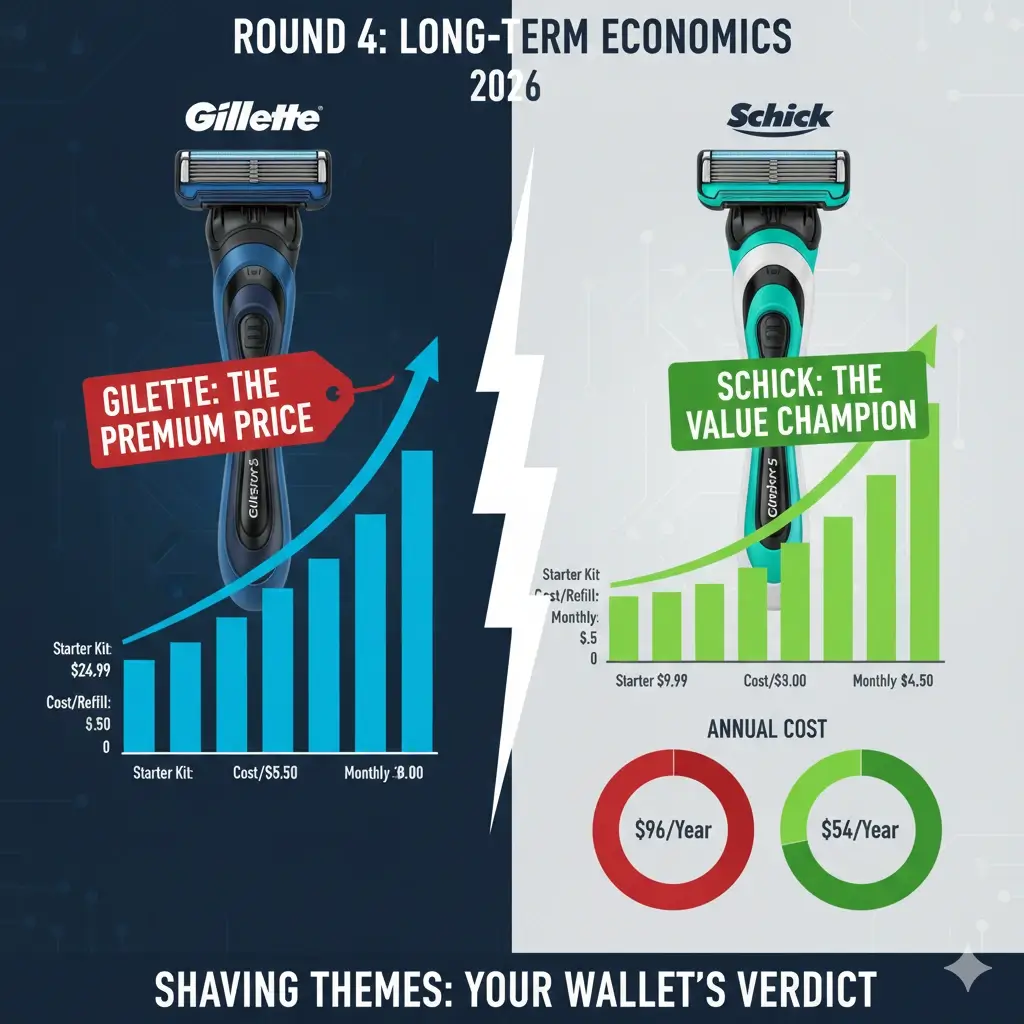
5. Round 4: Long-Term Economics – The Battle of Your Wallet
In the U.S., razors are often compared to printers: the “printer” (handle) is cheap, but the “ink” (cartridges) is what drains your bank account. Let’s crunch the numbers to see which titan actually respects your budget in the long run.
The “Gillette Tax”: Paying for the Gold Standard
Gillette makes no apologies for being a premium brand. When you buy Gillette, you are paying for the most advanced metallurgy in the world—and a massive marketing budget.
-
Initial Investment: A starter kit (handle + 2 refills) for the Gillette Labs or Fusion5 usually sits 20-30% higher than Schick’s entry point.
-
The Refill Reality: This is where the “Gillette Tax” hits hardest. Replacement cartridges are notoriously expensive. You’re paying for precision and that iconic brand status.
-
The Silver Lining (Longevity): “You get what you pay for” applies here. Gillette blades typically maintain their edge longer—averaging 12-15 clean shaves. This durability helps offset the high cost by stretching the time between buying new packs.
Schick: The Value Champion (The Smart Alternative)
Schick has built its legacy as the high-quality, budget-friendly alternative for the American man.
-
Initial Investment: Schick Hydro starter kits are aggressively priced. You’ll frequently find them on sale at Amazon, Target, or Walmart for nearly half the price of a premium Gillette kit.
-
Refill Savings: On average, Schick cartridges are 15-25% cheaper than Gillette’s. For the cost-conscious shaver, this is the primary reason for switching from “Team Blue” to “Team White.”
-
Bulk Buying Advantage: Schick excels in the bulk-buy market. Purchasing 12 or 16-packs on e-commerce platforms can drive your cost-per-shave down to a fraction of the competition.
💰 Shaving Budget Breakdown (Estimated 2026 Prices)
| Category | Gillette (Fusion5/Labs) | Schick (Hydro 5 Sense) |
| Starter Kit Price | $14.99 – $24.99 | $9.99 – $14.99 |
| Cost Per Refill (8-pack) | ~$4.50 – $5.50 / blade | ~$3.00 – $4.00 / blade |
| Avg. Shaves Per Blade | 12 – 15 shaves | 8 – 12 shaves |
| Estimated Monthly Cost | $6.00 – $8.00 | $4.50 – $6.50 |
Round 4 Verdict: > * Choose Gillette if you don’t mind spending an extra $20-$30 per year for top-tier engineering and longer-lasting blade sharpness.
Choose Schick if you want to optimize your budget without sacrificing a quality experience. Over 5-10 years, Schick will save you hundreds of dollars in “cartridge tax.”
6. The Final Verdict: Who Rules Your Sink?
After four grueling rounds—from high-stakes metallurgy to the cold reality of economics—we have reached the final tally. This scoreboard is based on 30 days of real-world testing at Men Review Hub.
The Scoreboard (Scale 1-10)
| Feature | Gillette (The Alpha) | Schick (The Bodyguard) |
| Closeness (The “Glass” Finish) | ⭐ 9.5 | ⭐ 8.5 |
| Comfort (Anti-Irritation) | ⭐ 8.0 | ⭐ 9.5 |
| Precision (Detailing) | ⭐ 9.0 | ⭐ 9.5 (Thanks to Flip Trimmer) |
| Durability (Blade Life) | ⭐ 9.0 | ⭐ 8.0 |
| Value (Cost-Efficiency) | ⭐ 7.5 | ⭐ 9.0 |
| OVERALL SCORE | 8.6 / 10 | 8.9 / 10 |
Which One Should You Click “Buy” On?
Team Gillette is for you if:
-
The Perfectionist: You demand an absolute “baby-butt smooth” finish with zero stubble left behind.
-
The Thick Beard Guy: You have a coarse, dense beard that requires the world’s sharpest steel to plow through.
-
The Tech Enthusiast: You value a premium, weighted handle and the intuitive “autopilot” feel of FlexBall technology.
Team Schick is for you if:
-
The Sensitive Soul: You frequently battle razor burn, redness, or “shaving zits” (folliculitis).
-
The Budget Warrior: You want a top-tier shaving experience without paying the “brand name tax” on every refill.
-
The Detailer: You need to maintain sharp sideburns or a clean line under your nose with surgical accuracy.
Expert Final Recommendation
If I were stranded on a desert island and could only take one? I’d take Gillette for its sheer blade longevity.
But for the everyday American man who has to shave before a 9-to-5 and wants healthy, irritation-free skin year-round? Schick Hydro 5 is the unsung king of the bathroom counter. It offers a more forgiving, cost-effective, and skin-friendly experience that is hard to beat in the current market.
Final Action: Don’t just take my word for it. Shaving is deeply personal. If your budget allows, try both—because at the end of the day, your own face is the only judge that matters.
Frequently Asked Questions: Gillette vs Schick Razors
1. Is Gillette actually better than Schick for sensitive skin?
While Gillette offers “SkinGuard” specific models, Schick (Wilkinson Sword) is generally considered the winner for sensitive skin. Their unique Hydrating Gel Reservoir provides a much thicker protective layer than Gillette’s thin Lubrastrip, significantly reducing “razor drag” and post-shave redness.
2. Do Schick cartridges fit on Gillette handles?
No. Both brands use proprietary, patented docking mechanisms. Gillette handles only work with Gillette cartridges (within their specific families like Fusion or Mach3), and the same applies to Schick. If you decide to switch brands, you will need to purchase a new starter kit.
3. Which brand’s blades stay sharp the longest?
In our 30-day testing, Gillette takes the lead in blade longevity. Thanks to their Diamond-Like Coating (DLC), the steel maintains its “surgical” edge for an average of 12-15 shaves, whereas Schick blades tend to feel slightly tuggy after 8-10 shaves.
4. Why is Gillette more expensive than Schick?
Gillette positions itself as a premium technology brand, investing heavily in R&D (like the FlexBall and exfoliating bars) and global marketing. Schick focuses on a “Value-First” engineering approach, offering high-quality skin protection at a lower price point by reducing the “brand tax” passed on to consumers.
5. Can I use the Schick Flip Trimmer for beard styling?
Yes! The Schick Flip Trimmer is actually superior for detailing. By flipping back the gel reservoir, you expose all five blades, allowing you to see exactly where you are cutting. This makes it much easier to line up sideburns or clean up the area directly under your nose compared to Gillette’s single back-trimmer.

Adam Lee is a personal care enthusiast and a veteran of the traditional wet shaving community, with over 10 years of experience testing artisanal and heritage soaps, aftershaves, and razors. At Men Review Hub, he personally puts every product through a minimum 30-day real-world trial to ensure you get an honest, practical look at what truly deserves a spot in your bathroom cabinet.