
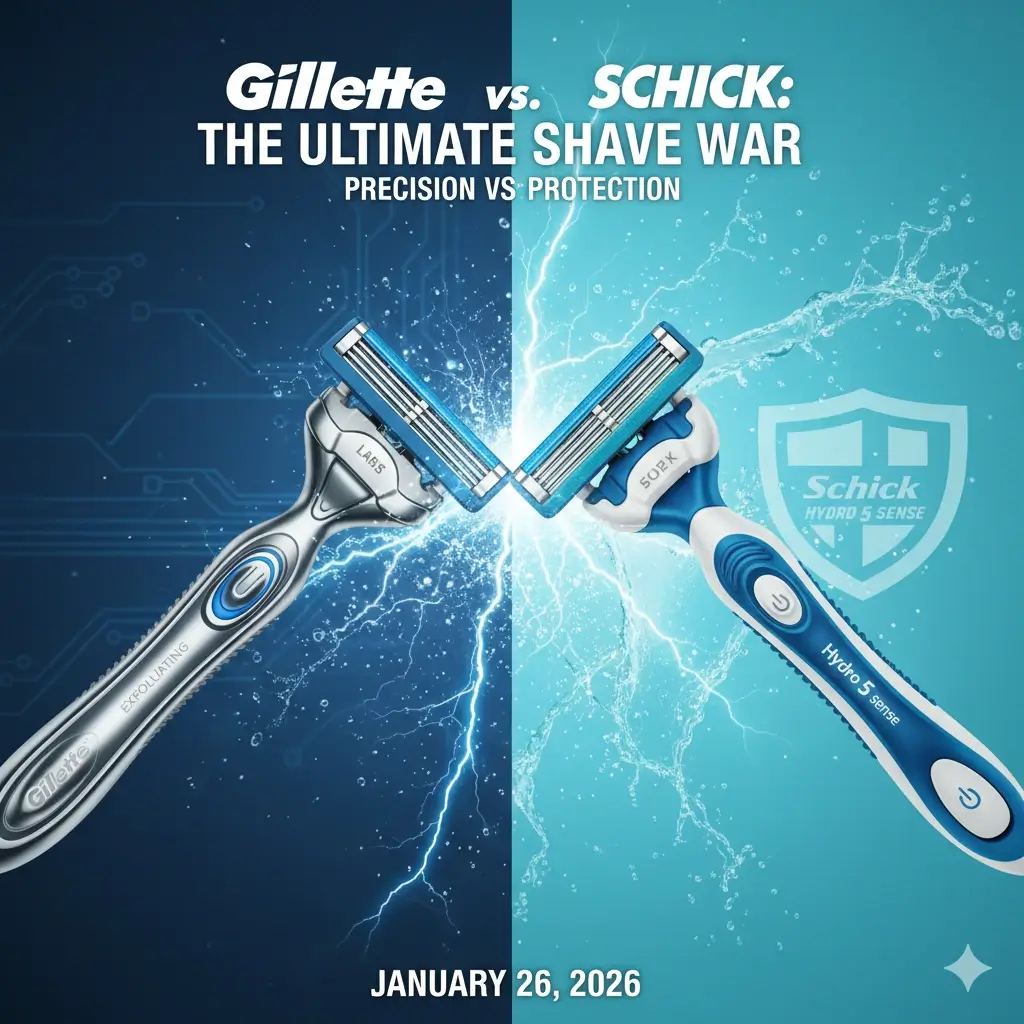
Gillette vs Schick Razors: A Real-World Shaving Comparison
Both Gillette and Schick have spent decades refining multi-blade cartridge systems, but they prioritize different aspects of the shaving experience. Gillette typically emphasizes closeness and cutting efficiency, while Schick focuses more on comfort and skin protection. Choosing between them comes down to understanding how their design choices interact with your specific skin type and shaving habits, rather than relying on standard retail marketing.
How I Tested These Razors
To provide an honest comparison, I put the Gillette Fusion5 and the Schick Hydro 5 Sensitive through a rigorous 30-day testing window. My testing baseline included the following controlled factors:
- Tester Profile: Moderately coarse beard hair with a sensitive neck area prone to occasional razor bumps.
- Shaving Frequency: Shaving every 48 hours to evaluate how each handle manages both short stubble and multi-day growth.
- Control Products: Used the exact same non-foaming shaving gel and warm-water prep routine for every single trial.
- Method: Half of the face was shaved with Gillette, and the opposite half with Schick, alternating sides each week to account for natural directional hair growth patterns.
Two Distinct Design Approaches
The competition between Gillette and Schick represents two different engineering goals. Gillette focuses on cutting efficiency and hair proximity, using progressive blade spacing designed to cut hair close to the skin surface on the initial pass. This approach works well for achieving a smooth result quickly, but it requires a careful hand if your skin is prone to irritation.
Schick (often sold as Wilkinson Sword in Europe) takes a more protective stance. Their designs assume that many users shave quickly or with uneven pressure. To counteract this, Schick integrates built-in guards on the blade edges and uses large moisture reservoirs to create a noticeable buffer between the steel and your face, favoring skin comfort over raw cutting speed.
Hardware Specifications: Core Product Features
Feature Comparison Matrix
| Feature | Gillette Fusion5 | Schick Hydro 5 |
|---|---|---|
| Primary Benefit | Closeness in fewer passes | Skin protection and heavy lubrication |
| Blade Guard Tech | Standard microfins (stretches skin) | Skin guards on each blade (smoothes skin) |
| Trimmer Design | Single reverse-side edging blade | Flip-back top gel reservoir |
| Lubrication Type | Thin, wearing polymer strip | Thick, fluid-release gel chambers |
Blade Performance: Closeness vs. Comfort
In my experience, Gillette’s blade design feels slightly more exposed, sitting closer to the skin line. During practical sink trials on my cheeks and jawline, this meant I could consistently achieve a smooth finish with just a single down-stroke. However, on a three-day beard growth, the Fusion5 required careful handling on my lower neck to avoid post-shave tightness or slight redness, due to that direct blade contact.
Schick takes a different approach by placing small guards on the tip of each blade. These guards help smooth out the skin surface as the razor slides forward. When shaving over sensitive areas on my neck, this design noticeably reduced irritation and nicks, even when I accidentally applied too much downward pressure. The trade-off I observed was that it left a very minor amount of hair stubble behind compared to Gillette on the first pass; the Hydro 5 required a quick clean-up pass under my jawline to match Gillette’s smoothness.
Rinsing & Clogging Efficiency in Coarse Stubble
A common issue with multi-blade cartridges is hair and shaving gel packing tightly between the blades, leading to blade lift and premature pulling. During 48-hour growth trials, both razors responded differently to water flow:
- Gillette Fusion5: Uses tighter inter-blade geometry. While this boosts initial cutting proximity, long stubble paired with thick shaving creams required higher faucet pressure to rinse completely clean.
- Schick Hydro 5: Features slightly wider pass-through channels behind the head. Combined with the water-activated gel dissolving quickly under warm water, Schick cleared debris noticeably faster between strokes, making it more forgiving if you shave in lower water pressure showers.
Handling and Maneuverability
Managing tricky areas like the chin requires a razor head that moves easily. Gillette utilizes a lateral pivot system called the FlexBall handle, which swings slightly from side to side. In my daily tests, this side-to-side rotation made it easier to maintain steady contact along my jawline contours without needing to continuously adjust my wrist angle.
Schick relies on a traditional vertical pivot but addresses fine detail work through its Flip Trimmer. Instead of using a separate precision blade on the back of the cartridge like Gillette—which often blocks your line of sight in the mirror—Schick allows you to snap the top gel reservoir backward using your thumb. I found the Flip Trimmer especially useful for trimming directly under my nose, where it was much easier to see the exact position of the cutting edge.
The Lubrication Systems
Both brands use lubricating materials to reduce friction, but their longevity and texture differ significantly. Gillette uses a classic slim strip behind the blades that slowly dissolves over time. It provides a lightweight glaze that allowed me to easily gauge blade pressure. However, by the 11th shave, I noticed the lubrication strip on the Fusion5 had faded noticeably, indicating the cartridge was nearing the end of its peak comfort window.
Schick Hydro features multiple built-in gel reservoirs that release a thicker, aloe-infused lubricating fluid when wet. This creates a dense cushion over the skin, which I found helpful if I needed to re-shave a patch where my shaving gel had already been wiped away. For users with very dry skin, this heavy lubrication offers excellent protection, though I noticed it takes a bit more rinsing under the faucet to keep the blade gaps clear of gel buildup.
Blade Durability & Usage Life
Tracking real-world blade life helps establish realistic expectations for replacement frequency. During my 30-day testing window, both cartridges demonstrated distinct durability characteristics under heavy daily use.
Real-World Blade Longevity Comparison
Gillette Fusion5
Averaged Blade Life: ~14 Shaves
Edge Retention: Excellent
Lubrication Strip Life: Moderate
Schick Hydro 5
Averaged Blade Life: ~9 Shaves
Edge Retention: Moderate
Gel Reservoir Life: Exceptional
Durability Assessment: In my testing, Gillette’s steel retained its efficient cutting edge for several extra shaves, resisting friction tugging even through thick beard hair. While Schick’s gel reservoirs provided unmatched skin cushion for the duration of the blade’s life, the steel cutting edges began to feel slightly dull sooner than Gillette under heavy stubble. If you want to bypass the cartridge model entirely, you can view our hands-on evaluation of classic steel options in our best grooming kits for men guide.
Pros and Cons
Gillette Fusion5
Pros:
- Provides a close shave with fewer total passes required.
- FlexBall handle moves fluidly around complex chin and jaw angles.
- Blades maintain clean cutting comfort longer before pulling.
Cons:
- Higher potential for skin irritation on the neck if used with rapid strokes.
- Tight blade spacing requires slightly more water pressure to rinse clean.
Schick Hydro 5
Pros:
- Blade tip micro-guards effectively minimize minor skin nicks and scrapes.
- Gel reservoirs supply a thick lubricating cushion over dry skin areas.
- Flip Trimmer simplifies line visibility under the nose and at the sideburns.
Cons:
- Can require an extra pass over dense hair growth to match Gillette’s closeness.
- The lubricating fluid can feel slightly heavy or slick during intermediate rinsing.
Field Ratings Across Key Criteria
These performance ratings reflect my personal observations over a 4-week trial period. Shaving outcomes vary naturally depending on your hair density, preparation habits, and skin sensitivity.
Shave Closeness (Single-Pass Performance)
Skin Comfort (Irritation Management)
Precision Edging (Detail Visibility)
Blade Edge Retention
Exploring Alternative Model Variants
While this comparison centers on the flagship **Fusion5 vs. Hydro 5**, both brands market specialized line extensions tailored to specific skin sensitivities:
Gillette Lineup Variations
• Gillette ProGlide: Features thinner, finer blade edges than Fusion5 to minimize tugging on thick growth.
• Gillette SkinGuard: Designed specifically for severe razor bumps; features a bridge between 2 blades that absorbs hand pressure.
Schick Lineup Variations
• Schick Hydro Skin Select: Features shock-absorbing handle technology that backs off automatically if you press too hard.
• Schick Quattro: A 4-blade alternative with wire-wrapped blades for sensitive daily shavers.
Which One is Right for You?
Choose Gillette Fusion5 If:
- You have coarse, straight beard hair that benefits from fast, efficient hair clearing.
- Your main goal is achieving a highly smooth finish that remains clean throughout the workday.
- You have normal skin that is generally resilient against post-shave tightness or razor burn.
Choose Schick Hydro 5 If:
- You have sensitive skin or find yourself prone to razor bumps along your lower neckline.
- You prefer a highly forgiving blade setup that handles quick or uneven hand pressure safely.
- You tend to experience dry, flaking skin and prefer a heavy, continuous moisture buffer.
Frequently Asked Questions
Which brand is better suited for highly sensitive neck skin?
The Schick Hydro line generally offers better protection for sensitive skin. The micro-guards on the blade tips help prevent skin tissue from pushing into the gaps between the blades, while the fluid from the gel reservoirs provides a dependable layer of lubrication. If your neck area is regularly irritated after shaving, you can read our guide on practical steps to manage your skin profile in our how to stop razor burn walkthrough.
Are Gillette cartridges and Schick handle mechanisms interchangeable?
No, they are completely incompatible. Both brands protect their hardware ecosystems with distinct, patented connection styles. A Gillette cartridge will not mount onto a Schick handle, and vice versa. If you plan to switch brands, you will need to buy a matching starter kit that contains the appropriate handle.
The Verdict: Choosing the Right Match
Ultimately, finding the ideal razor requires matching the blade setup to your individual facial features and skin tolerance. Real-world results always depend on your beard density, skin type, and overall shaving technique. If your skin handles multi-blade razors easily and your primary goal is achieving a close finish with minimal strokes, Gillette remains an effective option that delivers reliable cutting efficiency.
On the other hand, if you regularly experience skin redness, find yourself dealing with razor bumps, or simply prefer a heavy layer of built-in lubrication that protects dry skin on contact, the guarded blade design of Schick Hydro 5 offers a highly forgiving option for your morning routine. If you want to move away from manually guided blades and look into electronic grooming setups, you can check out your options in our detailed best electric shaver index. Choose the system that fits your individual skin needs, replace your blades regularly, and focus on clean skin comfort every morning.
Helping guys build a better morning routine | MenReviewHub