
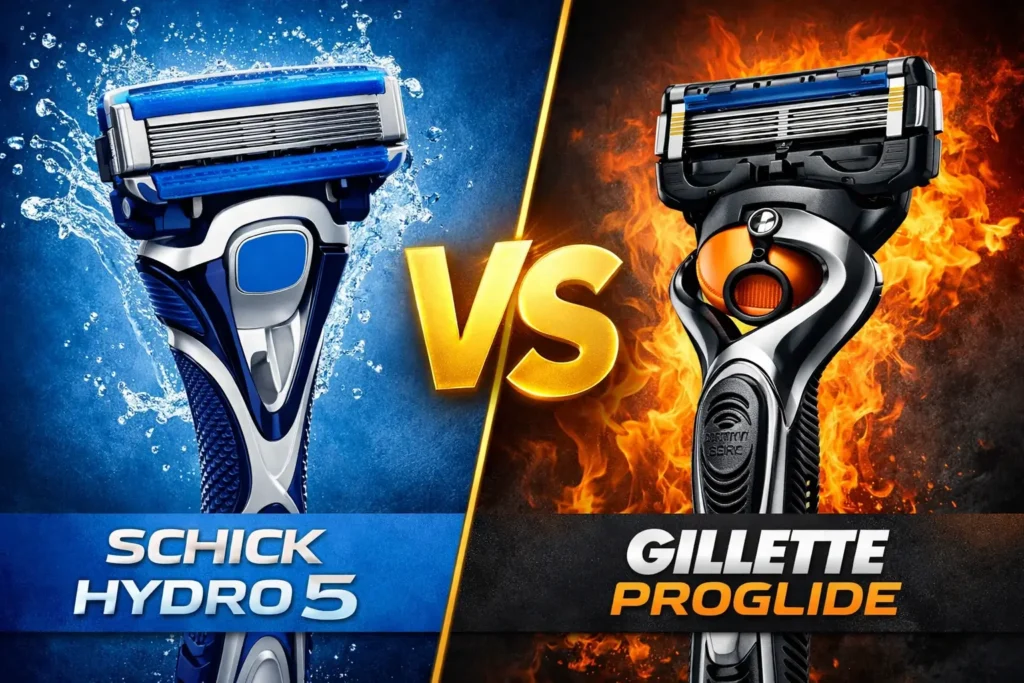
Full Technical Specifications Comparison
| Spec / Feature | Schick Hydro 5 | Gillette ProGlide |
|---|---|---|
| Blade Array | 5 Stainless Steel Blades with Integrated Skin Guards | 5 Ultra-Fine DLC-Coated Precision Edge Blades |
| Handle Mechanics | Standard Vertical Pivot (Forward/Backward) | 3D FlexBall Pivot (Lateral + Vertical Tracking) |
| Lubrication Technology | 7 Hydrating Gel Reservoirs (Aloe, Vitamin E, Hyaluronic) | Enhanced Lubrastrip with Mineral Oil & Polymers |
| Trimmer Design | Flip-Top Trimmer (Thumb push swivels gel pod back) | Precision Edging Blade (Single rear blade) |
| Blade Gap & Rinseability | Wider spacing; extremely easy tap-rinse clearing | Narrow spacing; requires strong water stream for heavy stubble |
| Handle Ergonomics | Heavyweight rubberized grip; solid wet traction | Ergonomic metal/elastomer body; lighter weight balance |
| Average Blade Lifespan | 8 to 10 Shaves (Gel runs out before blades dull) | 15 to 20 Shaves (Coating retains sharp edge) |
1. Understanding the Science: How Cartridges Affect Your Skin
When examining the Schick Hydro 5 vs Gillette ProGlide duel down at the skin level, we first need to talk about Blade Hysteresis (commonly called the “lift and cut” mechanism) and Skin Bulging.
When a multi-blade razor glides across your face, the leading blade snags the hair follicle and lifts it slightly out of the skin pore. Before the hair can retract back into the skin, the subsequent blades cut deeper down the shaft. While this delivers an exceptionally smooth result, it introduces two major risks:
- Skin Bulging: When you press a razor against soft skin (like the neck or under the chin), the skin pushes up into the gaps between the blades. This causes micro-cuts, nicking, and painful razor burn.
- Ingrown Hairs (PFB): If a blade cuts hair too far beneath the surface of the follicle, curly or coarse facial hair can curl back under the skin line as it regrows, creating inflamed red bumps.
This brings us to the core engineering difference in the Schick Hydro 5 vs Gillette ProGlide battle: Schick Hydro 5 fights skin bulging using mechanical guards and gel barriers, whereas Gillette ProGlide minimizes friction using ultra-thin steel and fluid pivoting motion.
2. In-Depth Analysis: Schick Hydro 5
In any Schick Hydro 5 vs Gillette ProGlide comparison, Schick approaches grooming with a defensive mindset. Every component of the Hydro 5 is designed to absorb pressure and leave a heavy moisture barrier behind.
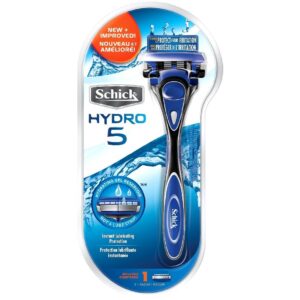
Key Engineering Highlights
Hydrating Gel Reservoirs
Rather than a flat lubricating strip that wears down in two uses, Schick features 7 distinct gel pools. Activated by water, they release a slick gel containing Aloe Vera, Vitamin E, and Hyaluronic Acid. It stays slick even during repeat passes over dry spots.
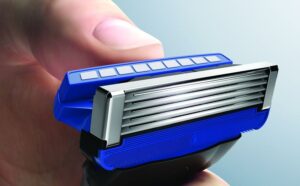
Integrated Skin Guards
Over each of the 5 blades sits a small metallic raised bumper. These guards double the points of contact on your face, flattening skin out so it won’t press deep into the inter-blade space. This drastically cuts down on accidental nicks.
⚠️ Real Tester Critique: The “Slime” Factor
During our 30-day trial, several testers noted that for the first 2–3 shaves with a brand new cartridge, the Hydrating Gel Reservoirs discharge an abundance of gel. If you prefer a clean, minimal touch, it can feel slightly gooey or “slimy” until broken in. However, for guys with sensitive or raw skin, this extra lubricant is a lifesaver.
3. In-Depth Analysis: Gillette Fusion ProGlide
Looking at the other side of the Schick Hydro 5 vs Gillette ProGlide debate, Gillette focuses heavily on cutting efficiency. The ProGlide is engineered to deliver a seamless cut with as few total strokes as possible.
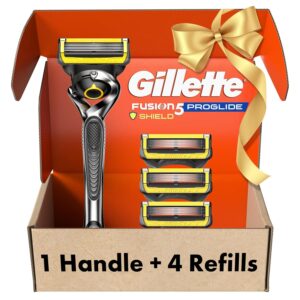

Key Engineering Highlights
FlexBall Handle Technology
The iconic FlexBall hinge allows the head to swivel left and right in addition to standard up/down pivoting. It effortlessly hugs curved surfaces—specifically the jawline, chin button, and scalp—without requiring you to alter your grip wrist position.
DLC-Coated Ultra-Thin Blades
Gillette uses blades coated with Diamond-Like Carbon (DLC). These edges are thinner than a surgical scalpel, allowing them to slice dense stubble with minimal resistance or hair pulling.
⚠️ Real Tester Critique: Blade Clogging on Multi-Day Growth
The tight spacing between Gillette’s 5 blades is fantastic for a close cut, but if you skip shaving for 4 or 5 days, long hair and thick shave cream can get trapped between the steel. You will need a strong stream of tap water to flush out the cartridge compared to the easier-clearing Schick Hydro 5.
4. Head-to-Head Test Results: Schick Hydro 5 vs Gillette ProGlide
A. Closeness of Shave
Winner: Gillette ProGlide
During our blind touch test 2 hours post-shave in the Schick Hydro 5 vs Gillette ProGlide evaluation, cheeks shaved with the Gillette ProGlide felt noticeably smoother than those shaved with Schick. The combination of thinner steel blades and closer gap geometry allows Gillette to cut slightly below the epidermis surface. Schick gets very close (90% of Gillette), but its safety guards naturally prevent the blades from seating quite as deep against the skin.
B. Sensitive Skin & Irritation Prevention
Winner: Schick Hydro 5
If you regularly experience red splotches, stinging aftershave responses, or neck irritation, Schick wins hands down. The Hydrating Gel Reservoirs lubricate the skin continuously—even if you go over the same neck spot twice without reapplying shaving cream. The built-in Skin Guards effectively cushion the blade pass, making it virtually impossible to cut yourself unless using severe angle mistakes.
C. Precision Edging & Trimming
Winner: Tie (Different Approaches)
Both razors solve the problem of trimming under the nose and lining up sideburns, but use completely different mechanisms:
- Schick Flip Trimmer: Flicking the top gel reservoir backward with your thumb exposes all 5 blades right to the top edge. This gives you maximum cutting power under the nostrils.
- Gillette Precision Blade: A single standalone blade built into the back top of the cartridge. Simply flip the handle 180 degrees to slice sharp sideburn lines.
D. Head Shaving Usability
Winner: Gillette ProGlide
Shaving the back of your scalp blind requires a razor that naturally conforms to curves. Gillette’s FlexBall mechanism absorbs uneven pressure across the skull, drastically reducing the chances of catching an edge behind the ears or along the occipital bone.
5. Long-Term Value: Schick Hydro 5 vs Gillette ProGlide Durability Comparison
Evaluating the long-term value of the Schick Hydro 5 vs Gillette ProGlide cartridges comes down to blade longevity and efficiency over time.
| Performance Metric | Schick Hydro 5 | Gillette ProGlide |
|---|---|---|
| Usable Shaves per Cartridge | ~9 Shaves (Gel pools dry out) | ~16 Shaves (Coated steel stays sharp) |
| Primary Replacement Indicator | Depletion of Hydrating Gel Reservoirs | Gradual blade dulling and tugging |
Value Takeaway: Gillette’s superior blade coating durability yields more total shaves per cartridge, making Gillette last noticeably longer per head.
Frequently Asked Questions
1. In the Schick Hydro 5 vs Gillette ProGlide comparison, which is genuinely better for sensitive skin?
Schick Hydro 5 is genuinely better for sensitive skin. It uses built-in metallic skin guards on every blade to flatten the skin surface, paired with water-activated gel reservoirs that coat the skin in aloe and hyaluronic acid. It creates significantly less friction than Gillette’s thinner lubricating strip.
2. Why do Gillette ProGlide blades seem to last longer than Schick?
Gillette applies a proprietary Diamond-Like Carbon (DLC) edge coating that maintains cutting sharpness for up to 15–20 shaves. Schick blades remain relatively sharp, but their gel reservoirs run dry after 8–10 shaves, signaling most users to replace the head early.
3. Can I use Gillette ProGlide cartridges on a Schick Hydro handle?
No. Gillette and Schick use entirely different locking mechanisms. Cartridges are strictly non-interchangeable across brands.
4. Which razor is easier to rinse clean under tap water?
Schick Hydro 5 is much easier to rinse. It features wider blade spacing and an open-back cartridge design that lets hair flow through easily. Gillette ProGlide’s tighter blade spacing can catch thick hair or shaving cream if you don’t rinse frequently.
5. Which razor is best suited for head shaving?
Gillette ProGlide is widely considered the superior choice for head shaving thanks to its FlexBall handle, which flexes side-to-side across the curved contours of the scalp.
The Final Decision: Schick Hydro 5 vs Gillette ProGlide
Both razors dominate the cartridge market for good reason. When weighing Schick Hydro 5 vs Gillette ProGlide, if your skin is prone to razor burn, bumps, or dry patches, purchase the Schick Hydro 5 for its unparalleled protective cushion. If you prioritize absolute closeness, effortlessly contouring your jawline, or shaving your scalp, go with the Gillette ProGlide.