
Table of Contents
TogglePhilips OneBlade vs Electric Shaver for Stubble: The Ultimate 2026 Master Guide
Today, we are thoughtfully putting the cult-favorite hybrid groomer up against heavy-duty traditional foils and rotaries to settle the Philips OneBlade vs Electric Shaver for stubble conversation once and for all. We will break down motor harmonics, blade friction geometry, dermatological impacts, and long-term financial dollar value so you can make an educated investment in your bathroom station.
⚡ Quick Verdict: Which Should You Buy?
- Choose Philips OneBlade if: You want to maintain a precise 1-3mm 3-day beard, hate ingrown hairs, need sharp edge lining, and have sensitive neck skin.
- Choose Traditional Electric Shaver if: You need a zero-gap smooth shave for work, prefer a long-lasting device without frequent blade re-orders, or want to explore top-rated full-face groomers featured in our roundup of the best electric shavers for men.
1. The Biology of Scruff: Why the 3-Day Shadow Needs Care
Before we can declare a definitive winner in the Philips OneBlade vs Electric Shaver for stubble debate, we must first understand the canvas we are working with: your skin and hair. Facial hair is the thickest hair on the human body. It grows at an average rate of 0.3mm to 0.5mm per day, depending on your individual genetics. The “perfect” designer stubble sits exactly between 1mm and 3mm in length.
This scientific reality means you have a razor-thin window of about 48 to 72 hours before your highly intentional scruff transitions into an unkempt, itchy phase. When hair reaches the 4mm mark, it begins to curl back towards the skin, triggering the dreaded “beard itch.” To stay comfortably in that sweet spot, you need a grooming tool that can essentially freeze time by slicing cleanly through the hair follicle without grinding down the skin tissue.
The Struggle with “Standard” Grooming Tools
Historically, men attempting to maintain this rugged look have felt let down by traditional options:
- Manual Razors (Cartridges & Safety Razors): These are engineered for absolute zero. They aggressively scrape away the top layer of your skin (the stratum corneum) along with the hair. They offer zero length control; you simply cannot use a manual blade to leave an even 2mm of hair.
- Standard Hair Clippers & Beard Trimmers: These tools are often massive and clumsy. Maneuvering a wide steel clipper blade under your nose or along the complex curves of your Adam’s apple without a mishap is difficult. Furthermore, their plastic snap-on guards are notorious for bending under pressure, leaving your stubble looking patchy and uneven.
To win the core debate of Philips OneBlade vs Electric Shaver for stubble, a device must offer the agility of a manual razor but the strict, unwavering length control of a professional barber clipper. This is exactly where the technological paths of Philips and traditional electric brands diverge.
2. Engineering the Hybrid King: Why the Philips OneBlade Excels
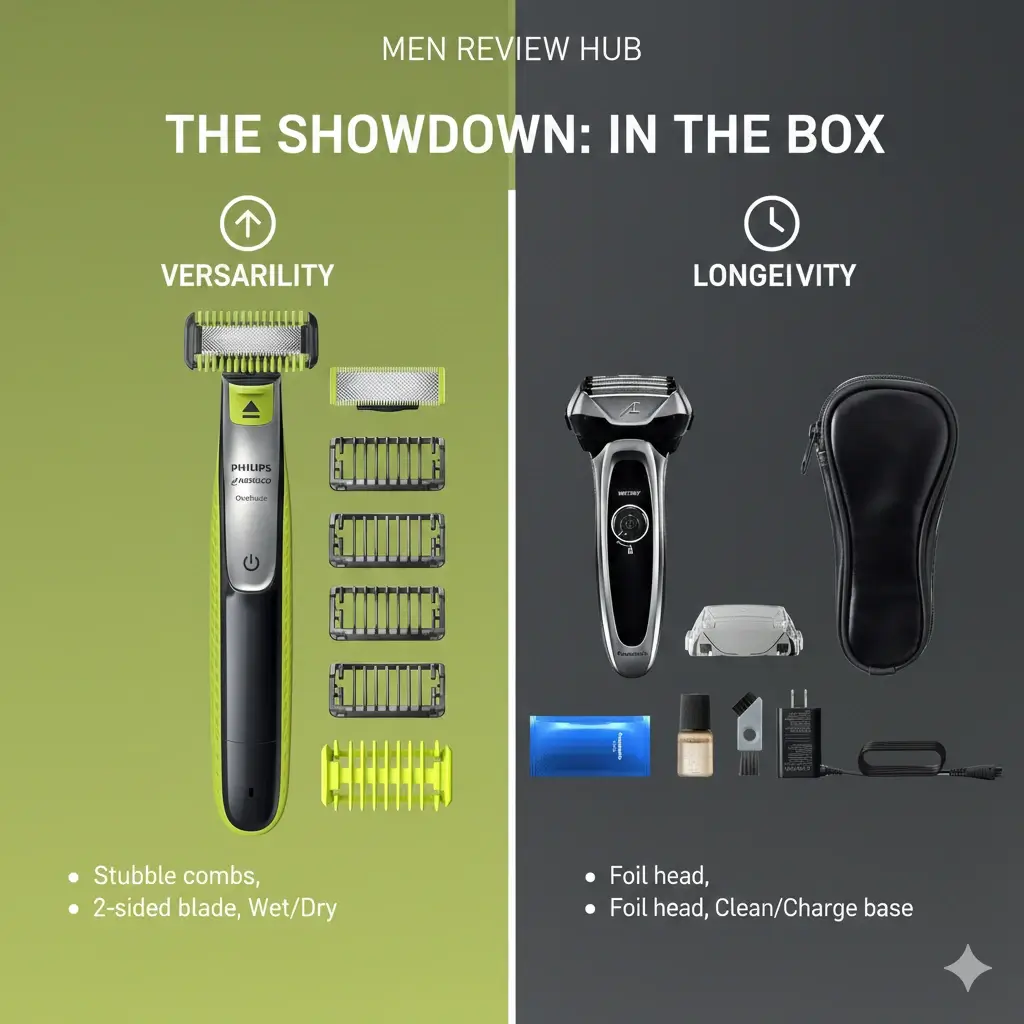
In the hyper-competitive grooming world, true innovation is rare. The Philips OneBlade earned its dedicated following by completely rethinking blade geometry from the ground up. When deeply analyzing the Philips OneBlade vs. electric shaver for stubble, the OneBlade’s patented hybrid architecture is undeniably its greatest, most comforting asset.

The Philips OneBlade Pro 360 features a dedicated adjustment dial, removing the clutter of plastic snap-on guards.
The 12,000 CPM Micro-Blade Mechanism
Traditional shavers work by trapping hair in a metal foil and cutting it at or below the skin level. The OneBlade takes a much kinder approach. It features a fast-moving internal cutter driven by a robust rotary drive that zips back and forth an astonishing 12,000 times per minute inside a protective outer comb. Because the blade is flat and features rounded polymer tips with a specialized friction-reducing coating, the sharp cutting element never actually rests against your bare skin cells.
It gently shears the hair off exactly 0.1mm above the epidermis. The result? You get that iconic, rugged 5 o’clock shadow instantly, without the trauma of a sharp metal edge scraping your face. In the context of the Philips OneBlade vs Electric Shaver for stubble matchup, this specific 0.1mm gap is the defining feature of the OneBlade. It is intentionally designed to fail at giving you a perfectly clean shave, leaving behind a flawless shadow instead.
Precision Trimming with Advanced Combs
The absolute difference between a sharp designer look and appearing unkempt is uniform length. The OneBlade Pro series utilizes reinforced, highly stable dial-operated combs that do not flex under hand pressure, respecting the natural bone contours of your jawline:
- The 1mm (The Scruff): Perfect for the barely-there grit that makes your jawline pop under harsh lighting.
- The 3mm (The Designer): The sweet spot—rugged enough for a weekend, yet sharp and intentional enough for a high-stakes professional setting.
- The 5mm (The Short Beard): For the guy who wants maximum facial coverage without crossing into full beard maintenance.
3. The Traditional Electric Shaver: Overqualified for the Wrong Job?
If we look closely at premium devices featured in our comprehensive breakdown of the best electric shavers for men—such as the Braun Series 9 Pro+ or Panasonic Arc6—we encounter true marvels of engineering. They possess 14,000 CPM linear motors, sonic vibration technology, and complex pivoting heads. However, when evaluating the Philips OneBlade vs Electric Shaver for stubble, you encounter a fundamental design mismatch: traditional electric shavers are meticulously built for total hair eradication.
Foil shavers utilize micro-thin foil mesh grids to actively lift hair, pull it upward, and slice it off below skin level. While ideal for a baby-smooth finish, this is the exact opposite of what a stubble enthusiast wants. Trying to maintain a 3-day beard with a zero-gap shaver is like trying to trim a bonsai tree with a gas chainsaw.
Pop-up trimmers on the back of foil shavers are meant purely for sideburn edging, lacking the length guards required for full-face scruff maintenance. In the Philips OneBlade vs Electric Shaver for stubble comparison, the traditional shaver is overqualified for the wrong task.
4. The Ultimate Head-to-Head Comparison Matrix
To definitively settle the Philips OneBlade vs. electric shaver for stubble argument, we must break down their performance across critical grooming metrics that affect your daily routine.

Traditional electric shavers utilize metallic foil mesh engineered to clip hair flat against the skin surface.
| Criteria | Philips OneBlade (Hybrid) | Electric Shaver (Foil/Rotary) |
|---|---|---|
| Primary Goal | Maintaining “3-Day Scruff” | Achieving “Baby-Smooth” Finish |
| Closeness Level | 0.1mm (Leaves natural shadow) | 0.0mm (Total hair removal) |
| Edge Control | Elite (Visible blade profile) | Poor (Bulky head limits vision) |
| Skin Irritation | Near Zero (Doesn’t touch skin) | Moderate (Requires technique) |
| Blade Replacement | Every 3-4 months (~$15/blade) | Every 18-24 months ($40-$60/head) |
| Portability | Ultra-Compact (Toothbrush size) | Bulky (Requires large travel case) |
5. Deep Dive: Precision Edging, Necklines, and Shaping
Stubble only looks intentional if the borders are immaculate. The neck beard zone is a major style killer. In the Philips OneBlade vs Electric Shaver for stubble edging test, physical tool design makes all the difference.
The Crucial Visibility Factor
To carve a precise line above your Adam’s apple or sculpt cheekbones, you must see where the blade meets skin. Standard foil shavers have broad heads that obstruct your view, often leading to uneven beard lines.
The OneBlade, with its flat, dual-sided blade, functions like a modern safety razor. You can push downward or pull upward to draw razor-sharp beard borders effortlessly, making it the clear winner for precision detailing.
6. Dermatological Impact: Preserving the Skin Barrier
Over 60% of American men report having sensitive facial skin. When reviewing Philips OneBlade vs. electric shaver for stubble, skin health is a top consideration.
Preventing Razor Bumps and Neck Irritation
Foil shavers cut hairs beneath skin level. As curly hair regrows—especially around the lower neck—it can curl backward and trap under the surface, causing painful ingrown bumps. Passing warm metal foils over the neck multiple times can also strip protective natural skin oils.
Because the OneBlade deliberately leaves 0.1mm of hair protruding, hair follicles rarely retract below skin level. This geometry virtually eliminates ingrown hairs and severe neck redness.
7. The 5-Year Financial Math: Subscriptions vs. Upfront Investment
To fairly evaluate the Philips OneBlade vs. Electric Shaver for stubble, consider Total Cost of Ownership (TCO) over 5 years rather than initial store price tags.
- Philips OneBlade Plan: ~$40 initial handle + $60/year in replacement blades (4 blades per year) = ~$340 total over 5 years.
- Premium Electric Shaver Plan: ~$250 initial investment + $150 in replacement foil cassettes over 5 years = ~$400 total over 5 years.
The total costs remain relatively close over five years. OneBlade has a much lower upfront entry barrier, while high-end foil shavers appeal to those who prefer buying a heavy-duty device once every few years.
8. The Secret Routine for Perfect, Comfortable Stubble
Having stubble doesn’t mean abandoning skincare. Untended facial scruff can trap oil and dead skin cells, causing itchiness and dryness underneath.
Step 1: Exfoliate Prior to Trimming
Use a gentle face scrub twice weekly to lift flat-lying hairs away from the skin barrier. This allows blade attachments to capture hairs cleanly in one single pass.
Step 2: Hydrate Hair and Skin
After trimming with your chosen device from the Philips OneBlade vs Electric Shaver for stubble matchup, apply a light beard oil or non-comedogenic moisturizer to soften coarse hair ends.
9. Clinical FAQs: Philips OneBlade vs Electric Shaver
Does the Philips OneBlade leave a noticeable shadow?
Yes, by design. The OneBlade leaves a 0.1mm micro-stubble layer that gives an instant 5 o’clock shadow without skin abrasion. If you need a completely hairless finish for a formal dress code, consider standard shavers highlighted in our guide to the best electric shavers for men.
Is the OneBlade better than a standard beard trimmer for stubble?
Yes. Standard beard trimmers are larger and designed for bulk beard removal. The OneBlade offers a much slimmer profile, making it significantly easier to maneuver around chin contours, lip edges, and upper necklines.
Can I use a traditional foil shaver with a stubble guard?
You can, but it is often inefficient. Foil shavers are built to capture short hairs against the foil surface. Plastic guards over foil heads interfere with how hair feeds into the cutter, requiring extra passes and potentially creating uneven stubble patches.
Do I need shaving cream with the Philips OneBlade?
No. The OneBlade is 100% waterproof and works effectively on dry skin, saving you time and eliminating the need for mandatory shaving creams or gels.
10. The Final Verdict: Choose Your Ultimate Weapon
The ultimate choice in the Philips OneBlade vs. electric shaver for stubble matchup depends on your daily grooming goals and personal style preferences.
The Winner for Stubble Purists
If your signature look is an intentional 1-3mm stubble, the Philips OneBlade is the clear top option. It is specifically designed not to shave too close, protecting sensitive neck skin while carving crisp beard edges.
The Winner for Clean Shaves & Versatility
If you need a smooth, zero-hair shave for work alongside occasional stubble touch-ups, a traditional high-end shaver is your best fit. Discover top models in our roundup of the best electric shavers for men.