

The Remington Balder Pro XR7000 is a dedicated rotary head shaver built around five dual-track cutting heads, multidirectional pivoting and a palm-oriented body. Its biggest advantage is scalp coverage: the curved cutting assembly is designed to maintain contact as it moves across the changing contours of the head.
Remington Balder Pro Review: Quick Verdict
As an Amazon Associate, I earn from qualifying purchases. MenReviewHub.com is a participant in the Amazon Services LLC Associates Program. If you purchase through our links, we may earn a commission at no extra cost to you.
The Remington Balder Pro is one of the more practical dedicated electric head shavers for users who maintain a closely shaved scalp on a frequent schedule. Its five rotary cutting heads cover a relatively large area, while the flexible shaving assembly helps the cutters maintain contact across the rounded geometry of the scalp.
The important limitation is hair length. Like most rotary head shavers, the Balder Pro performs most efficiently when used on short growth. It can handle several days of stubble, but the workload increases as hair becomes longer, denser or more uneven.
Frequent scalp shaving where speed, coverage and contour tracking matter.
Five dual-track rotary heads combined with multidirectional scalp contouring.
Slow full charging and cordless-only operation.
Remington Balder Pro Ratings
| Test Area | Editorial Score |
|---|---|
| Scalp shaving performance | 9.7/10 |
| Closeness | 9.5/10 |
| Longer-stubble handling | 9.1/10 |
| Scalp comfort | 9.3/10 |
| Contour tracking | 9.8/10 |
| Shaving speed | 9.5/10 |
| Ergonomics | 9.5/10 |
| Battery runtime | 9.0/10 |
| Charging | 7.8/10 |
| Cleaning | 9.5/10 |
| Versatility | 8.8/10 |
| Long-term practicality | 9.4/10 |
| Overall | 9.6/10 |
The 9.6/10 rating evaluates the Balder Pro specifically as a dedicated electric head shaver. It is not a claim that it is the closest possible shaving tool or the best choice for facial shaving.
What Is the Remington Balder Pro?

The Remington Balder Pro XR7000 is a rotary electric shaver designed specifically around scalp shaving. Instead of using a long foil, it uses five dual-track rotary heads arranged across a flexible shaving surface.
The current U.S. model is commonly identified as the Balder Pro XR7000, while product documentation may use the more specific XR7000A model designation. For this review, both references describe the same Balder Pro product family, with XR7000 used as the primary search term.
Remington describes the cutting system as five dual-track heads and specifies multidirectional Pivot, Flex and Contour movement. The company also rates the shaver for up to 50 minutes of cordless runtime.
The design objective is straightforward: maximize the amount of scalp covered with each pass while allowing the cutting assembly to conform to the head.
That is fundamentally different from a conventional facial electric shaver. The scalp has a larger shaving surface, and its curvature changes continuously from the crown to the sides and back. The Balder Pro’s geometry is designed around that problem.
Remington Balder Pro Specifications
| Specification | Balder Pro XR7000 / XR7000A |
|---|---|
| Shaving system | Rotary |
| Cutting heads | 5 dual-track heads |
| Head movement | Multidirectional Pivot, Flex & Contour |
| Blade material | Stainless steel |
| Rated runtime | Up to 50 minutes |
| Operation | Cordless |
| Wet/dry | 100% waterproof |
| Pop-up trimmer | Yes |
| Hair collection chamber | Yes |
| Charging indicator | Yes |
| Voltage | Worldwide voltage |
| Grip | Non-slip textured grip |
| Warranty | 5-year limited warranty |
The specifications above distinguish published manufacturer specifications from MenReviewHub’s editorial assessment. Runtime, waterproofing, cutting-head configuration, trimmer availability and warranty are product specifications; the category scores elsewhere in this review are editorial evaluations.
Why the Five Dual-Track Heads Matter
The Balder Pro’s five-head arrangement is more than a simple head-count specification. A rotary head shaver needs sufficient cutting surface to cover the scalp without forcing the user to make excessive numbers of passes.
Each rotary unit uses a dual-track cutting structure. The five units work together as a broad, curved shaving surface rather than functioning as five completely independent shaving tools.
The practical benefit is coverage. More active cutting area allows the shaver to process hair across several zones of the scalp during each movement.
More cutting heads do not automatically mean a closer shave. On the Balder Pro, their primary advantage is increased scalp coverage and a broader cutting surface that can remain engaged with the head.
Balder Pro Scalp Contouring
Scalp contouring is arguably the Balder Pro’s most important technical advantage.
The crown, sides and back of the head are not flat. A rigid shaving head can create inconsistent contact, forcing the user to change wrist angle repeatedly or apply unnecessary pressure.
The Balder Pro combines movement at the individual rotary heads with flexibility in the overall shaving assembly. This allows the cutting surface to adapt as it moves over the scalp.
That design is particularly useful around the crown, where the direction and curvature of the scalp change quickly.
Contour-tracking score: 9.8/10
How Close Does the Remington Balder Pro Shave?
For a dedicated rotary head shaver, the Balder Pro can produce a notably smooth result when used with appropriate technique.
Rotary cutters work by capturing short hairs through the openings around each cutting head. The resulting shave is very close, but it should not be confused with the physical cutting geometry of a traditional blade.
That distinction matters because users comparing an electric head shaver with a wet razor may notice a small difference in final smoothness. The advantage of the electric system is that the user can achieve a close scalp finish without performing the same blade-based shaving routine.
Closeness score: 9.5/10
How Fast Is the Remington Balder Pro?
Speed is another strong point of the Balder Pro.
The five-head layout covers considerably more scalp area than a small conventional facial shaver. Instead of repeatedly moving a narrow cutting surface across the head, the Balder Pro can remove hair across several cutting zones simultaneously.
Remington promotes the Balder Pro as capable of producing a smooth shaved head quickly under specific growth and technique conditions. That should be treated as a manufacturer performance claim rather than a universal shaving time.
Actual shaving time depends on hair density, growth direction, the amount of regrowth, scalp shape and how closely the user wants to finish.
Speed score: 9.5/10
Can the Balder Pro Shave Longer Hair?
Yes, but expectations need to remain realistic.
Rotary head shavers work most efficiently when the hair is already relatively short. As scalp hair becomes longer, the cutters have to capture more material before producing the final close result.
The Balder Pro can handle several days of scalp growth, but performance becomes less efficient as length and density increase.
If the scalp has been allowed to grow substantially, a clipper can be the more efficient first step. The Balder Pro is best viewed as a finishing and maintenance shaver rather than a substitute for a heavy-duty hair clipper.
Longer-stubble score: 9.1/10
Is the Remington Balder Pro Comfortable?
Comfort is one of the areas where the Balder Pro performs particularly well.
The scalp is a large shaving surface, so a heavy conventional electric shaver can become tiring during repeated passes. The Balder Pro’s palm-oriented body and textured grip make it easier to control while moving around the head.
The flexible shaving assembly also reduces the need to force the cutters against the scalp. A rotary head shaver generally works best when the user maintains controlled contact rather than applying heavy pressure.
Comfort remains individual. Skin sensitivity, shaving frequency, hair density and technique all influence the experience.
Comfort score: 9.3/10
Balder Pro Ergonomics
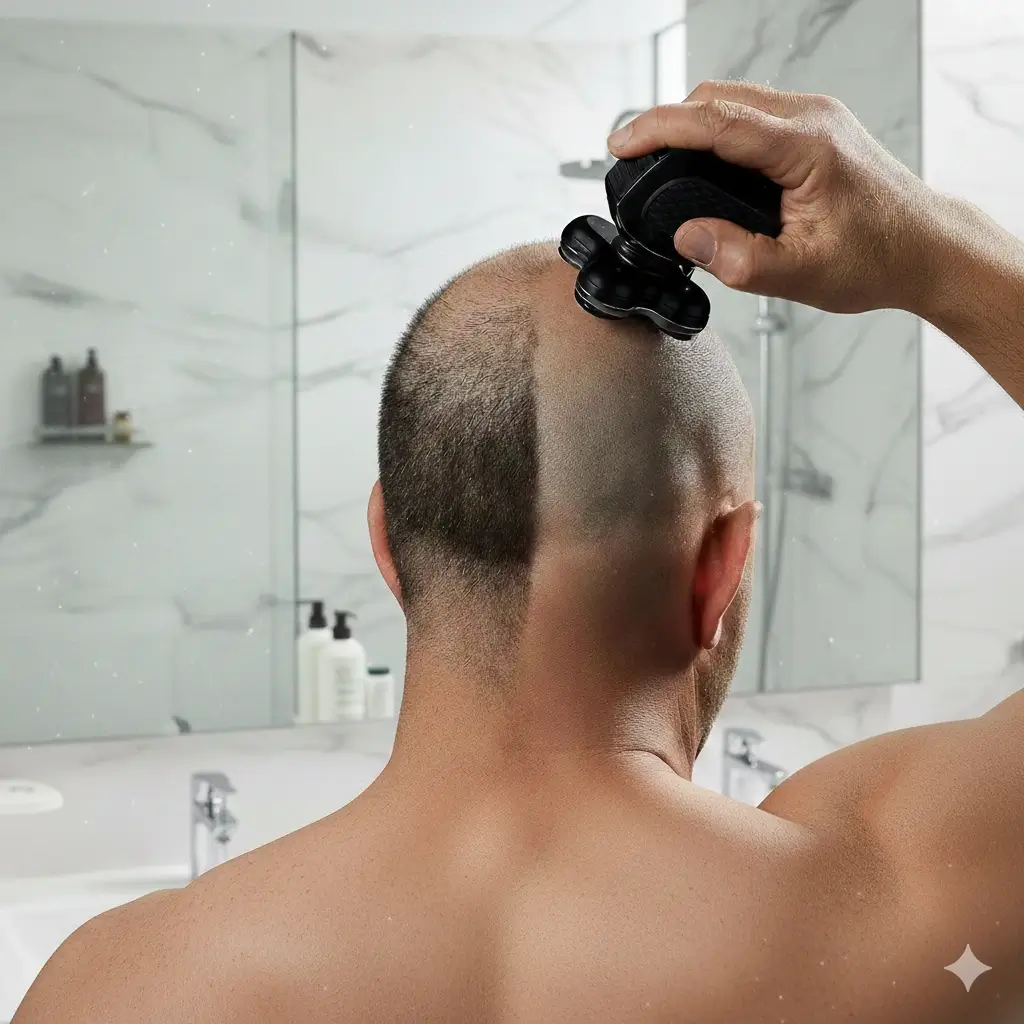
The egg-shaped handheld body is intentionally different from a conventional facial shaver. It allows the user to hold the machine in the palm and move it across the scalp without maintaining the same wrist orientation required by a long rectangular foil shaver.
The textured sides also reduce the need for a tight grip. This matters because head shaving requires many small directional movements across the entire scalp.
The palm-oriented form is particularly useful when reaching the back of the head, where visibility is limited and hand positioning becomes more important.
Ergonomics score: 9.5/10
Is the Remington Balder Pro Waterproof?
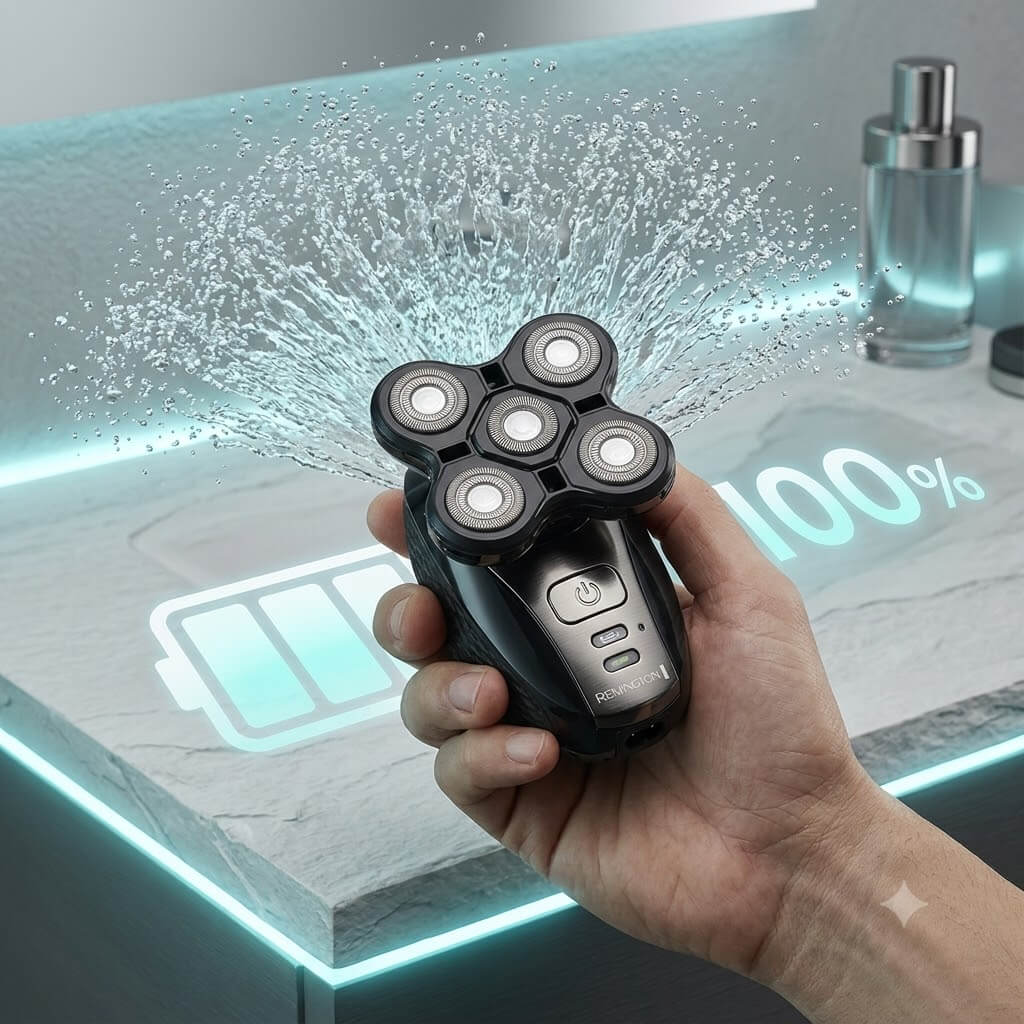
Yes. Remington specifies the Balder Pro as 100% waterproof and suitable for wet or dry use.
This is a meaningful advantage for scalp shaving because some users prefer to shave after showering, while others prefer dry shaving for speed and visibility.
Waterproof construction also simplifies cleaning. The cutting assembly can be rinsed as part of the regular maintenance routine.
Waterproof construction does not mean the shaver is maintenance-free. Hair, skin oils and debris still need to be removed from the cutters and collection area.
Cleaning the Remington Balder Pro
Cleaning is one of the Balder Pro’s practical strengths because the shaver incorporates a hair-collection chamber beneath the cutting heads.
Instead of allowing every clipped hair to fall directly onto the sink or floor, the chamber captures much of the removed hair during use.
For peak performance, Remington recommends thoroughly washing the cutters and hair pocket after use.
That recommendation matters more for scalp shaving than many users might expect. A full scalp session can produce considerably more short hair than a quick facial shave.
Cleaning score: 9.5/10
Does the Balder Pro Collect Hair?
Yes. The Balder Pro includes a collection chamber below the cutting heads designed to capture trimmed hair during shaving.
This is more useful than it might initially appear. Head shaving produces a relatively large amount of short hair, and collecting it inside the device can reduce cleanup around the sink.
The chamber still needs to be emptied and cleaned regularly. Hair collection reduces mess; it does not eliminate maintenance.
Remington Balder Pro Battery Life
Remington rates the Balder Pro for up to 50 minutes of cordless runtime.
For a dedicated head shaver, that is a useful amount of operating time because an individual scalp-shaving session can be relatively short when the device is used frequently.
The more important limitation is not the rated runtime but the charging behavior. Because the Balder Pro is cordless only, a depleted battery cannot be treated like a conventional corded shaver.
The most practical ownership habit is therefore simple: recharge the shaver after use rather than waiting until the battery is nearly empty.
Battery runtime score: 9.0/10
How Long Does the Balder Pro Take to Charge?
Charging is one of the weaker areas of the Balder Pro.
Published third-party testing has reported a full-charge time in the roughly three-and-a-half-to-four-hour range, depending on the test procedure and charging conditions.
The important ownership point is not the difference between individual measurements. It is the relationship between charging time and the approximately 50-minute rated operating time.
The Balder Pro therefore rewards users who keep it charged between sessions. It is less convenient for someone who routinely discovers an empty battery immediately before shaving.
Charging score: 7.8/10
Can You Use the Balder Pro While Plugged In?
No. The Balder Pro is designed for cordless operation.
That makes battery planning more important than it would be with a cord-and-cordless model. Keeping the shaver charged after each session is the easiest way to avoid interruptions.
Balder Pro Pop-Up Trimmer
The Balder Pro includes a built-in pop-up trimmer for detail work around areas such as the sideburns and hairline.
It is useful because the large rotary cutting surface is optimized for scalp coverage rather than precise edge work.
The trimmer should not be considered a replacement for a dedicated hair clipper. Its role is finishing and detailing, not bulk hair removal.
Can You Use the Remington Balder Pro on Your Face?
The Balder Pro is designed primarily as a head shaver, and that distinction matters.
Its large five-head geometry is optimized for the broad surface of the scalp. A conventional facial shaver is generally easier to control around the nose, upper lip, chin and other smaller facial areas.
For that reason, the Balder Pro should be evaluated primarily as a scalp-shaving tool rather than as a replacement for a dedicated facial electric shaver.
Scalp shaving. If your main goal is facial shaving, a purpose-built facial foil or rotary shaver is the more appropriate category.
Remington Balder Pro Replacement Head
The Balder Pro uses a replaceable cutting assembly. Independent product documentation identifies the replacement assembly as SPR-XR7000, with RP00656 referenced as the associated part number.
Replacement availability matters because rotary cutters are wear components. As the cutting surfaces age, the shaver can require more passes and may deliver a less consistent finish.
Before replacing the head, clean the cutting system thoroughly and follow the manufacturer’s maintenance instructions. Hair buildup and inadequate maintenance can create symptoms that resemble cutter wear.
When purchasing a replacement, match the part number and model compatibility carefully rather than assuming every Remington rotary head is interchangeable.
Balder Pro Maintenance Routine
The Balder Pro is relatively simple to maintain if cleaning becomes part of every shaving session.
- Switch the shaver off after finishing.
- Open or remove the appropriate cutting assembly according to the manual.
- Clear loose hair from the shaving area and collection chamber.
- Wash the cutters and hair pocket thoroughly.
- Allow components to dry appropriately.
- Lubricate the cutting system only as specified by the manufacturer’s maintenance instructions.
- Inspect the cutters periodically for wear or damage.
Regular cleaning is particularly important for head shaving because the device processes a larger volume of hair than it typically would during a short facial shave.
How Often Should You Use the Balder Pro?
The Balder Pro is most effective when the scalp is maintained regularly.
Short daily or every-few-days growth gives the rotary cutters an easier target than substantially longer hair. When the scalp has been allowed to grow for a longer period, the cutting system has to capture and process more hair before achieving a smooth finish.
For users who want the most efficient routine, the Balder Pro makes more sense as a maintenance shaver than as an occasional replacement for a clipper.
Balder Pro Wet vs. Dry Shaving
| Factor | Dry Shaving | Wet Shaving |
|---|---|---|
| Speed | Advantage | Usually slower |
| Cleanup | Simple with hair chamber | Requires rinsing |
| Visibility | Advantage | Can be harder in the shower |
| Skin feel | Depends on skin and technique | Some users prefer foam |
| Water compatibility | Yes | Yes |
There is no universally superior method. The Balder Pro’s waterproof construction gives users the option to choose the routine that works best for their scalp and schedule.
Balder Pro Long-Term Ownership
A head shaver should not be evaluated only on the first few shaving sessions. The cutting assembly, battery, cleaning routine and charging behavior all affect the ownership experience over time.
Cutting-head wear
The rotary cutters are wear components. As they age, the device may require additional passes to achieve the same finish. Regular cleaning can help prevent premature performance loss caused by debris and residue.
Battery management
The 50-minute rated runtime is adequate for routine scalp maintenance, but the cordless-only design makes charging habits important. Keeping the unit charged after use is more practical than relying on emergency charging.
Cleaning workload
The waterproof construction and hair chamber make routine cleaning straightforward. This is a meaningful ownership advantage because scalp shaving generates a relatively large amount of cut hair.
Replacement parts
The replaceable cutting assembly gives the product a clearer maintenance path than a completely sealed disposable design. Replacement-part availability should still be checked before committing to long-term ownership.
Remington Balder Pro vs. Skull Shaver Pitbull
The Skull Shaver Pitbull is one of the most obvious category competitors because both product families use palm-oriented rotary designs specifically for head shaving.
| Priority | Remington Balder Pro | Skull Shaver Pitbull |
|---|---|---|
| Scalp coverage | Excellent | Excellent |
| Contour tracking | Excellent | Excellent |
| Grip style | Palm-oriented body | Finger-oriented designs vary by model |
| Built-in trimmer | Yes | Model dependent |
| Hair collection | Yes | Model dependent |
| Battery information | Basic indicators | Model dependent |
| Charging | Relatively slow | Model dependent |
The better choice depends on the user’s priorities. The Balder Pro is particularly compelling for buyers who prefer its palm-shaped body, five-head layout, integrated trimmer and hair-collection design.
Because Pitbull specifications vary by generation, a direct model-to-model comparison should always use the exact Pitbull model being considered.
Remington Balder Pro vs. Foil Head Shaver
A rotary head shaver and a foil head shaver solve the scalp-shaving problem differently.
The Balder Pro’s advantage is coverage and contouring. Five circular cutting heads can adapt to the scalp while covering a broad surface.
A foil shaver uses a long straight cutting surface. That geometry can be useful for users who prefer controlled linear strokes and a familiar foil-shaving technique.
For someone shaving the entire scalp frequently, the Balder Pro’s rotary geometry is easy to maneuver over the curved head. For someone already comfortable with a professional foil shaver, a foil system may still provide a familiar alternative.
Remington Balder Pro Pros and Cons
Pros
- Five dual-track rotary heads
- Excellent scalp coverage
- Strong contour tracking
- Comfortable palm-oriented design
- Easy to maneuver around the scalp
- Very good close-shave performance
- Fast for frequent scalp maintenance
- 100% waterproof construction
- Hair-collection chamber
- Pop-up detail trimmer
- Worldwide voltage
- Five-year limited warranty listed by Remington
Cons
- Slow full charging
- Cordless operation only
- Basic battery indicators
- Large cutting head is less suitable for small facial areas
- Best performance requires relatively short growth
- Replacement cutting assembly is a recurring ownership consideration
- Not a substitute for a clipper when hair is substantially long
Who Should Buy the Remington Balder Pro?
The Balder Pro is a strong fit for users whose primary grooming task is maintaining a closely shaved scalp.
- People who shave their scalp frequently
- Users who want a dedicated head shaver
- Buyers who prefer rotary shaving
- Users who want wet/dry flexibility
- People who value broad scalp coverage
- Users who find conventional shavers awkward around the back of the head
- Buyers who want an integrated detail trimmer
- Users who value a hair-collection chamber
Who Should Skip the Balder Pro?
- Users who mainly need a facial electric shaver
- People who want corded operation as a backup
- Users who routinely allow scalp hair to grow substantially before shaving
- Buyers who prioritize very fast charging
- Users who want a highly detailed battery-percentage display
- People who strongly prefer a traditional foil shaving technique
How to Get a Better Scalp Shave With the Balder Pro
1. Keep the growth reasonably short
The Balder Pro performs most efficiently when used as a maintenance shaver rather than a once-a-week replacement for a clipper.
2. Use small overlapping movements
Controlled overlapping movements help the rotary cutters encounter hair growing in different directions without requiring excessive pressure.
3. Change direction around the crown
Hair direction changes across the scalp. A single pass in one direction can leave areas that require another angle.
4. Use light pressure
The flexible cutting assembly is designed to maintain contact without requiring heavy pressure. Excessive force increases skin contact without guaranteeing a closer result.
5. Clean after every session
Regular cleaning keeps hair and residue from interfering with the cutting assembly and collection chamber.
Is the Remington Balder Pro Worth It in 2026?
Yes, for the right type of user.
The Balder Pro succeeds because it is designed around the geometry of scalp shaving. Five dual-track heads provide broad coverage, while the multidirectional Pivot, Flex and Contour system helps keep the cutters engaged as the head curves from the crown to the sides and back.
Its waterproof construction, hair-collection chamber and integrated trimmer add useful everyday functionality. The 50-minute rated runtime is sufficient for routine scalp maintenance, although the slow charging system prevents the power section from receiving a higher score.
The other important condition is frequency of use. If the scalp is maintained regularly, the Balder Pro has a much easier job. If substantial hair length accumulates, a clipper becomes a useful first-stage tool.
The Balder Pro is most compelling for a buyer who wants a dedicated, easy-to-maneuver rotary head shaver rather than a general-purpose facial electric shaver.
Remington Balder Pro Final Score
| Category | Score |
|---|---|
| Scalp shaving | 9.7/10 |
| Closeness | 9.5/10 |
| Longer growth | 9.1/10 |
| Comfort | 9.3/10 |
| Contour tracking | 9.8/10 |
| Speed | 9.5/10 |
| Ergonomics | 9.5/10 |
| Battery | 9.0/10 |
| Charging | 7.8/10 |
| Cleaning | 9.5/10 |
| Versatility | 8.8/10 |
| Long-term practicality | 9.4/10 |
| Overall | 9.6/10 |
Final Verdict
The Remington Balder Pro XR7000 is a highly capable dedicated head shaver because its hardware is built around the geometry of the scalp rather than adapted from a conventional facial razor.
The five dual-track rotary heads provide broad cutting coverage, while the multidirectional Pivot, Flex and Contour system helps keep the cutters engaged as the head curves from the crown to the sides and back.
Its waterproof design, hair-collection chamber and pop-up trimmer add useful everyday functionality. The 50-minute rated runtime is sufficient for routine scalp maintenance, although the slow charging system prevents the power section from receiving a higher score.
The Balder Pro is not a universal grooming device. Its large rotary head is optimized for the scalp, and users who allow substantial hair growth should consider trimming the hair shorter before using the shaver.
A strong dedicated scalp shaver for frequent head maintenance, with excellent contour tracking, broad coverage, very good closeness and useful wet/dry flexibility. Its biggest weakness is slow charging.
Remington Balder Pro FAQ
Is the Remington Balder Pro a good head shaver?
Yes. Its five dual-track rotary heads, flexible contouring system, palm-oriented body and strong scalp coverage make it particularly well suited to frequent head shaving.
How close does the Remington Balder Pro shave?
It produces a very close result for a rotary electric head shaver when used with controlled overlapping movements and appropriate technique.
Is the Remington Balder Pro waterproof?
Yes. Remington specifies 100% waterproof construction and wet/dry use.
Can you use the Balder Pro in the shower?
Yes. The waterproof design allows wet use, including shaving with foam or in the shower.
How long does the Balder Pro battery last?
Remington rates the rechargeable system for up to 50 minutes of runtime.
Does the Balder Pro work while charging?
No. The Balder Pro is designed for cordless operation, so it should be charged before use rather than treated as a corded backup shaver.
Does the Balder Pro collect hair?
Yes. A collection chamber below the cutting heads is designed to capture trimmed hair during shaving.
How often should you clean the Balder Pro?
The cutters and hair-collection area should be cleaned regularly, with thorough washing recommended as part of the normal maintenance routine.
Can the Balder Pro shave several days of scalp growth?
Yes. It can handle several days of growth, although efficiency decreases as hair becomes longer and denser.
Can the Balder Pro replace a hair clipper?
No. It is primarily a finishing and maintenance shaver. A clipper is more appropriate for removing substantial hair length before a close electric shave.
Does the Balder Pro work on facial hair?
The product is designed specifically around head shaving. Its large five-head geometry is less practical for detailed facial areas, so a dedicated facial shaver is generally the better tool.
What replacement head does the Balder Pro use?
Independent product documentation identifies the replacement cutting assembly as SPR-XR7000, with RP00656 referenced as the associated part number.
Is the Balder Pro good for sensitive scalps?
Its flexible cutting assembly can provide a comfortable shave, but individual skin response varies. Light pressure, appropriate technique and regular cleaning are important.
Editorial Methodology
This review separates manufacturer specifications from editorial performance assessment. Product architecture, waterproofing, rated runtime, cutting-head configuration, trimmer availability and warranty are treated as published product specifications.
Third-party testing and published product observations can be used to cross-check real-world characteristics such as closeness, contour tracking, ergonomics, comfort, charging and longer-stubble handling.
No unsupported laboratory measurements are presented as proprietary MenReviewHub measurements in this article.
The final 9.6/10 score evaluates the Balder Pro specifically as a dedicated electric head shaver. It should not be interpreted as a universal ranking against every facial shaver, foil shaver or professional clipper.
Sources & Verification
Product specifications should be verified against the current U.S. Remington documentation before publication, particularly runtime, waterproofing, warranty, replacement-part compatibility and model designation.
Third-party testing can be used as supporting evidence for real-world observations involving closeness, contour tracking, ergonomics, comfort, cleaning, charging and longer-stubble handling.
MenReviewHub’s editorial score is independent of manufacturer claims and should not be interpreted as a manufacturer rating or aggregate customer rating.