
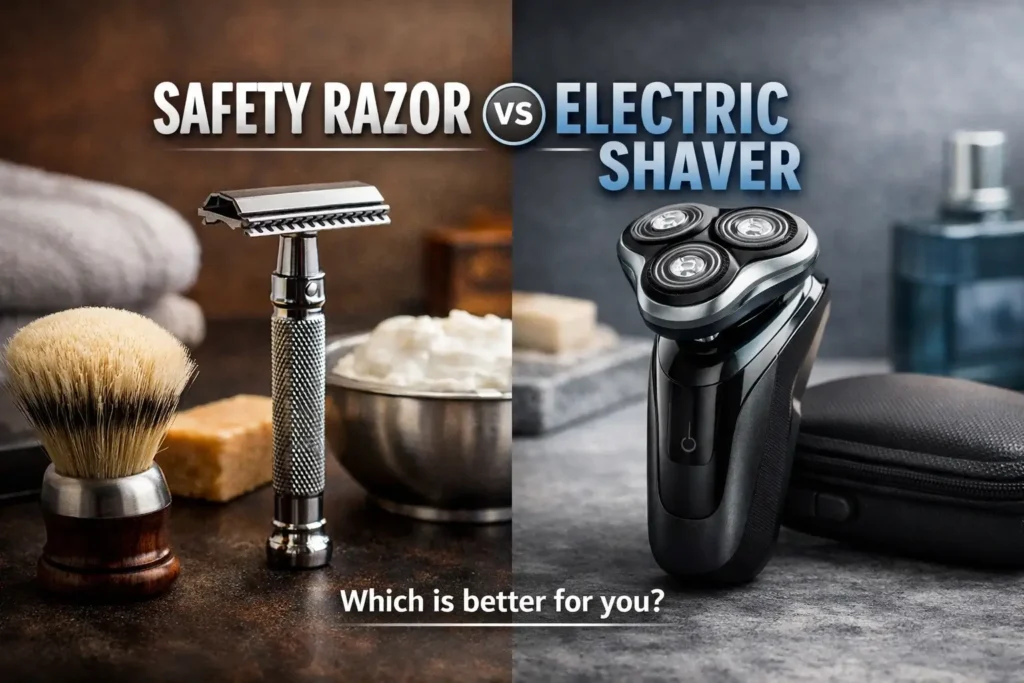
Comprehensive Grooming Guide (2026 Edition)
Safety Razor vs Electric Shaver: Finding the Best Razors for Men
In our ultimate safety razor vs electric shaver matchup, we bench-tested both shaving systems for 30 days across different facial hair densities, skin sensitivities, and morning routines to help you choose among the best razors for men today.
⚡ Safety Razor vs Electric Shaver: Quick Winner Summary
Ditch the overpriced 5-blade plastic cartridges. Here is your fast decision matrix when shopping for modern grooming gear:
The Smoothness Champ
Double-Edge Safety Razor
The clear winner for an unbeatable barbershop-smooth shave that eliminates painful neck ingrown hairs and provides maximum long-term value.
- Closeness: 10 / 10
- Shave Time: 10 – 15 Mins
- Long-Term Value: Outstanding Savings
The Speed Demon
Electric Foil Shaver
Takes the crown for busy 2-minute morning routines, zero nicking risks, and acne-prone skin that reacts poorly to direct blades.
- Closeness: 8.5 / 10
- Shave Time: 2 – 3 Mins
- Long-Term Value: Premium Investment
1. Mechanics 101: Why Traditional Multi-Blade Cartridges Fail
If you suffer from red, itchy bumps across your lower neck after every shave, your tool is likely to blame—not your skin. When searching for the best razors for men, understanding how blades interact with hair follicles is essential. For decades, cartridge razor brands claimed “more blades equals a smoother shave.” In reality, extra blades increase friction exponentially.
The “Hysteresis Effect” Trap in Cartridge Razors
Multi-blade cartridges operate on a mechanical trick called hysteresis (or “lift-and-cut”). The leading blade grabs the hair stem and pulls it upward out of the follicle before cutting it.
When the hair snaps back, it retreats below the skin line. As it grows back, curly or coarse hair frequently gets trapped beneath tissue, turning into painful Pseudofolliculitis Barbae (ingrown hairs). Single-blade and foil designs bypass this trap completely.
2. Safety Razor vs Electric Shaver: The Single-Blade Advantage
A Double-Edge (DE) Safety Razor features a solid weighted metal handle and a single surgical-grade blade. Instead of scraping 5 dull cartridges across your cheek, it relies on one precise slice at the skin surface.
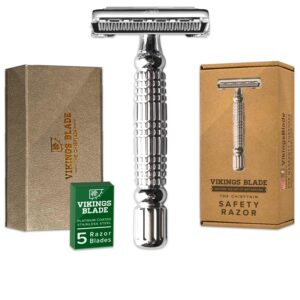
Safety Razor Styles for Men: Closed Comb vs. Open Comb
To pick the right tool for a classic wet shave, you need to understand blade guard styles:
- Closed Comb (Mild): Features a solid bar under the blade. Ideal for beginners, daily shaving, and sensitive skin. Very forgiving.
- Open Comb (Aggressive): Has teeth-like notches under the blade to channel thick 3-to-5 day beards straight to the edge.
- Adjustable Razors: Allows you to twist the handle to change blade gap settings—mild for your neck, aggressive for your chin.
✔️ Safety Razor Advantages:
- Barbershop Closeness: Delivers the cleanest, longest-lasting smoothness of any traditional shaver.
- Ends Razor Bumps: Single-pass slicing prevents hairs from curling under the pore wall.
- Exceptional Long-Term Value: Double-edge replacement blades are vastly more economical than cartridge refills.
- Zero Plastic Waste: 100% recyclable steel blades and solid brass/chrome handles.
- Beard Line Precision: Perfect visibility for lining up mustache edges, cheeklines, and goatees.
❌ Safety Razor Drawbacks:
- Learning Curve Required: Must hold the razor at a 30° angle without pressing down.
- Prep Required: Demands lathering with shaving soap/cream and warm water.
- Risk of Cuts: Moving sideways or rushing will result in minor nicks.
3. Safety Razor vs Electric Shaver: High-Tech Convenience
Electric shavers place a protective metal mesh barrier between your face and high-speed moving blades. For men who prioritize speed and convenience, electric shavers are unmatched.
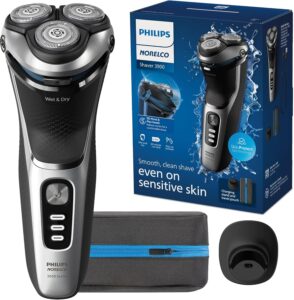
Foil Shavers vs. Rotary Shavers: Choosing the Best Electric Shaver
⚡ Foil Shavers (Recommended)
Uses straight-line oscillating blades under micro-thin metal screens. Best for fine to medium facial hair, sensitive neck skin, and daily straight-pass shaving.
🔄 Rotary Shavers
Features 3 spinning circular heads. Best for thick, wild, multi-directional hair growth and men with prominent facial contours/jawlines.
✔️ Electric Shaver Advantages:
- Lightning Fast: Complete a clean shave in 2–3 minutes with zero lather prep.
- Zero Nicks & Cuts: Steel foil shields keep cutting blades away from skin tissue.
- Blemish Friendly: Safely glides over active acne, skin tags, and moles.
- Dry & Wet Options: Shave dry at your computer desk or wet in the shower.
❌ Electric Shaver Drawbacks:
- Leaves Micro-Stubble: The metal foil guard thickness prevents cutting 100% flush.
- Higher Hardware Investment: Requires periodic replacement of foil and cutter head cartridges.
- Battery Dependent: Requires charging and regular lubricated cleaning.
4. Safety Razor vs Electric Shaver: Side-by-Side Comparison
To help you choose among the best razors for men, here is how both options compare directly across key performance metrics:
| Feature Comparison | Safety Razor | Electric Foil Shaver |
|---|---|---|
| Shave Closeness | 10 / 10 (Baby Smooth) | 8.5 / 10 (Slight shadow by evening) |
| Safety (Nicks/Cuts) | Requires focus & angle control | 10 / 10 (Foolproof guard) |
| Ingrown Hair Prevention | Barber-grade cure | Very Good (If not pushed hard) |
| Total Routine Time | 10 to 15 minutes | 2 to 4 minutes |
| Best Skin Match | Coarse Beards / Neck Bumps | Acne-Prone / Sensitive / Busy Men |
| Long-Term Value | Extremely High (Minimal Blade Cost) | Moderate (Periodic Foil Head Replacements) |
| Environmental Impact | Zero Plastic / 100% Recyclable | E-Waste (Li-ion battery + plastic) |
5. How to Get the Best Results with Either Tool
Whichever route you choose, adapting your technique is key to unlocking the full potential of the best razors for men:
🪒 Safety Razor Routine
- Softened Hydration: Wash face with warm water or shave post-shower to open pores and soften hairs.
- Build Real Lather: Use a shaving brush and cream instead of canned aerosol foam.
- Master the 30° Angle: Hold the handle at ~30 degrees relative to your skin. Lock your wrist.
- Zero Pressure: Let the heavy metal head cut under its own weight. Do NOT push down.
- With-the-Grain Pass: Map hair growth directions. Always shave with the grain first.
⚡ Electric Shaver Routine
- Shave Bone Dry: Facial hair should be completely dry and stiff for best foil entry during dry shaving.
- Use Pre-Shave Lotion: Pre-shave lotions lift stubble and absorb residual skin moisture.
- Stretch Your Skin: Use your free hand to pull skin taut, forcing stubble upright.
- 90-Degree Angle: Hold the foil head perpendicular (90°) to your cheek or neck.
- Clean Post-Shave: Tap out hair dust immediately and rinse under warm water.
6. Safety Razor vs Electric Shaver: Maintenance & Longevity
Understanding the care requirements and component lifespan helps ensure optimal performance over time:
| Maintenance Factor | Safety Razor Setup | Electric Foil Shaver Setup |
|---|---|---|
| Hardware Durability | Lifetime (Solid Brass or Stainless Steel Handle) | Multi-Year (Rechargeable Lithium-Ion Battery) |
| Blade / Foil Replacement Cycle | Every 3 to 7 shaves (Inexpensive double-edge blades) | Every 12 to 18 months (Outer foil & cutter cassette) |
| Daily Care Routine | Rinse head under hot water & air dry | Tap hair chamber, rinse, or use automatic cleaning station |
| Long-Term Maintenance Effort | Very Low (Simple & Mechanical) | Moderate (Electronic Cleaning & Charging) |
7. Safety Razor vs Electric Shaver FAQ
Q1: Which shaving system is better for sensitive skin?
Both are vastly superior to multi-blade cartridges. A safety razor uses a single double-edge blade to slice hair flush without pulling, stopping ingrown hairs and neck razor bumps. An electric foil shaver uses a micro-thin screen guard that prevents cutting blades from touching skin tissue directly, making it ideal for active acne breakouts or easily nicked skin.
Q2: Which option is more economical long-term?
The safety razor is vastly more economical over time. While both require an initial investment, replacement double-edge blades are significantly less expensive than electric shaver foil and cutter head replacements.
Q3: Can an electric shaver shave as close as a safety razor?
Technically, no. Electric shavers leave a microscopic fraction of hair behind because the thin metal foil guard sits between the moving blade and your skin. A safety razor cuts completely flush at the skin line, delivering an authentic ‘barbershop smooth’ finish that lasts 24 hours.
Q4: How long does it take to learn how to use a safety razor?
Most men master the basics within 5 to 7 shaves. The key rules are locking your wrist to maintain a 30-degree blade angle, applying zero downward pressure, and letting the heavy metal handle do the cutting work.
Safety Razor vs Electric Shaver: The Final Verdict
By stepping away from plastic 5-blade cartridges and exploring the best razors for men, you are taking a huge step toward healthier skin and a better morning routine.
Choose the Safety Razor if you want barbershop-close smoothness, suffer from ingrown hairs, and value exceptional long-term savings. Choose an Electric Shaver if you need a fast, foolproof 2-minute shave before work that guarantees zero cuts.