
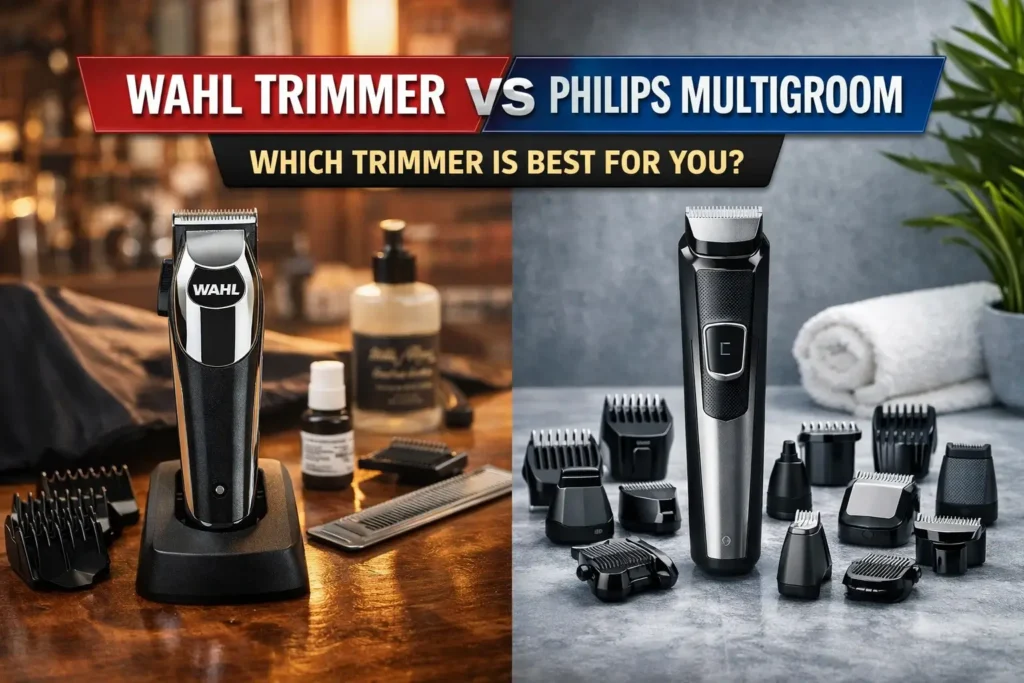
⚡ Quick Verdict: Which One Should You Buy?
Choose Wahl Trimmer If:
You have dense, coarse beard hair, prefer crisp barber-style line-ups, want fine-taper control, and don’t mind oiling the blades.
Choose Philips Multigroom If:
You want an all-in-one face, head, and body grooming kit, 100% waterproof operation, zero maintenance, and endless battery life.
1. Power and Performance: Raw Torque vs. Smooth Speed
Thick, coarse hair requires a machine that keeps moving without hesitation. If a trimmer struggles or bogs down mid-stroke, it yanks the hair out instead of cutting it cleanly—and your neck will let you know about it immediately. Understanding how Wahl and Philips drive their blades tells you a lot about how they handle heavy growth.
The Wahl Experience: Constant, Heavy-Duty Power
Wahl’s reputation is rooted in pure cutting force. Their classic corded tools rely on strong electromagnetic motors, while their cordless models use robust, high-torque rotary motors. Instead of just chasing fast RPM speeds, Wahl gears their machines to prioritize pushing power. When the blades meet dense, coarse patches of hair, they don’t slow down—they sweep right through with stable, reliable consistency. It feels solid, substantial, and incredibly dependable for taking down bulk growth without a single snag.
The Philips Experience: High-Speed, Quiet Agility
The Philips Multigroom approaches performance from a place of efficiency. It features a lightweight, high-speed rotary motor that is exceptionally quiet and produces very little hand vibration. Rather than relying on brute force, Philips pairs its quick blade speed with optimized cutting geometry. It glides through normal-to-medium beards and body hair effortlessly, making the entire grooming experience feel smooth, comfortable, and controlled. It’s built for comfortable endurance and easy maneuvering.
2. Blades and Upkeep: Sharp Precision vs. Zero Hassle
How the blades are made tells you exactly how close your trim will look, how long the edge will stay sharp, and how much time you’ll spend cleaning up afterward. This is where the two brands show different philosophies.
Wahl: High-Carbon Steel Edge
Wahl relies on precision-ground, high-carbon steel blades. Carbon steel allows the metal to be sharpened to an incredibly fine, razor-sharp edge. For guys who want crisp, distinct lines around the beard or like to adjust their blades to be “zero-gapped” for an ultra-close finish, Wahl offers a level of barbershop precision that is hard to beat.
The Trade-off: High-carbon steel loves a bit of attention. To keep the blades smooth and entirely rust-free, you will need to add a few drops of clipper oil every few uses.
Philips: Self-Sharpening Stainless
The Multigroom features robust stainless steel blades. Thanks to the chromium in the metal, these blades are completely immune to rust, making the entire tool water-friendly and easy to rinse under the tap. Even better, the blades gently brush against each other while running, meaning they continuously self-sharpen over time.
The Trade-off: Because the safety guards keep a slight protective gap and the blades are designed for general use, it won’t give you that skin-tight, razor-sharp alignment that a zero-gapped Wahl can deliver.
3. Wahl Trimmer: Classic Power and Control
Wahl’s prosumer and professional lines are built for guys who enjoy the craft of grooming. They are solid, satisfyingly heavy, and focused on absolute cutting control.
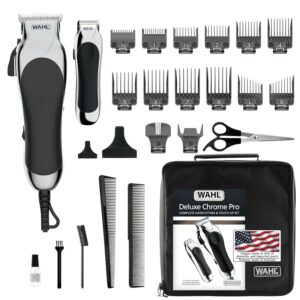
The Adjustable Taper Advantage
Many premium Wahl models feature a built-in side taper lever. This clever mechanical lever lets you micro-adjust your cutting length smoothly on the fly without having to swap plastic guards constantly. It’s exactly what you need to blend a clean, natural fade into your beard or sideburns without leaving harsh, uneven steps in your hair.
⚡ Performance Blueprint:
Torque: Maximum | Blade Type: Precision Carbon Steel | Upkeep: Requires Regular Oiling
- What Wins: Tremendous torque glides through thick hair easily; zero-gap capability for skin-close definition; durable, sturdy chassis built to last.
- What to Note: Noticeably heavier in the hand; blades must stay oiled to remain in top shape; usually not waterproof.
- Best Fit: Guys who love crisp detail work, clean beard lines, and don’t mind a simple maintenance routine.
4. Philips Multigroom: Modern, All-in-One Versatility
The Philips Multigroom series is designed for the modern pragmatist. It leaves behind hyper-specialization to give you a single, incredibly flexible tool that easily manages everything from your face to your body.
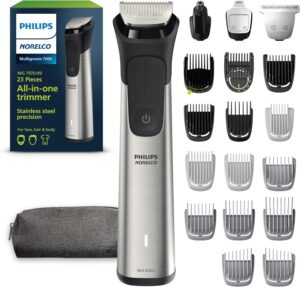
Seamless Efficiency and Full-Body Utility
The standout feature of the Multigroom is its premium Lithium-Ion battery, which keeps running for hours on a single charge—making it ideal for travel. The modular attachments are incredibly easy to swap out: you can move from a clean T-blade for your beard to a safe body-grooming guard, a nose hair trimmer, or a detail attachment. Since the body is fully waterproof, you can clean it under the sink or comfortably trim your chest or torso in the shower without any cleanup hassle.
⚡ Performance Blueprint:
Battery Life: Exceptional Endurance | Blade Type: Maintenance-Free Stainless | Upkeep: Zero (100% Washable)
- What Wins: Fantastic full-body versatility; zero blade oil or complex maintenance required; outstanding battery life; completely showerproof.
- What to Note: Fixed attachments mean no micro-adjusting lever; storing all the individual guards takes up some space.
- Best Fit: The guy who wants one dependable, worry-free tool to handle all his head-to-toe grooming needs quickly and easily.
5. The Side-by-Side Comparison Matrix
Let’s look at how these two different approaches compare when put to work in a real-world setting.
| Grooming Focus | Wahl Trimmers | Philips Multigroom |
|---|---|---|
| Thick Growth & Power | Excellent. High-torque motor sweeps through dense bulk effortlessly. | Very Good. Fast, smooth cut, but prefers a slower pass on heavy growth. |
| Beard Lines & Edges | Barbershop Quality. Zero-gap capability gives a crisp, skin-tight finish. | Clean & Natural. Great for daily neatness with built-in skin safety. |
| Battery and Mobility | Standard. Reliable cordless runtimes geared entirely toward constant torque. | Outstanding. Premium lithium battery holds a charge for weeks. |
| Below-the-Neck Grooming | Not Recommended. Sharp, open blades are designed only for face and head. | Superb. Specialized body guards protect sensitive skin fully. |
| The Practical Verdict | Built for Barber Precision and Raw Power | Built for Full-Body Versatility and Zero Upkeep |
6. Looking at the Long-Term Value
Investing in a good trimmer means thinking about how it fits into your budget over the next few years. Both options offer great value, but in completely different ways.
- The Wahl Way (Modular and Long-Lasting): A professional Wahl machine is built like a tank. It costs a bit more upfront, but it is completely modular. If your blades happen to dull after years of heavy use, you don’t throw away the tool—you simply unscrew them and pop on a fresh blade set for a low cost. It’s a classic, sustainable approach to hardware that can last a lifetime with proper care.
- The Philips Way (All-In-One Value): The Multigroom gives you an incredible amount of value from day one. It is highly affordable, comes with every guard you could ever need, and requires zero maintenance costs—no oil to purchase or blade replacements to worry about. It’s a sealed unit designed to run beautifully for years without making you think about upkeep.
7. Questions Guys Frequently Ask
1. Can I use a professional Wahl trimmer for body grooming?
It’s usually best to avoid it. Professional Wahl blades have sharp, close-cutting teeth designed specifically for thick facial and head hair. Using them on highly sensitive body skin carries a higher risk of nicks. For anything below the neck, the dedicated bodyguards on a Philips are a much safer bet.
2. What exactly is “Zero-Gapping” and can Philips do it?
Zero-gapping is a quick manual adjustment where you align the moving blade perfectly level with the stationary guard blade to get a skin-close cut. The Philips Multigroom blades are set at the factory with a built-in safety margin to protect your skin, so they cannot be adjusted or zero-gapped manually.
3. Do the self-sharpening blades on the Philips really work?
Yes, they do. They are engineered to touch lightly against each other during operation, maintaining a reliable cutting edge through daily use. They stay sharp for the entire operational life of the device without requiring you to use any blade oil.
4. Are Wahl trimmers fine to use in the shower?
Most traditional and professional Wahl trimmers are not waterproof. Water can harm the inner components and cause high-carbon steel blades to rust if they aren’t dried immediately. If you prefer to handle your grooming routine in the shower, the waterproof Philips Multigroom is the perfect match.
5. Which trimmer is easier for blending a clean fade?
Wahl takes the win here. The adjustable taper lever gives you seamless control over your cutting lengths between guards, making it easy to create smooth, natural transitions. Fixed clip-on guards can sometimes leave distinct lines that take a bit more work to blend out.
The Final Verdict: Which One Fits Your Morning?
At the end of the day, choosing between a Wahl and a Philips comes down to what you value most in your daily routine.
If you want that robust barbershop power to handle a heavy beard, enjoy sharp precision line-ups, and like the fine control of a taper lever, investing in a Wahl Trimmer will give you a satisfyingly precise tool that lasts for years.