
Table of Contents
ToggleVikings Blade Chieftain Safety Razor Review: Is It Worth It?
We’ve all been there: standing in front of the bathroom mirror early in the morning, splashing warm water on your face, dragging an expensive plastic cartridge razor across your skin. Within minutes, you feel that familiar, sharp tugging sensation. An hour later, your neck breaks out in a painful, inflamed landscape of razor bumps, irritation, and ingrown hairs. It is an expensive, frustrating routine that modern grooming marketing has tricked us into believing is just the price of a clean shave.
To be completely transparent, shaving should never feel like a daily battle against your own skin. Big-brand razor companies have spent decades convincing men that stacking five or six cheap blades onto a plastic strip is the ultimate shaving technology. In reality, dragging multiple tightly spaced blades across your face simultaneously strips away your skin’s essential lipid barrier while pulling facial hair beneath the surface. This exact realization is what drives millions of men toward traditional wet shaving in search of substantial, long-lasting tools.
Switching to a weighted single-edge safety razor turns a rushed, annoying chore into a deliberate, satisfying morning ritual. If you are currently researching options in our comprehensive guide to the best razors for men, you have undoubtedly stumbled upon Vikings Blade. In this hands-on Vikings Blade Chieftain Safety Razor review, we put its 95g solid brass chassis, butterfly opening mechanism, blade gap tolerances, and cutting geometry through weeks of real-world testing to help you decide if it deserves a permanent spot on your bathroom counter.
The Physics of a Single-Blade Shave vs. Multi-Blade Cartridges
To appreciate why a heavy-duty metal razor drastically improves skin condition, you must examine the basic physics of hair cutting geometry. Mass-market cartridge razors rely on a mechanical sequence known as hysteresis. The leading blade hooks into the hair follicle and stretches the shaft upward out of the skin. The subsequent blades cut the stretched hair, and the trailing blade scrapes raw epidermal skin. As the remaining hair snaps back, it retracts below the surface opening, where it easily gets trapped to form painful ingrown bumps.
🔬 Shaving Mechanical Dynamics Comparison:
A heavy-duty safety razor operates on a fundamentally different mechanical principle. Supported by a solid metal head, a single double-edge blade slices whiskers cleanly right at skin level without pulling. Because there are no secondary blades dragging behind to scratch live skin cells, razor burn drops dramatically. Furthermore, the substantial weight of a solid handle removes the need to press down hard—gravity supplies all the required cutting force, allowing you to simply guide the edge at a natural 30-degree angle.
2026 Head-to-Head Comparison: Premium Safety Razors
How does the Chieftain line up against top contenders featured in our roundups of the best razors for men? Here is a breakdown of specs, weights, and user profiles:
| Razor Model | Mechanism | Weight | Aggressiveness | Ideal User Profile |
|---|---|---|---|---|
| Vikings Blade Chieftain (“Odin”) | Twist-to-Open Butterfly | 95g (Substantial) | 4.5 / 10 (Mild-Medium) | Beginners & Daily Shavers |
| Edwin Jagger DE89 | 3-Piece Traditional | 76g (Standard) | 4.0 / 10 (Mild Clean) | Men with Fine Beard Hair |
| Merkur 34C | 2-Piece Heavy Duty | 78g (Balanced) | 5.0 / 10 (Medium Drive) | Traditional Wet Shaving Purists |
| Vikings Blade The Emperor | Adjustable Butterfly | 115g (Ultra Heavy) | 2.0 to 9.0 (Variable Dial) | Shavers with Coarse, Heavy Growth |
In-Depth Hands-On Review: Vikings Blade Chieftain “Odin”

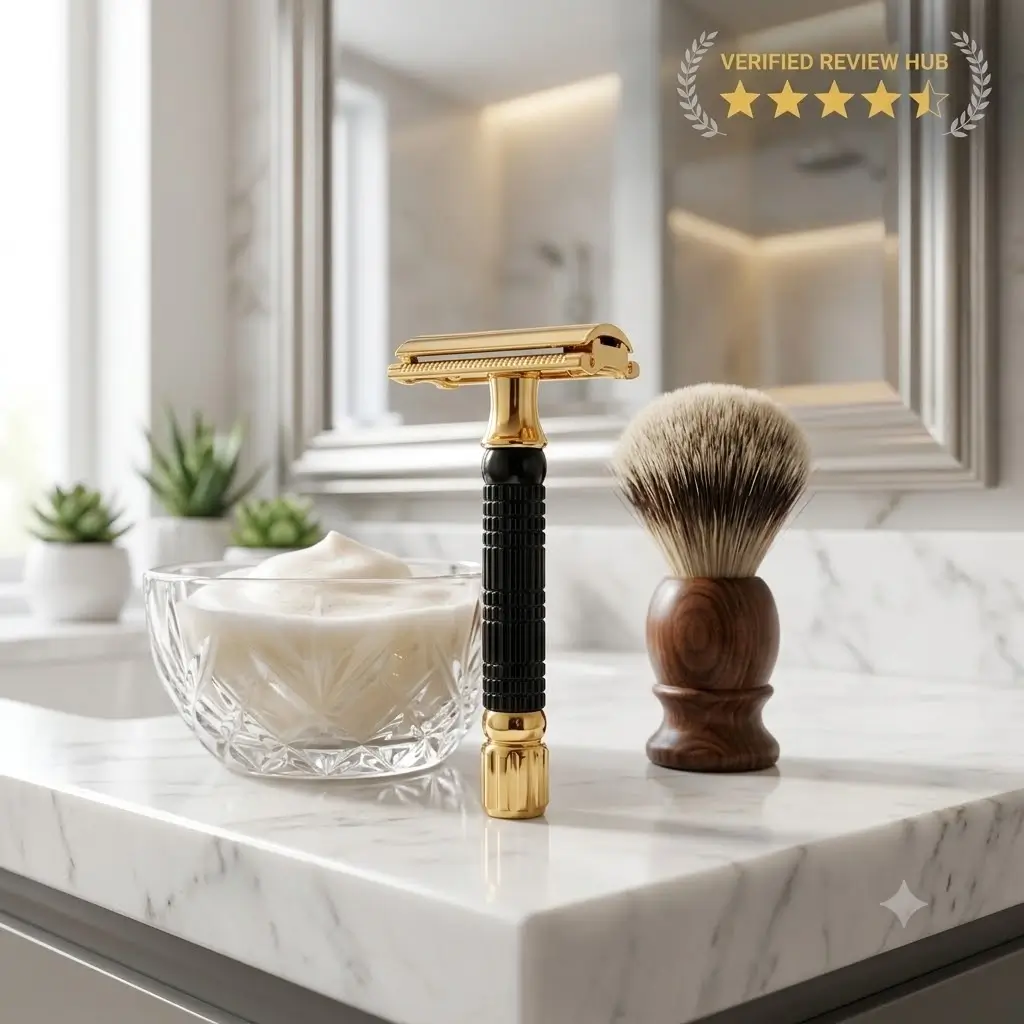
The Chieftain “Odin” arrives packaged in a faux-leather, felt-lined travel box featuring a built-in mirror and a hidden compartment beneath the tray that stores replacement double-edge blades. Right out of the box, the 95-gram mass feels reassuringly solid in hand—setting a high benchmark for construction density compared to lighter starter razors.
📱 Key Structural Architecture Breakdown:
Loading a blade into the Chieftain is incredibly simple. A quick twist of the knurled knob at the base smoothly opens the top butterfly doors like wings. You place a double-edge Swedish steel blade onto the center mounting posts, spin the dial shut, and the blade anchors completely flat. During three full weeks of field testing, this razor handled dense multi-day facial hair easily in just two basic passes (with the grain and across the grain). The blade gap is tuned conservatively toward the mild-to-medium side, making it exceptionally forgiving for beginners learning proper wet shaving technique.
Important Buying Boundary: Pay attention to this tool’s design intent. While the Chieftain is superb for facial grooming and neck lines, its rigid butterfly head geometry is NOT recommended for bald head shaving. Scalp shaving requires flexible, multi-pivoting cartridge systems that adapt safely to tight skull contours.
🟢 Verified Advantages
- Butterfly door design allows finger-safe blade changes in under 5 seconds.
- Substantial 95g total weight prevents you from applying dangerous downward pressure.
- Mirror-finish electroplated chrome reduces friction glide drag over shaving soap.
- Forgiving blade angle tolerance minimizes nicks, making it ideal for beginners.
🔴 Verified Drawbacks
- Slightly wider TTO head profile takes practice when trimming tightly under the nose.
- Shavers with thick, coarse hair maps may find the mild blade gap requires an extra pass for ultra-smooth results.
Technical Deep Dive: Materials and Construction Quality
Solid Brass Core vs. Cheap Zinc Pot Alloys (Zamak)
Cheap safety razors are usually manufactured from injection-molded zinc alloy (Zamak) because it is cheap to mass-produce. However, Zamak is notoriously brittle. If dropped onto bathroom tile, the threaded neck posts on a Zamak razor frequently snap off instantly. Once water seeps into microscopic cracks in the chrome finish, zinc cores rot and decay from the inside out. In contrast, the Vikings Blade Chieftain uses a solid anti-corrosive copper-brass alloy foundation. Even if the chrome coating gets scratched over years of use, the internal brass structure remains completely immune to rust and cracking.
Butterfly Open Dynamics and Blade Alignment
Inferior butterfly razors often exhibit blade chatter and uneven exposure, where one side of the guard bar reveals more cutting edge than the other. The internal linkage system inside the Chieftain handle employs dual internal tension rods. When you tighten the bottom dial, these gears press down evenly across the spine of the blade, securing the steel edge flat against the guard bar to eliminate dangerous blade vibration during strokes.
Maintenance & Longevity: Preventing Mechanical Sticking
While a solid brass safety razor can easily last decades, leaving dried soap scum, skin oils, and hard water minerals inside internal linkage tracks can cause the mechanism to feel stiff over time. Keep your gear operating smoothly with this simple post-shave routine:
⚙️ Post-Shave Gear Maintenance Steps:
Pro Gear Lubrication Tip: Because a butterfly razor drives a central threaded rod through the handle column, it benefits from periodic lubrication. Every few months, place a single drop of mineral oil or clipper oil down into the top open head cavity and onto the lower rotating threads. Twist the butterfly doors open and closed 5 times to distribute the oil evenly and keep internal gears operating smoothly.
Frequently Asked Questions
How often should you replace the double-edge safety razor blades?
For the average man shaving 3 to 4 times a week, one double-edge blade lasts between 5 to 7 full shaves before showing dullness. Swap the blade immediately at the first sign of pulling or tugging to keep your shave completely friction-free.
Are butterfly twist-to-open razors less durable over time than standard 3-piece razors?
While TTO razors feature moving joints, high-tensile brass internal linkage rods protect the gears from stripping out. With basic periodic cleaning, a brass butterfly razor will provide decades of reliable service.
Final Verdict: Who Is The Chieftain For?
Our extensive evaluation confirms that the Vikings Blade Chieftain serves as a benchmark entry-level safety razor. It successfully bridges traditional barbershop engineering with forgiving, user-friendly cutting geometry.
Beginners and daily shavers looking for a substantial, weighted brass safety razor handle that uses its own mass to eliminate razor burn and bypass overpriced cartridge refills forever. (OPTIMAL FIT)
Fast scalp/head shavers who need multi-pivoting flex heads designed to glides across skull contours without nicks. (MISMATCHED USE)