

We have all dealt with this nightmare: You are getting ready for a massive job interview or a Saturday morning event, and your cheap multi-blade plastic cartridge razor drags aggressively across your throat, leaving a bloody trail of razor bumps and painful ingrown hairs. Your neck looks like a warzone before you even tie your tie.
That is why guys across the country are dumping mass-market plastic junk, referencing our master roundup of the best razors for men, and searching specifically for the Best Safety Razors for Beginners. The raw engineering truth is that multi-blade cartridges rely on a flawed mechanical premise called the “hysteresis effect.” The first blade pulls the hair follicle outward, while the second, third, and fourth blades chop it below the surface. As the hair snaps back beneath skin level, it curls inward—triggering inflammation, pseudofolliculitis barbae (razor bumps), and agonizing ingrown hairs.
A traditional double-edge (DE) safety razor relies on pure blade geometry, heavy head balance, and clean shear physics. You do not press it into your skin; you simply let the weighted metal head glide naturally under gentle control. It is just a single, razor-sharp edge doing honest work without tearing your epidermal layer to pieces.
🏆 Quick Verdict: Best Safety Razors for Beginners at a Glance
- 🥇 Best Overall Daily Driver: Merkur 34C HD — Unbeatable brass balance, short-handle agility, and effortless angle learning curve.
- 🛡️ Best for Sensitive Skin & Zero Nicks: Henson AL13 — Precision aerospace aluminum engineered to eliminate blade chatter completely.
- ⚙️ Best Fully Adjustable System: Rockwell 6C — Features 6 interchangeable settings to handle everything from sensitive skin to 5-day beard growth.
- 🇩🇪 Best Gentle & Forgiving: Muhle R89 — Closed-comb German engineering ideal for fine facial hair and irritation-prone necklines.
- 🇬🇧 Best Precision Detailer: Edwin Jagger DE89 — Perfectly weighted chrome alloy designed for smooth daily maintenance and line cleanup.
- 💵 Best Budget Option: King C. Gillette — Affordable, solid steel handle with an extra-mild safety bar for total wet shaving newbies.
2026 Spec Breakdown: Best Safety Razors for Beginners
| Product Name | Aggression Level | Core Specs & Materials | Blade Gap / Exposure | Best Use Case |
|---|---|---|---|---|
| Merkur 34C HD | Mild-Medium | 2-Piece / 78g / Brass & Zamak | 0.71 mm / Neutral | Daily face shaving & classic balance |
| Henson AL13 | Very Mild | 3-Piece CNC / 37g / Aerospace Aluminum | 0.68 mm / Positive (Ultra-Tight) | Sensitive skin, prone to nicks & razor burn |
| Rockwell 6C | Adjustable (1-6) | 3-Piece Multi-Plate / 100g / Zinc Chrome | 0.20 mm to 1.00 mm | Coarse beard growth & grain tuning |
| Muhle R89 | Mild / Forgiving | 3-Piece Closed Comb / 64g / Chrome Zamak | 0.58 mm / Neutral | Sensitive skin & light-to-medium stubble |
| Edwin Jagger DE89 | Mild / Efficient | 3-Piece Lined / 74g / Chrome Alloy | 0.58 mm / Neutral | Gentle cleanup & precision beard lining |
| King C. Gillette | Very Mild | 3-Piece Scalloped / 104g / Steel & Zinc | 0.50 mm / Negative Exposure | Budget-conscious wet shaving beginners |
How We Tested These Razors: Over 30 days of testing, each unit was judged on four critical performance pillars: blade clamping rigidity (freedom from flex/chatter), wet-hand traction under lather, head geometry tolerance, and long-term metal finish durability across 24-hour, 48-hour, and 72-hour stubble cycles.
Deep Dive Product Reviews
1. Merkur 34C HD
- Design Type: 2-Piece Heavy-Duty Construction
- Weight: 78 grams
- Head Style: Scalloped Closed Comb

Performance & Handling: The Merkur 34C HD (Heavy Duty) remains the gold standard among the best safety razors for beginners. Its stubby 3-inch barrel pushes the tool’s center of gravity directly beneath the razor head. This front-heavy balance allows gravity to drive the cutting stroke without requiring you to apply manual pressure—a habit that ruins cartridge shaves.
Material Notes & Durability: The handle features a solid brass core mated to a die-cast zinc alloy (Zamak) top cap. While extremely durable under normal daily conditions, avoid forcing or over-tightening the bottom knurled knob during blade changes. Stop turning the moment you feel solid metal resistance to protect the internal thread pitch.
Design Insights: As a 2-piece razor, the baseplate remains permanently anchored to the handle tube. Changing blades simply involves unscrewing the base ring, lifting off the top cap, dropping in a double-edge blade, and screwing it back down. Fewer loose parts mean less risk of dropping components down the drain.
✔ What We Like
- Intuitive front-weighted balance for effortless angle control
- 2-piece construction reduces loose parts
- Thick knurling provides superb wet grip
✖ What We Don’t Like
- Zamak top cap threads can strip if over-tightened
- Short handle may feel cramped for larger hands
2. Henson AL13
- Design Type: 3-Piece Precision Machine Cut
- Weight: 37 grams
- Head Style: Ultra-Tight Tolerance Closed Comb
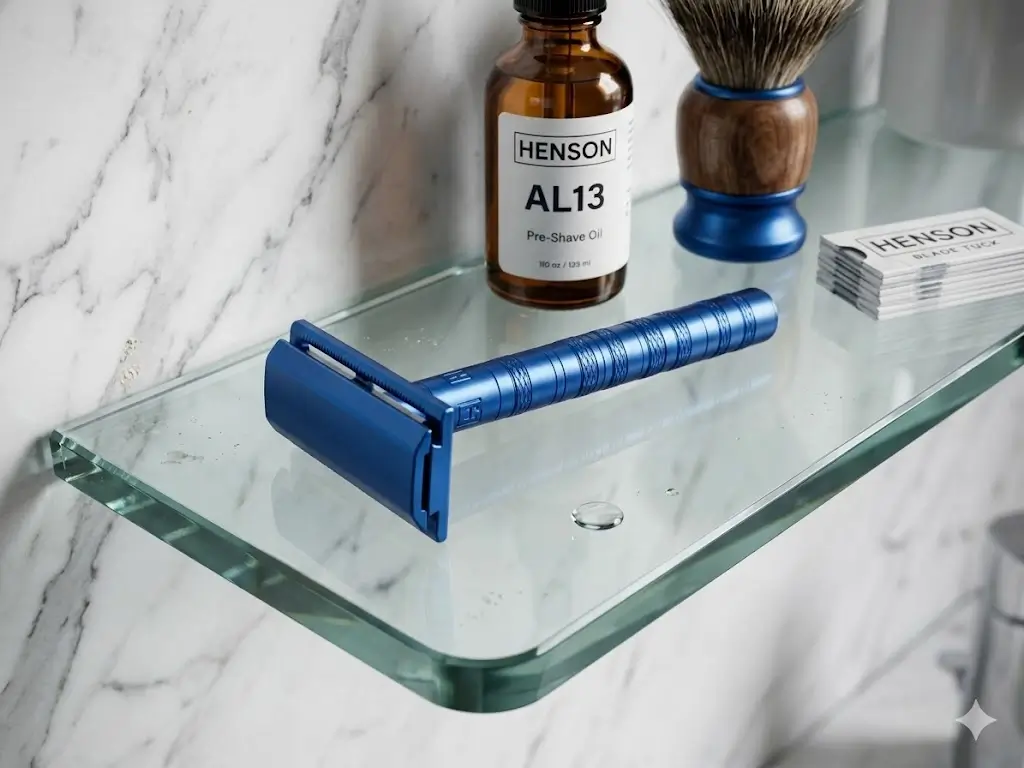
Performance & Precision: Machined in Canada using aerospace-grade CNC aluminum, the Henson AL13 approaches wet shaving from a pure engineering standpoint. If you are looking for the best safety razor for beginners with ultra-sensitive skin, the AL13 holds the blade at an exact, rigid angle with minimal overhang to eliminate “blade chatter” (micro-vibration).
Ergonomics & Touch: Tipping the scales at a featherlight 37 grams, the Henson feels vastly different from traditional heavy brass razors. Shavers making the leap from disposable plastic cartridges will find its weight instantly familiar and exceptionally nimble around tight neck contours.
Design Insights: The head geometry features extended end tabs that completely enclose the sharp sides of the double-edge blade, preventing accidental scrapes against your nostrils or ears during quick passes.
✔ What We Like
- Virtually impossible to nick yourself when used correctly
- Aerospace CNC tolerances eliminate blade vibration
- Enclosed side tabs prevent nostril and ear scratches
✖ What We Don’t Like
- Lightweight feel lacks classic weighted heft
- Requires precise rinsing to clear thick lather build-up
3. Rockwell 6C
- Design Type: 3-Piece Interchangeable Plate System
- Weight: 100 grams
- Head Style: 6 Adjustable Blade Gap Settings

Versatility & Customization: If your facial hair density varies wildly across your cheeks, chin, and neck, the Rockwell 6C stands out as one of the best safety razors for a beginner who wants room to customize. It comes packaged with three reversible baseplates, unlocking six distinct blade gap settings (Size 1 through Size 6). Size 1 delivers an ultra-mild shave for ultra-sensitive skin, while Size 6 provides the gap needed to clear heavy multi-day stubble.
Component Maintenance: Constructed from cast zinc alloy with a deep chrome finish, the 6C feels heavy and substantial in the hand. Because the plates feature tight alignment channels, make sure to thoroughly rinse away lather film and soap scum after every use to maintain perfect blade alignment.
✔ What We Like
- 6 distinct settings grow with your technique
- Hefty 100g weight glides effortlessly under gravity
- Eliminates the guesswork of buying multiple razors
✖ What We Don’t Like
- Changing settings requires swapping plates over the sink
- Bulkier head geometry under the nose
4. Muhle R89
- Design Type: 3-Piece Design
- Weight: 64 grams
- Head Style: Closed Comb Precision Geometry

Handling & Skin Comfort: Designed and manufactured in Stützengrün, Germany, the Muhle R89 is world-renowned for its forgiving nature. Its engineered scalloped safety bar lifts and flattens skin tissue just before the cutting edge makes contact, preventing skin bunching and eliminating razor burn along vulnerable necklines.
Durability & Finish: The chrome plating on the R89 is legendary—smooth, mirror-like, and highly resistant to corrosion. However, like most zinc-diecast safety razors, dropping the unit onto hard bathroom tile or porcelain can snap the top cap’s center post. Keep a dry towel grip while handling.
✔ What We Like
- Flawless German chrome finishing
- Highly forgiving geometry for sensitive neck skin
- Lightweight balance provides nimble maneuverability
✖ What We Don’t Like
- Can feel underpowered on extremely thick, coarse beards
- Die-cast cap post can break if dropped on porcelain
5. Edwin Jagger DE89
- Design Type: 3-Piece Design
- Weight: 74 grams
- Head Style: Classic Closed Comb

Daily Shaving Characteristics: Hailing from Sheffield, England—a city historic for fine steel cutlery—the Edwin Jagger DE89 shares a similar head design with the Muhle R89 but incorporates a slightly heavier handle. It offers predictable blade alignment and excels at defining sharp sideburn lines and neck borders.
Hardware Breakdown: The handle features standard M5 x 0.8 threading, allowing you to swap in custom aftermarket stainless steel or titanium handles later on. The lined knurling offers decent wet traction while maintaining an understated aesthetic.
✔ What We Like
- Exquisite English chrome finish and classic look
- Standard thread pitch allows aftermarket handle swaps
- Predictable blade gap ideal for daily upkeep
✖ What We Don’t Like
- Smooth chrome handle can get slippery when coated in pre-shave oil
- Requires multiple passes on 3-day stubble
6. King C. Gillette
- Design Type: 3-Piece Heritage Design
- Weight: 104 grams
- Head Style: Mild Closed Comb

Shaving Feel for New Users: Backed by over a century of shaving heritage, the King C. Gillette brings wet shaving back to big-box retail. It features an exceptionally mild head geometry with negative blade exposure, making it one of the most accessible and budget-friendly safety razors for beginners available today.
Weight & Ergonomics: The extra-long stainless steel handle pushes total weight up to 104 grams. While the long handle feels familiar to cartridge users, the knurling is somewhat shallow. When your hands are slick with lather, hold the barrel near the neck for optimal control.
✔ What We Like
- Widely available and extremely budget-friendly
- Heavy, durable stainless steel handle
- Extra-mild geometry protects beginners from cuts
✖ What We Don’t Like
- Shallow handle knurling can feel slippery when wet
- May require multiple passes for coarse hair
Step-by-Step: How to Shave with a Safety Razor Without Nicks
Owning the Best Safety Razors for Beginners is only half the battle; technique is what prevents irritation. Follow this traditional 3-pass wet shaving process:
💡 Pro-Tip: Finding the Perfect 30-Degree Angle
Place the flat top cap of the razor directly against your cheek so the handle points straight out. Gradually tilt the handle downward toward the floor while sliding lightly. The exact moment the blade edge contacts your hair—usually around a 30° angle—is your cutting zone. Maintain this wrist angle!
- Preparation: Never shave cold, dry skin. Shaving immediately after a warm shower softens facial hair keratin, making whiskers up to 30% easier to slice. Apply a quality pre-shave oil to build a slick protective barrier.
- Build Real Lather: Ditch canned aerosols packed with drying propellants. Use a shaving brush and a tallow- or glycerin-based shaving cream to build a rich, cushiony lather that hydrates hair and lubricates the blade path.
- Pass 1: With the Grain (WTG): Map your facial hair growth direction. Your first pass should always run in the exact same direction your hair grows. Hold the razor at a 30-degree angle relative to your skin and let the weighted head glide without applying downward pressure.
- Pass 2: Across the Grain (XTG): Re-lather your face. Pass the razor perpendicular (across) the direction of hair growth. This safely reduces remaining stubble down to skin level without straining hair follicles.
- Pass 3: Against the Grain (ATG – Optional): Only attempt this if your skin is non-sensitive and you desire a glass-smooth finish. Re-lather and glide gently against growth direction using short, light strokes.
- Post-Shave Recovery: Rinse your face with ice-cold water to constrict pores. Apply an alum block or an alcohol-free, witch-hazel-based aftershave balm to soothe skin and seal micro-abrasions.
Pairing the Best Safety Razors for Beginners with the Right Blade
A safety razor holds the blade, but the blade edge determines the cut. Double-edge blades are manufactured with different sharpness levels, bevel grinds, and protective coatings (Platinum, Teflon, Chromium):
| Blade Brand | Sharpness Rating | Coating Type | Best Paired With |
|---|---|---|---|
| Astra Superior Platinum | Medium / Balanced | Platinum Coated | All beginner razors (Merkur 34C, DE89) |
| Feather Hi-Stainless | Ultra-Sharp | Platinum & Polymer | Mild razors (King C. Gillette, Henson AL13) |
| Derby Extra | Mild / Smooth | Chromium-Ceramic-Platinum | Sensitive skin & fine facial hair |
| Personna Platinum (Lab Blue) | Medium-Sharp | Platinum Coated | Coarse beard growth & daily shavers |
Troubleshooting Common Beginner Shaving Problems
| Symptom | Root Cause | Instant Fix |
|---|---|---|
| Razor Burn on Neck | Applying too much downward pressure or shaving ATG on pass 1. | Relax your hand grip; let the weight of the metal head glide over skin. |
| Bleeding Weepers / Nicks | Shaving angle too steep (>45°) or un-lubricated skin. | Flatten the top cap against face, lower handle until blade contacts hair (~30°). |
| Tugging & Pulling | Dull blade or dry lather lacking hydration. | Swap blade (after 3-5 shaves) and add more water to your shaving lather. |
Buyer’s Guide: How to Choose the Best Safety Razor for Beginners
- Closed-Comb vs. Open-Comb: Beginners should strictly stick to closed-comb heads. An open-comb razor features visible teeth that expose more blade edge directly to the skin, making it prone to user error.
- Weight Distribution: Front-weighted razors naturally guide your stroke, preventing you from applying manual force that causes razor burn.
- Grip & Knurling: Look for diamond, spiral, or lined handle knurling. Lather and pre-shave oil make handles slick; aggressive knurling ensures safety.
Maintenance Tips for Decades of Use
Critical Hardware Maintenance: Soap scum and hard water deposits trapped inside safety razor threads cause binding and premature oxidation. Proper care ensures your razor lasts a lifetime.
- The Post-Shave Rinse: Loosen the handle barrel half a turn after every shave, run under warm tap water to flush trapped hair, and shake off excess moisture.
- Deep Clean Every Blade Swap: Scrub the baseplate channels and safety bar with an old toothbrush and mild dish soap whenever you pop in a fresh blade.
- Lube the Screw Threads: Place a tiny drop of mineral oil or petroleum jelly on the top cap’s threaded post once a month for buttery-smooth assembly.
Frequently Asked Questions (FAQ)
Is a safety razor actually better for beginners than a cartridge razor?
Yes. A safety razor uses a single sharp blade at a fixed angle, slicing hair cleanly at skin level. Cartridge razors use multiple blades that pull hair outward before chopping it beneath skin level, which leads to severe razor bumps, ingrown hairs, and chronic skin irritation.
How often should a beginner replace a double-edge razor blade?
On average, a double-edge blade lasts between 3 to 6 close shaves. As soon as you feel the blade tugging at stubble instead of slicing cleanly, safely dispose of it and drop in a fresh blade.
Are safety razors dangerous for beginners?
No. Modern safety razors feature closed-comb safety bars that restrict blade exposure. As long as you maintain a 30-degree shaving angle and avoid applying downward pressure or sliding the razor sideways, cuts are rare.
Can I travel with a safety razor on an airplane?
You can bring a safety razor body in your carry-on luggage, but loose double-edge blades are strictly prohibited by TSA in carry-on bags. Blades must be packed in checked luggage or purchased at your destination.
Summary & Final Verdict
When selecting the best safety razor for beginners, your final pick depends on your skin profile and shaving goals. If you want the undisputed gold standard for balanced weight, short-handle agility, and time-tested design, buy the Merkur 34C HD. For guys with ultra-sensitive skin prone to razor bumps, the precision-engineered Henson AL13 offers unmatched nick-free protection. If you want a modular system that grows alongside your technique, invest in the adjustable Rockwell 6C.
If you are exploring broader razor styles beyond traditional double-edge tools, be sure to check out our complete breakdown of the best razors for men. Ditch disposable plastic junk, take your time mastering the 30-degree glide, and enjoy the cleanest shave of your life.