
Dermatological Grooming Benchmark • Stratum Corneum Barrier Mechanics & Clinical Protocols
Table of Contents
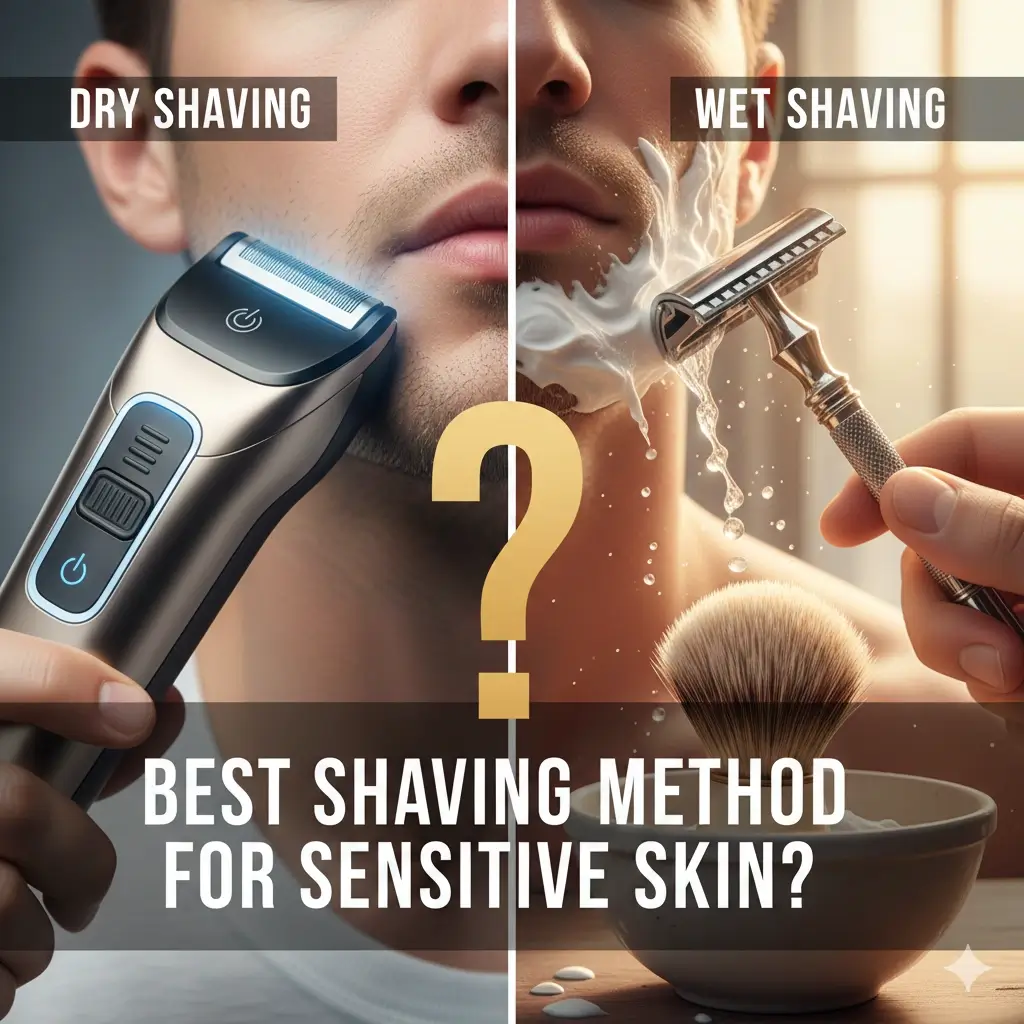
ToggleDry vs. Wet: Discovering the Best Shaving Method for Sensitive Skin
Direct Answer: Which Shaving Method Is Clinically Superior for Sensitive Skin?
Dry electric foil shaving is clinically the best daily shaving method for men prone to chronic erythema, razor bumps (Pseudofolliculitis Barbae), and reactive allergies because micro-perforated metallic foils physically separate moving cutting blocks from the epidermis, preventing stratum corneum abrasion. Conversely, traditional wet shaving with a single-blade Double-Edge (DE) safety razor provides superior skin closeness (0.00mm flush blade cut) with minimal irritation when paired with dense, unpressurized glycerin lather, outperforming multi-blade cartridges that induce the aggressive hysteresis effect. For comprehensive machine evaluations, explore our flagship index of the best electric shavers for men.
Determining the optimal shaving protocol requires evaluating cellular barrier disruption rather than subjective marketing claims. We analyze the biochemical softening of keratin structures during wet lathering, calculate friction downforce across electric foil screens, and provide a clinical roadmap to eliminate post-shave erythema entirely.
⚡ Quick Reference Specification: Dry vs. Wet Shaving Clinical Matrix
| Clinical Metric | Dry Shaving (Electric Foil) | Wet Shaving (Single-Blade DE) | Multi-Blade Cartridges (Reference) |
|---|---|---|---|
| Epidermal Contact Friction | Ultra-Low (Foils Glide via Micro-Pulsations) | Low (Hydrated Lubrication Buffer) | Severe (3–5 Consecutive Bare Blades) |
| Stratum Corneum Desquamation | Near Zero (Blades Never Touch Skin Layer) | Minimal (Single Controlled Blade Edge) | High (Strips Protective Surface Lipids) |
| Residual Follicle Length | 0.048 – 0.068 mm (Safe Surface Truncation) | 0.000 mm (Direct Pore-Flush Severance) | Sub-Surface (< 0.00 mm via Hysteresis) |
| Ingrown Hair (PFB) Potential | Negligible (Follicle Remains Above Dermis) | Low (Cut Cleanly with the Grain) | Severe (Sub-Dermal Curl Re-entry) |
| Application Downforce Required | < 1.8 Newtons (Motor Velocity Cuts Hair) | Zero Downforce (Tool Weight Governs Cut) | 3.0 – 5.0 Newtons (User Downward Pressure) |
| Grooming Duration & Prep | 2 – 4 Minutes (No Mandatory Hydration) | 10 – 15 Minutes (Hot Towel + Brush Lather) | 5 – 7 Minutes (Aerosol Foam Application) |
| Overall Dermatological Tolerability | 9.8 / 10 (Safest Daily Routine) | 9.1 / 10 (Safest Pure Wet Ritual) | 4.5 / 10 (Primary Cause of Irritation) |
⚡ Quick Expert Summary: Choosing Between Dry and Wet Protocols
- Choose Dry Electric Shaving if: You suffer from chronic razor bumps on the neck, lack 15 minutes for elaborate hot-towel preparation, or need daily corporate grooming without compromising barrier lipids.
- Choose Single-Blade Wet Shaving if: You prioritize baby-smooth closeness above all else, enjoy a mindful grooming ritual, and commit to swapping inexpensive DE blades every 3 to 5 shaves.
- The Universal Golden Rule: Never use multi-blade cartridge razors if your skin is clinically reactive; multi-blade hysteresis is the primary mechanical trigger of ingrown hairs and contact erythema.
1. Understanding the Root Cause: Why Shaving Traumatizes Sensitive Skin
Multi-blade cartridge systems cause mechanical micro-lacerations in the stratum corneum by pulling hairs upward and severing them sub-dermally through the hysteresis effect.
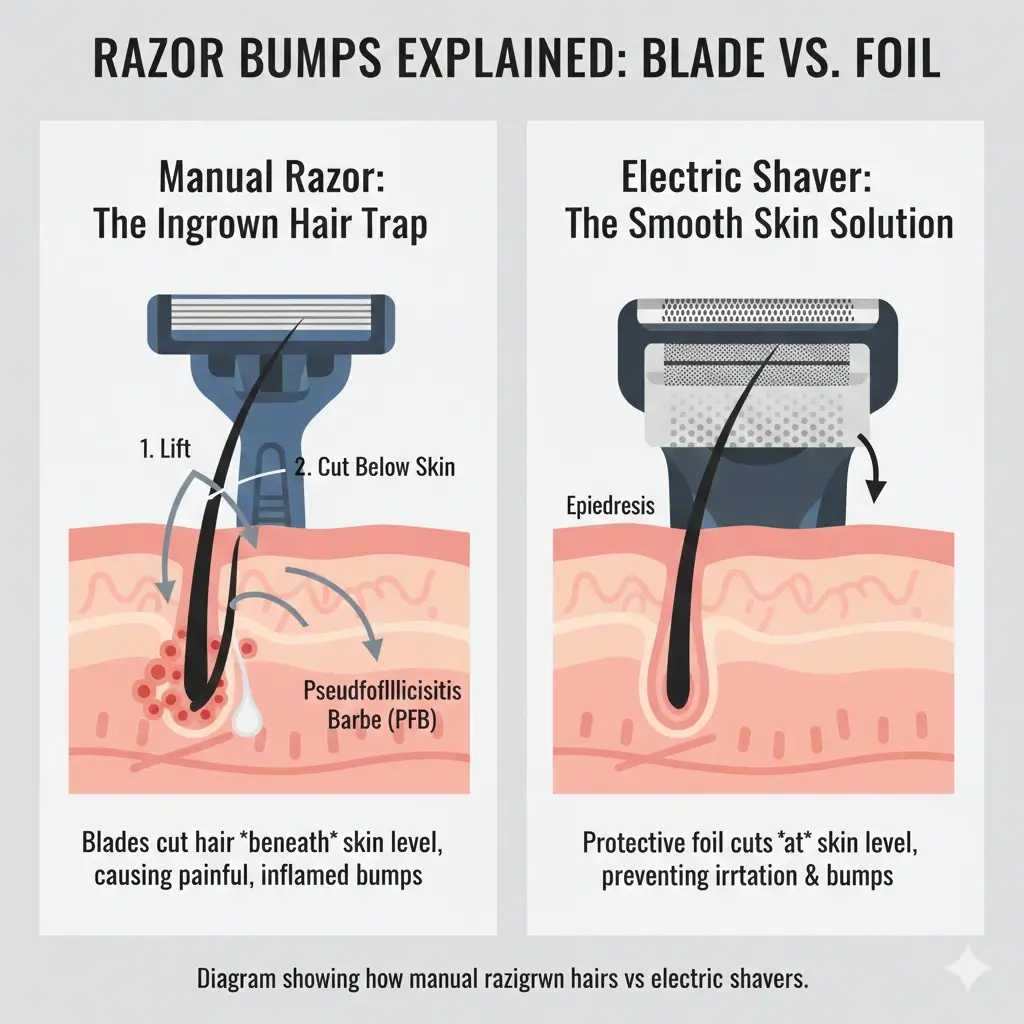
The microscopic biomechanics: Understanding how different blades interact with the skin layer.
If you have experienced chronic post-shave neck erythema, technical error is rarely the sole culprit. In the vast majority of cases, cellular inflammation is a direct physiological consequence of multi-blade cartridge friction passing across vulnerable epidermal junctions.
The Stratum Corneum: Your Skin’s Unsung Hero
The human face relies on the stratum corneum—the outermost layer of keratinized corneocytes embedded in an intercellular lipid matrix of ceramides, cholesterol, and free fatty acids. This physiological barrier prevents transepidermal water loss while blocking environmental allergens and pathogens. When bare steel slides directly over this layer without adequate shielding, it shears away protective lipids alongside facial hair. Stripping these lipids exposes fragile underlying desmosomes, triggering acute neurosensory stinging, inflammation, and erythema.
The Hysteresis Effect: How Multi-Blades Challenge Sensitive Skin
Consumer advertising suggests that additional blade rows increase shaving performance. While five blades achieve extreme closeness, they severely stress sensitive dermal tissue via the mechanical principle of hysteresis. The leading blade snags and extends the hair follicle upward from the canal; preceding blades cut the shaft before it retracts back beneath the epidermal surface level.
When severed hairs retract beneath the pore margin, curved facial hair pierces the follicular wall during subsequent growth phases, producing foreign-body inflammatory papules clinically diagnosed as Pseudofolliculitis Barbae (ingrown hairs). For clinical strategies to heal inflamed skin barriers, review our medical protocol on how to stop razor burn.
2. Dry Shaving vs. Wet Shaving: A Compassionate Mechanical Breakdown
Hydration-assisted wet shaving relies on water absorption to reduce hair cut force, while dry electric shaving deploys perforated micro-foils to isolate moving steel from facial skin.
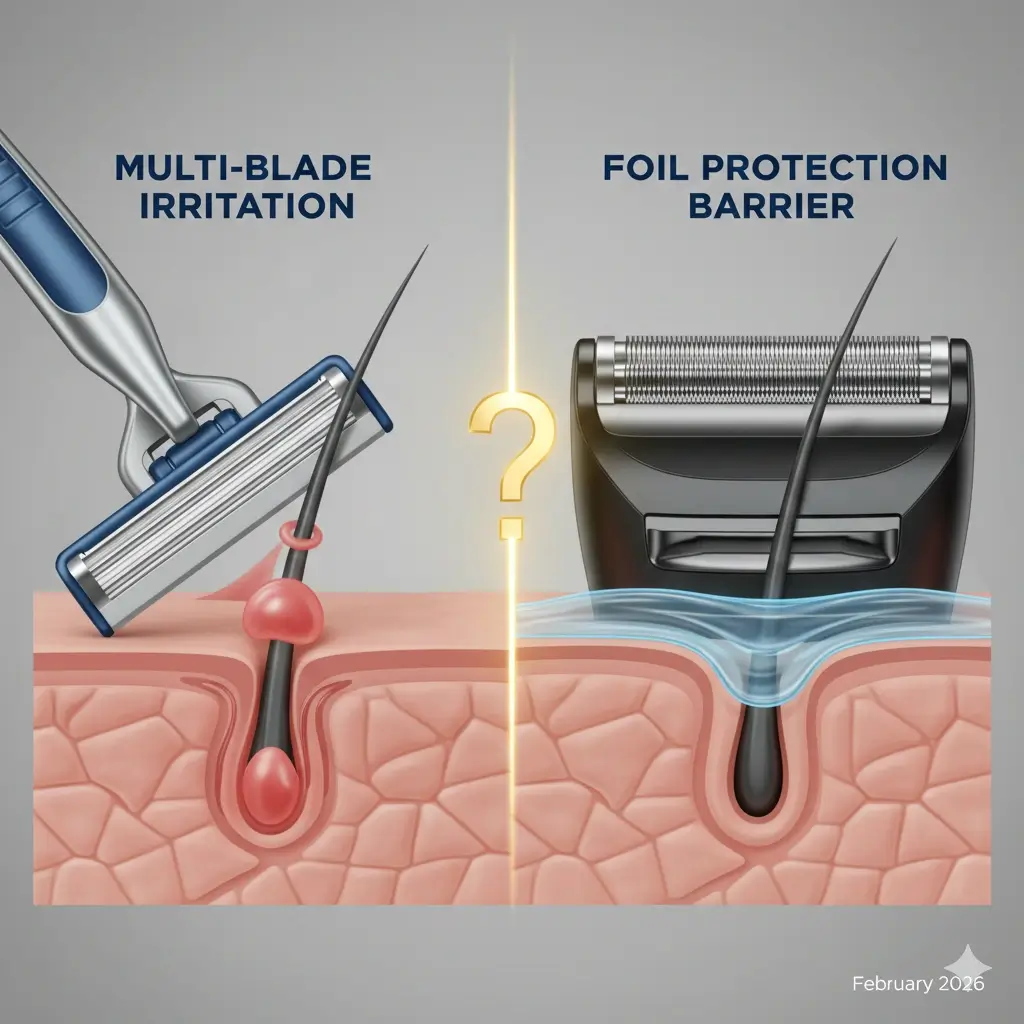
A Mechanical Look: Cartridge razors interact directly with the skin barrier, while electric foils offer a protective shield.
The Chemistry of Wet Shaving
Wet shaving leverages the hygroscopic nature of human keratin. Soaking whiskers in warm water for two minutes swells the hair shaft by 34% in volume and reduces cut resistance by nearly 65%, allowing sharp steel to slice through cleanly.
However, manual wet shaving requires blade edges to contact epidermal ridges directly. Without refined single-blade handling, this direct contact scrapes away the stratum corneum, causing persistent inflammation on sensitive skin.
The Physics of Dry Shaving
Dry electric shaving deploys high-speed reciprocating motors behind ultra-thin perforated metallic screens. The foil screen rests flat against the face, serving as a physical shield while internal shearing blocks oscillate at up to 14,000 cycles per minute.
Separating moving cutting edges from dermal tissue prevents direct scraping of the stratum corneum. Dermatologists widely recommend high-end foil razors as the most reliable daily tool for managing chronic neck redness.
3. The Clinical Data: Head-to-Head Comparison Table
Clinical dermatology benchmarks evaluate dry electric foil shaving and single-blade wet shaving across skin irritation risk, closeness, and daily time investment.
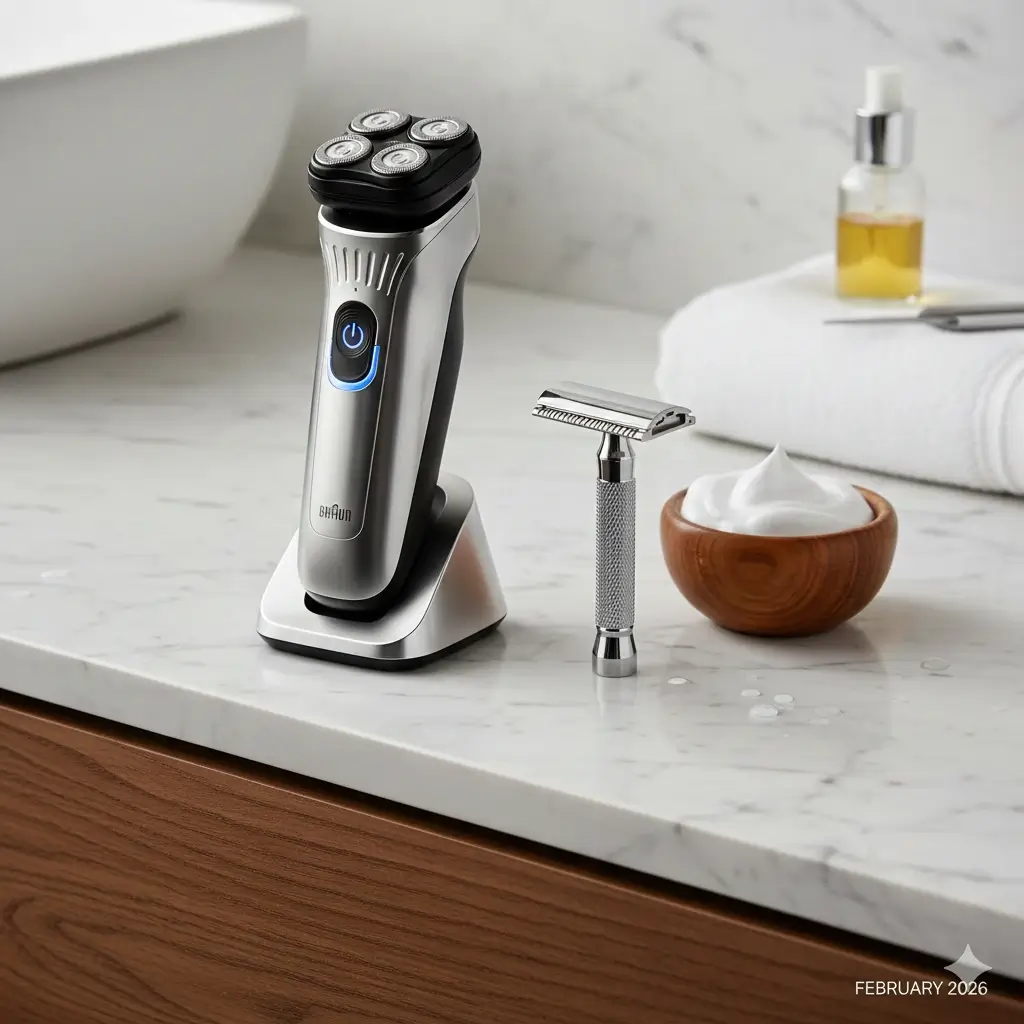
The Tool Contenders: Dry shaving with the Braun Series 9 vs. wet shaving with the Merkur Safety Razor.
| Performance Variable | Dry Shaving (Electric Foil) | Wet Shaving (Single-Blade DE Safety) |
|---|---|---|
| Erythema & Irritation Risk | Extremely Low: Micro-foils physically isolate the skin barrier from the cutter. | Moderate: Requires disciplined blade angle (30°) to prevent scrape. |
| Ingrown Hair Risk (PFB) | Minimal: Cuts flush at the pore without sub-dermal hysteresis retraction. | Low to Moderate: Safe with the grain, elevated when shaving against the grain. |
| Measurable Closeness | Clean Corporate Finish (Leaves ~0.05mm follicular residue). | Superior: Direct edge contact yields a completely smooth, bare-skin cut. |
| Morning Time Requirement | 3 – 5 Minutes: Highly efficient for active daily schedules. | 10 – 15 Minutes: Requires hydration prep, brush lathering, and slow passes. |
| Benchmark Hardware | Braun Series 9 Pro+ | Merkur 34C Heavy Duty Safety Razor |
| Ideal Clinical User | Men seeking rapid relief from chronic razor burn and contact dermatitis. | Grooming purists seeking BBS (Baby Butt Smooth) results via traditional methods. |
4. The Case for Dry Shaving: Protecting the Dermal Barrier
High-frequency linear motors oscillating at 10,000 to 14,000 CPM shear facial hair above the dermal plane to preserve the stratum corneum and prevent ingrown hairs.
Transitioning to an electric foil shaver provides an effective exit strategy from recurrent skin irritation. While foil systems leave a microscopic 0.05mm stubble residue, their protection of long-term skin health remains unmatched:
- Preservation of Barrier Lipids: Because cutting blocks oscillate safely behind micro-perforated screens, the physical blade never drags across live skin cells, keeping essential moisture-retaining lipids intact.
- Eradication of Ingrown Hairs: By trimming whiskers flush at the epidermal surface rather than sub-dermally, electric shavers prevent curved neck hairs from curling backward beneath the pore opening. If you struggle with severe ingrown bumps, review our curated guide to the best electric shavers for razor bumps.
- Friction Reduction via High CPM Velocity: Mag-lev linear drives sever hair instantly, eliminating the need to pass the shaver repeatedly over inflamed neck zones—the primary mechanical cause of contact dermatitis.
5. The Case for Wet Shaving: Refining Single-Blade Technique
Double-edge safety razors utilize a single surgical-grade blade edge to sever hair flush in one pass, eliminating the multi-blade scraping that compromises sensitive skin.
The Single-Blade Mechanical Advantage
The gentlest way to wet shave is replacing 5-blade plastic cartridges with a heavy double-edge safety razor. With a single sharp cutting edge, one pass equals one clean cut. The natural mass of a solid brass or zinc-alloy handle provides sufficient downforce to shear whiskers cleanly, eliminating the need to press down against the skin. For traditional wet razor rankings, see our guide on the best razors for men with sensitive skin.
Hydration and Lubrication Chemistry
Replacing aerosol foams with rich shaving soaps or glycerin creams protects the epidermal barrier. Aerosol propellant gases (isobutane and propane) strip moisture from skin cells. Whipping a natural cream with a badger or synthetic brush builds a dense lubricating cushion that shields sensitive tissue during blade passes.
Blade Replacement Economics
Standard safety razor blades cost roughly $0.15 to $0.25 each. This low cost allows users to install a fresh, sharp blade every 3 to 5 shaves, avoiding the painful tugging caused by dulling cartridge blades.
6. The Hybrid Grooming Approach: Combining Both Protocols
Alternating between weekday electric foil shaving and unhurried weekend wet safety razor rituals protects the skin barrier from chronic fatigue while satisfying closeness preferences.
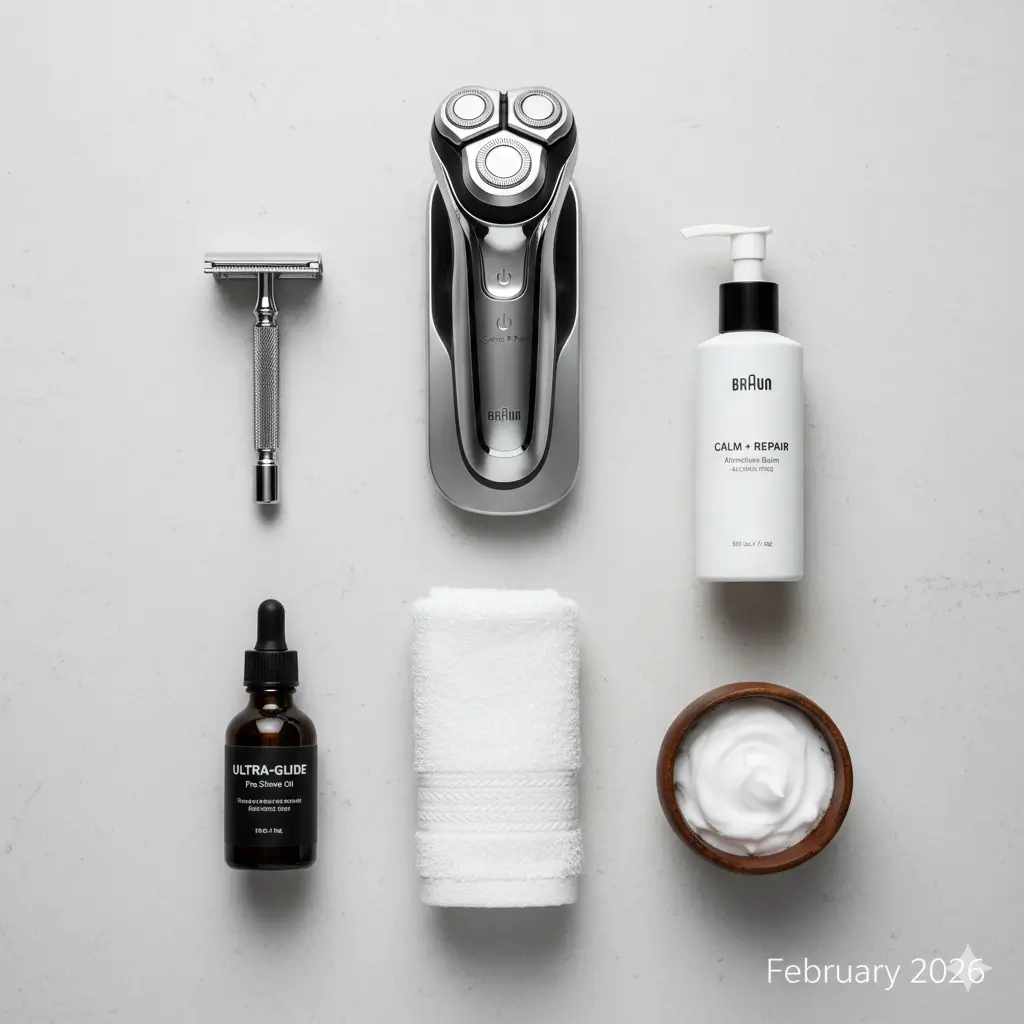
The Ultimate Arsenal: Utilizing a premium electric foil for the busy workweek and a classic safety razor for a relaxing weekend ritual.
Many men with reactive skin adopt a hybrid strategy matched to their weekly schedule. During busy workdays, a high-end electric foil razor delivers a quick, irritation-free clean-up that protects the dermal lipid barrier.
On weekends, taking time for a hot-towel single-blade safety razor shave provides close results with gentle exfoliation. Blending both tools gives sensitive skin time to recover while delivering reliable grooming performance throughout the week.
7. The Universal Skincare Protocol: Preparation and Post-Care
Comprehensive pre-shave hydration and alcohol-free barrier restoration balms dictate epidermal healing regardless of whether wet or dry tools are deployed.
Pre-Shave Barrier Preparation
Hydrating Keratin: Take a warm shower or apply a damp towel before shaving. Warmth and moisture soften facial hair, significantly lowering the cutting force needed.
Boundary Lubrication: Applying a few drops of pre-shave oil containing jojoba or squalane creates a slick barrier that reduces steel friction across the skin surface.
Gentle Exfoliation: Using a mild enzymatic face wash clears away dead skin cells, helping razor heads glide smoothly over facial contours.
Restorative Post-Shave Protocol
Avoid Denatured Alcohols: Traditional alcohol aftershaves dry out skin cells and slow natural barrier recovery. Choose soothing, alcohol-free formulations instead.
Replenishing Lipids: Apply post-shave balms formulated with ceramides, niacinamide, and aloe vera to restore microscopic wear in the stratum corneum.
Restoring Comfort: Lightweight balms like Nivea Men Sensitive or Bee Bald Heal calm post-shave heat without clogging freshly trimmed pores.
8. Answering Your Common Concerns: Clinical FAQs
Technical and dermatological answers clarify essential daily habits for managing sensitive facial skin.
Can I use shaving cream with an electric razor?
Yes. Many modern electric foil shavers are 100% IPX7 waterproof. Applying a thin layer of shave gel reduces foil friction and cools skin temperatures during high-speed cutting.
How often should I replace shaving blades?
For wet safety razor shaving, change blades every 3 to 5 sessions to maintain a sharp, tug-free cut. For electric foil shavers, replace the cutter cassette every 12 to 18 months to avoid dull blades and extra friction.
Will switching to dry shaving cause a temporary adaptation redness?
Yes. Facial skin typically requires a 2-to-3-week adjustment phase when transitioning to a new mechanical shaver. Avoid mixing manual razor passes during this period to let the stratum corneum adapt smoothly.
What is the golden dermatological rule for sensitive skin?
Always shave with the grain (the natural direction of hair growth) on the first pass. Shaving against the grain pulls the hair backward before cutting, which frequently causes ingrown hairs and contact irritation.
Final Verdict: Choosing Comfort and Confidence
The ideal shaving method for sensitive skin balances clean grooming results with consistent skin barrier health. Choose your protocol based on daily schedule and closeness preferences:
For Daily Speed & Chronic Irritation Relief
Invest in a premium electric foil shaver. Physical foil barriers prevent direct blade-to-skin contact, keeping the face comfortable throughout busy workweeks.
For the Mindful Ritual & Maximum Closeness
Choose a traditional single-blade safety razor with rich brush-lathered cream. A single sharp blade severs whiskers flush without multi-blade hysteresis irritation.