
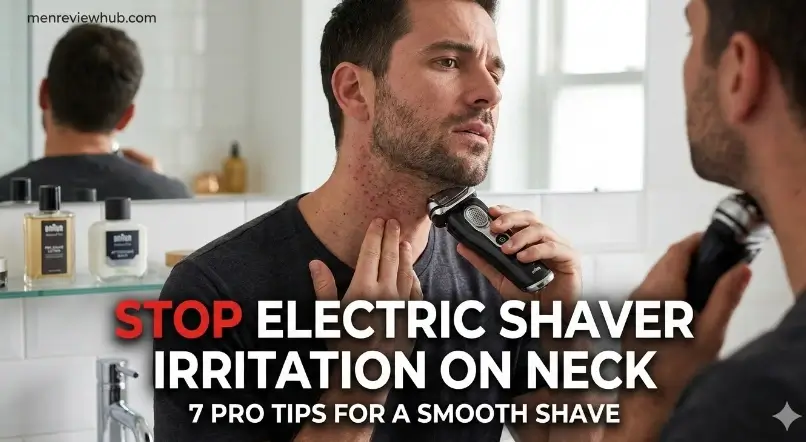
Tired of the burn? Learn how to stop electric shaver irritation on the neck with our expert guide. Master the technique and get a smooth shave today
Let’s be real: looking like you just wrestled a swarm of angry bees isn’t exactly the “clean-shaven” look you were going for. We’ve all been there—that stinging, red, itchy mess known as electric shaver irritation on the neck.
Most guys are quick to toss their expensive Braun or Norelco out the window, but after 15 years in the grooming game, I can tell you: it’s usually the “pilot,” not the “plane.” The skin on your neck is thinner than a cheap 1-ply tissue, and the hair there grows in more directions than a lost tourist. If you’re tired of your shirt collar feeling like 80-grit sandpaper against your skin, listen up.
In this guide, I’m breaking down the no-BS, pro-level strategy to kill the burn, erase the bumps, and finally master the art of the irritation-free shave. No fluff, just the hard-earned facts to save your skin and your morning.
Why Does Your Electric Shaver Cause Neck Irritation?
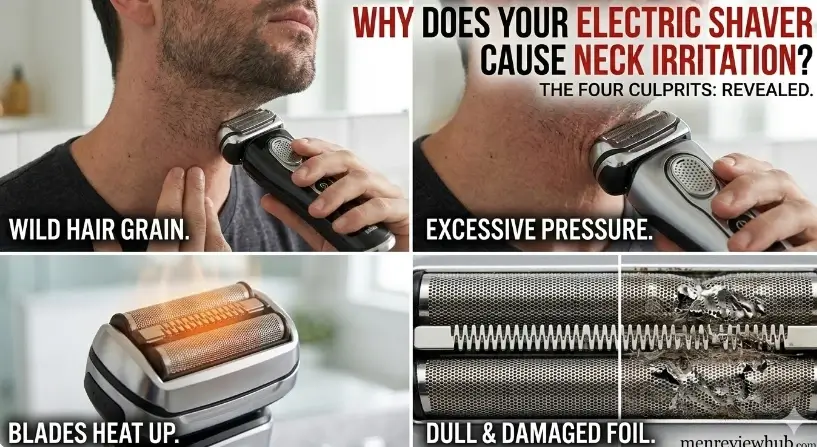
If your face feels like a million bucks but your neck looks like a crime scene, welcome to the “No-Man’s Land” of grooming. The neck is a biological nightmare for any blade, and your electric razor isn’t always the villain—sometimes it’s just the victim of bad physics.
Here is why your electric shaver irritation on the neck is ruining your morning:
-
The Topographical Nightmare: Unlike your flat, sturdy cheeks, the skin on your neck is thin, stretchy, and wraps around a moving Adam’s apple. Even worse? Neck hair is the rebel of the body—it grows in spirals, sideways, and upside down. Most shavers are designed for straight lines, so they end up “tugging” at these wild hairs instead of slicing them.
-
The “Motorized Sandpaper” Effect: Every electric shaver—whether it’s a high-end foil or rotary—generates friction. Friction creates heat. If you’re doing 50 passes over the same spot, you’re essentially buffing your skin with a hot metal plate. That “fire” you feel? That’s your skin’s way of telling you it’s being cooked.
-
The “Heavy Hand” Rookie Mistake: A lot of guys think pressing harder equals a closer shave. Big mistake. Modern shavers like the Braun Series 9 or Panasonic Arc5 are precision instruments, not lawnmowers. When you press too hard, you’re pushing the skin into the blades, leading to micro-cuts and the dreaded razor burn.
-
Dull Blades & Gunk: If you haven’t changed your blades in over a year, you’re not shaving; you’re performing a low-speed tug-of-war with your follicles. Add in a buildup of dead skin cells and old oils inside the shaver head, and you’ve got a recipe for a bacterial breakout.
Pro Tip: Your neck hair doesn’t follow orders. Before you even turn the shaver on, take two fingers and rub them across your dry neck. If it feels like sandpaper moving upward, that’s your “against the grain” direction. Knowing is half the battle.
Essential Pre-Shave Routine to Prevent Neck Irritation
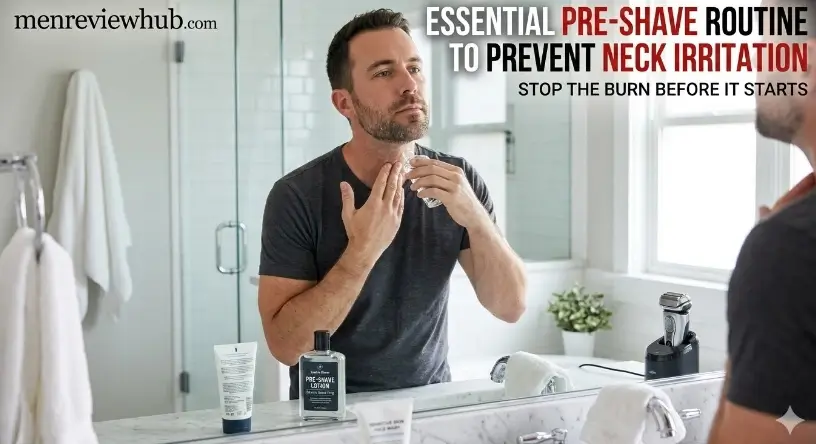
Most guys treat shaving like a 100-meter sprint—they jump out of bed, splash some cold water, and start hacking away. If that’s you, don’t be surprised when your neck looks like a topographical map of Mars.
Prepping your skin isn’t “extra”—it’s the difference between a smooth finish and a week of regret. If you want to prevent neck irritation, you need to treat your face like a canvas before a masterpiece. Here is the ritual I’ve used for years to keep things cool:
-
Hydrate Like You Mean It: You wouldn’t try to cut a dry, brittle branch with a pair of scissors, right? The same logic applies to your whiskers. Spend at least two minutes splashing warm water on your neck or, better yet, shave right after a hot shower. The steam softens the keratin in your hair, making it 50% easier to cut.
-
The “Clear the Deck” Exfoliation: Dead skin cells are the arch-nemesis of a smooth shave. They clog your shaver and trap hairs, leading to those painful red bumps. Use a gentle face scrub once or twice a week. It lifts those “lazy” flat-lying hairs off the skin so your shaver can actually grab them.
-
The Secret Weapon: Pre-Shave Electric Lotion: If you’re dry shaving, this is non-negotiable. Products like Williams Lectric Shave or Speick contain ingredients that do two things: they create a powdery lubricant barrier so the metal glides, and they make your hair stand up straight. It’s like giving your shaver a clear shot at the target.
-
Dry Means Bone Dry: If you aren’t using a “Wet/Dry” shaver with gel, make sure your neck is completely dry before you start. Any dampness will cause the shaver head to “skip” and “drag” on your skin—a one-way ticket to electric shaver irritation on the neck.
The Expert Verdict: If you’re in a rush, don’t skimp on the prep. I’d rather you spend three minutes prepping and one minute shaving than five minutes butchering your neck with a “cold start.” Trust me, your collar will thank you.
Proper Technique for Shaving Your Neck with an Electric Razor
Listen closely: You can buy a $400 Braun Series 9, but if you use it like a caveman, you’re still going to get electric shaver irritation on the neck. Shaving your face is easy; shaving your neck is an art form. It requires a steady hand, a bit of strategy, and the realization that your neck is not a flat piece of plywood.
If you want to stop the bleed and start the lead, follow these professional-grade techniques for shaving your neck with an electric razor:
-
The “Cold Start” Strategy: This is the most underrated tip in the grooming world. Your shaver’s head heats up the longer it runs. Heat is the primary trigger for redness and irritation. Always shave your neck first. Start there while the metal foils or rotary blades are still ice-cold. By the time the shaver gets warm, you should already be moving on to your much-tougher chin and cheeks.
-
Map Your Grain (Seriously): Your neck hair is a chaotic mess. It likely grows “up” near the Adam’s apple and “sideways” near the jawline. Run your fingers over your stubble to find the rough direction. You want to shave against the grain for closeness, but if you have ultra-sensitive skin, make your first pass with the grain to knock down the bulk without the bite.
-
The “Three-Finger” Stretch: An electric shaver needs a flat surface to work efficiently. If your skin is bunching up, the shaver will “bite.” Use your non-shaving hand to pull your skin taut. Tilt your head back to create a smooth “landing strip” on your throat, but don’t pull so hard that you’re distorting the hair follicles.
-
Zero Pressure. Period: If you are pressing the shaver into your neck to get a closer cut, you’ve already lost the battle. Modern shavers are designed with floating elements that do the work for you. Hold the razor lightly—like you’re holding a fountain pen—and let the blades glide. If it’s not cutting, your blades are dull; more pressure just leads to more pain.
-
Short, Controlled Strokes: Stop the long, sweeping motions from jaw to collarbone. Use short, 1-inch to 2-inch strokes. For foil shavers, move in straight lines (up and down). For rotary shavers, use small, overlapping circular motions.
Expert Insight: If you hit a “trouble spot” where hair just won’t cut, don’t keep hovering over it. Move on and come back once the skin has had a 30-second breather. Overworking a single patch of skin is the fastest way to trigger a “neck fire” that lasts all day.
Choosing the Best Electric Shaver for Sensitive Neck Skin
If you’re still using that $20 drugstore special and wondering why your neck looks like a pepperoni pizza, it’s time for an intervention. When it comes to electric shaver irritation on the neck, your gear is either your best friend or your worst enemy.
In the grooming world, we have two main camps: Foil vs. Rotary. For the neck, the winner is usually clear, but there are exceptions. Here is the breakdown of the heavy hitters for 2026:
The Foil King: Braun Series 9 Pro+
This is the gold standard for sensitive necks. Why? Because it doesn’t just “cut”; it has a specialized ProLift trimmer designed specifically to lift those flat-lying hairs that usually hide on your neck. Its sonic vibrations help the head glide over your skin like it’s on a cushion of air. It’s an investment, sure, but so is not having a red neck for the rest of your life.
The Precision Beast: Panasonic Arc6
If you have a thick, “lumberjack” beard but skin as sensitive as a newborn, the Arc6 is your go-to. It uses a 6-blade system and a motor that hits 84,000 cross-cutting motions per minute. This means it cuts the hair in a single pass. Remember: Fewer passes = less irritation.
The Rotary Maverick: Philips Norelco S9000 Prestige
Normally, I tell guys with sensitive skin to avoid rotaries. However, the Prestige is the exception. It features SkinComfort rings coated with thousands of microscopic beads to reduce friction. If your neck hair grows in wild, circular patterns, this rotary might actually be better at “catching” them than a foil.
The Budget-Friendly Savior: Braun Series 7 (360 Flex)
Don’t want to drop $300? The Series 7 features a 360° Flex Head that stays in constant contact with the dips and curves of your neck and jawline. It’s the best “bang for your buck” if you need flexibility without the premium price tag.
| Shaver Model | Best For | Key Neck-Saving Feature |
| Braun Series 9 Pro+ | Ultimate Comfort | ProLift Trimmer for flat hairs |
| Panasonic Arc6 | Thick Hair / One-Pass | Ultra-fast motor (84k cpm) |
| Philips Norelco S9000 | Wild Growth Patterns | Pressure sensors & Microbead coating |
| Braun Series 7 | Best Value | 360° Flex head for contours |
The Expert Verdict: If you shave every day and your main struggle is redness, stick with a Foil shaver. They provide a protective barrier between the blades and your skin that rotaries just can’t match.
Still can’t get a comfortable shave with an electric? You might want to go old-school. Check out our guide on luxury shaving kits & traditional safety razors for the ultimate sensitive skin solution
Post-Shave Care: How to Soothe Razor Burn on Neck Fast
You’ve finished the shave, but the “fire” is just starting to crawl up your throat. This is the critical moment. What you do in the next five minutes determines whether you’ll be rocking a clean look or hiding behind a turtleneck for the next three days.
If you need to soothe razor burn on neck areas immediately, stop reaching for that high-alcohol splash that smells like your grandfather’s locker room. It’s time for some actual skin science:
-
The Cold Water Shock: This is your “fire extinguisher.” As soon as you turn off the razor, splash your neck with the coldest water you can stand. This constricts blood vessels, reduces inflammation, and helps “close” the skin’s defense system.
-
Pat, Don’t Rub: Take a clean, soft towel and pat your neck dry. Never, ever rub. Your skin just went through a motorized workout; the last thing it needs is a rough-texture towel exfoliation.
-
Ditch the “Home Alone” Scream: Most traditional aftershaves are loaded with alcohol. On a fresh shave, alcohol is a desert—it sucks the moisture out and leaves your skin vulnerable to more electric shaver irritation on the neck. Switch to an alcohol-free balm.
-
Look for the “Big Three” Ingredients: To heal fast, your balm or moisturizer should contain:
-
Aloe Vera: The ultimate cooling agent.
-
Witch Hazel: A natural astringent that kills bacteria without the burn.
-
Shea Butter or Glycerin: To rebuild the skin barrier you just scraped.
-
-
The “Hands-Off” Policy: I know it’s tempting to feel how smooth your shave is, but stop touching your neck. Your hands are covered in oils and bacteria that love nothing more than jumping into a freshly shaved follicle to cause a breakout.
Pro Tip: If the redness is truly out of control, a tiny dab of 1% Hydrocortisone cream (available at any US drugstore like CVS or Walgreens) can kill the inflammation in an hour. Just don’t make it a daily habit—it’s an emergency “break glass in case of fire” fix only.
Maintaining Your Shaver to Avoid Future Skin Issues

Think of your electric shaver like a high-performance sports car. You wouldn’t drive a Porsche for 50,000 miles without an oil change, right? If you neglect your gear, it stops being a grooming tool and starts being a bacterial breeding ground that hacks at your face.
If you want to permanently end electric shaver irritation on the neck, you have to keep your hardware in “Day One” condition. Here is the maintenance playbook:
-
The 18-Month Rule (is a Lie): Manufacturers like Braun or Philips often say to replace your foils or cutters every 18 months. In my experience? If you have thick hair or shave daily, 12 months is the limit. Once those blades lose their “factory edge,” they start tugging. Tugging leads to redness. If you’re feeling more “pull” than “cut,” it’s time to order new blades.
-
Lubrication is Life: Metal-on-metal friction creates heat, and heat is the #1 cause of neck burn. Use a single drop of clipper oil or the manufacturer’s spray once a week. This keeps the blades sliding smoothly, reduces the temperature of the shaver head, and extends the life of the motor.
-
Deep Clean the Gunk: Even if your shaver is “self-cleaning,” take the head off once a week and give it a manual rinse. Dead skin cells, old hair dust, and dried pre-shave lotion build up inside. This “gunk” blocks the blades from moving freely and can cause “razor bumps” (folliculitis) due to bacterial transfer.
-
Alcohol-Based Cleaning Stations: If your shaver came with a cleaning dock, use it. The alcohol-based solution doesn’t just wash away hair; it sanitizes the blades. For guys with sensitive skin on their neck, starting every shave with a 100% sterile blade is a game-changer.
-
Protect the Foil: The foil on a shaver is thinner than a human hair. One tiny dent or microscopic tear is enough to turn it into a jagged saw blade. Always use the protective cap when you’re not shaving, especially in your gym bag or suitcase.
Expert Insight: If you’re using a foil shaver, never tap the foil head against the sink to get hair out. You will dent it, and that dent will cause “mysterious” nicks on your neck tomorrow. Use a small brush on the internal cutters only, or just rinse it under the tap.
Frequently Asked Questions (FAQ)
If you’re still scratching your head (and your neck), you aren’t alone. I’ve rounded up the most common questions I get from guys trying to escape the “red zone.” Here are the quick-fire answers to help you master electric shaver irritation on the neck.
How long does electric shaver irritation last?
Typically, the redness and “fire” from a bad shave will fade within 4 to 24 hours. However, if you’ve developed razor bumps (ingrown hairs), those can stick around for 3 to 5 days. To speed up recovery, keep the area moisturized and—for the love of grooming—don’t shave over the irritated skin the next day. Give it a rest.
Why is my neck itchy after shaving but not my face?
Your neck skin is thinner and has fewer oil glands than your cheeks, making it prone to dryness and friction. Plus, neck hair often grows at a flat angle, meaning the shaver has to work harder to “pick it up,” which leads to more skin contact and irritation.
Can I use shaving cream with an electric razor?
Yes—if your shaver is rated for “Wet/Dry” use. Most modern high-end shavers are. Using a thin layer of gel or cream can provide a massive boost in lubrication, reducing friction on the neck. Just avoid thick, “puffy” foams, which can clog the foils and actually make the shave worse.
Does the “18-month blade replacement” rule really apply?
For most guys? No. If you have a coarse beard, your blades will likely start dulling around the 8 to 10-month mark. If you start noticing that you have to go over the same spot on your neck four or five times to get it smooth, your blades are toast. Replace them.
Is a foil or rotary shaver better for a sensitive neck?
In my 15 years of testing, a foil shaver is usually the winner for sensitive necks. Foil shavers have a thin metal barrier that keeps the moving blades from ever touching your skin. Rotary shavers, while great for contouring, have a more “aggressive” motion that can catch and pull thin neck skin if you aren’t careful.
Final Word: Don’t Settle for the Burn
At the end of the day, electric shaver irritation on the neck isn’t a “manhood” rite of passage—it’s just a sign that your technique or your gear needs an upgrade. Start with the “Cold Start” method tomorrow, grab a decent pre-shave, and stop pressing so hard. Your neck will thank you, and you’ll finally start looking as sharp as you feel.
A clean neck is just one part of the puzzle. Don’t forget to tidy up the rest with the [best nose, ear & eyebrow trimmers] to complete your professional look
As an Amazon Associate, I earn from qualifying purchases. This comes at no extra cost to you. These commissions help support MenReviewHub in maintaining our grooming lab and providing high-quality, honest reviews for the community. Stay sharp!

Adam Lee is a personal care enthusiast and a veteran of the traditional wet shaving community, with over 10 years of experience testing artisanal and heritage soaps, aftershaves, and razors. At Men Review Hub, he personally puts every product through a minimum 30-day real-world trial to ensure you get an honest, practical look at what truly deserves a spot in your bathroom cabinet.