
Why the Electric Shaver is the “Cheat Code” for Bald Men
The Time Factor: From 20 Minutes to 2
If you’re using a manual razor, you’re looking at a whole production: hot towels, lathering up, careful strokes, and a surgical cleanup. Modern high-torque motors operate at thousands of cycles per minute, clearing stubble fields in seconds so you can be done before your coffee is finished brewing.
The “Blind Shave” Confidence
One wrong angle with a standard manual blade at the base of your skull, and you’re bleeding onto your dress shirt. Electric head shavers use protective foil or rotary guards that act as a barrier. You can safely shave the back of your head by feel alone without risking a nick.
Skin Integrity (The “No-Bump” Life)
A manual blade continuously scrapes the top layer of your skin off. Doing that every 48 hours leads to chronic redness and folliculitis. Because electric blades don’t scrape the epidermis directly, you avoid razor burn entirely—a game-changer for sensitive scalps.
The Freedom of the Dry Shave
The manual razor makes you a slave to the sink. With an electric head shaver, you enjoy complete mobility with no foam and no mess, allowing you to quickly refresh your look anywhere, anytime.
Long-Term ROI
Buying packs of decent multi-blade cartridges every month burns cash fast. A premium electric shaver is a durable, one-time investment. Even replacing the cutting head every year costs mere pennies per shave over time.
Choosing Your Weapon: Rotary vs. Foil
You don’t bring a butter knife to a steak dinner. You need a tool engineered for the uneven geography of your skull. Here is the breakdown of the only two systems you should consider.

The Rotary Shaver (The Speed Demon)
Features 3 to 5 circular heads that flex independently, hugging the unique bumps of your skull perfectly.
- Best for: Men with irregular head shapes, deep ridges, or those wanting the fastest shave.
- Technique: Small, circular motions.
- The Gold Standard: Skull Shaver Pitbull Gold PRO offers an ergonomic handle to reach the back of your head effortlessly.
The Foil Shaver (The Closeness King)
Uses oscillating blades hidden behind an ultra-thin perforated metal sheet. Cuts in clean, straight lines.
- Best for: Men with highly sensitive skin or those who demand a “smooth as glass” finish.
- Technique: Straight, steady lines.
- The Premier Option: Braun Series 9 PRO+ utilizes 10,000 sonic vibrations to minimize passes and eliminate skin irritation.
| Feature | Rotary Shaver | Foil Shaver |
|---|---|---|
| Speed | ⚡⚡⚡⚡⚡ (Fastest) | ⚡⚡⚡ (Moderate) |
| Closeness | ⭐⭐⭐⭐ | ⭐⭐⭐⭐⭐ (Closest) |
| Sensitivity Protection | Good | Best Protection |
| Best Motion | Circular loops | Straight linear strokes |
Expert Insight: Don’t be tempted by cheap “all-in-one” body groomers for your head. The skin on your scalp is incredibly thin. Specialized head shavers distribute pressure safely, whereas standard body groomers will chew your scalp up.
Phase 1: Pre-Shave Prep (The Foundation of Smoothness)
If you skip the prep, you aren’t shaving—you are just sanding your scalp with a high-speed motor. Take 3 minutes to set up the canvas, and you’ll save 10 minutes of irritation later.

The “Trimming Rule”: Don’t Kill Your Motor
Electric shavers are built to mow through stubble, not long hair. If your hair is longer than 2mm, you must trim it first. Use a balanced balding clipper with no guard to get it to sandpaper length. Forcing a shaver through long hair will rip follicles out by the root.
Soften the Keratin
Hair is structurally tough. Dry, cold hair fights back against active blades. Take a warm shower for 3 minutes before you start. The heat expands the hair shaft, making it 30% easier to shear, keeping your blades sharper for months longer.
Cleansing & Lubrication
Wash away dead skin cells and sebum so they don’t clog your pores. If you have sensitive skin, apply a light lubrication layer. For wet-electric shavers, a thin application of premium pre-shave oil works beautifully to let the metal glide smoothly without friction spikes.
Phase 2: The Tactical Execution (Step-by-Step)
You’ve prepped the canvas, now it’s time to execute. Don’t just wildly drag the machine around your head. Proceed step-by-step.
Start with the Heavy Lifting (Sides and Back)
Tackle the densest hair patches first while the hardware blades are cool and battery output peaks. Use your free hand to pull the skin completely taut, creating a flat surface. Move upwards with foils, or in smooth circles with a rotary model.
Navigate the “Danger Zones”
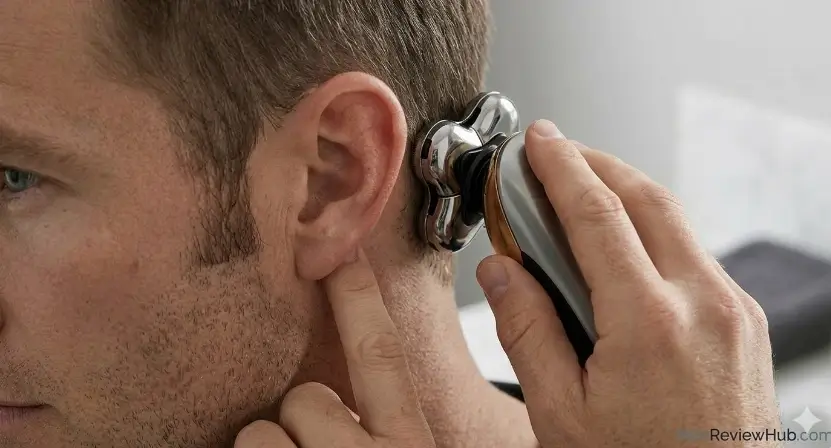
This is where hidden islands of hair get missed. Fold your ear down cleanly with your thumb to expose the hidden skin profiles behind it. For the neckline, tilt your chin downwards to stretch the rear skin evenly, letting the pivoting head handle the contour transitions.
Conquer the Crown
The crown hair whorl grows in multiple wild directions. Take your time. Utilizing a reliable 3-way mirror system is an absolute lifesaver here, letting you clearly see the back of your head instead of shaving blindly.
Pressure Control (Stop Pushing!)
This is the ultimate rookie pitfall. Pressing the shaver down heavily into your skull does not yield a closer cut. It simply forces delicate skin tissue up into the moving cutters, causing micro-tears. Hold it lightly; if it doesn’t clip cleanly, your cutting elements are simply dull.
The “Sandpaper” Touch Test
Mirrors can occasionally deceive you, but your fingertips won’t. Flatly run your palm over the entire scalp texture. If you detect any rough or scratchy resistance, make one final light pass over that specific area until it feels consistently smooth.
Phase 3: Post-Shave Care (Protect the Dome)
You just cleared the runway, but don’t drop the ball now. This newly exposed skin is highly delicate and needs immediate recovery and defense against environmental elements.
- The Cold Water Shock: Shaving friction dilates surface blood vessels. Immediately rinse your head with cold water for 30 seconds to calm active inflammation and tighten pores smoothly.
- Hydration (Balm over Splash): Ditch alcohol-heavy aftershaves that dry out the scalp tissue. Apply an alcohol-free balm to deeply hydrate and restore normal pH balance without leaving a greasy oil slick.
- SPF is Non-Negotiable: Your scalp is now a direct target for UV radiation. To prevent painful burns and long-term damage, apply a matte-finish sunscreen daily to stay completely protected without looking glossy.
- Manage the Shine: Decide on your preferred aesthetic. If you favor a pristine high-gloss finish, utilize a lightweight grooming oil. If you want a clean matte appearance, rely on specialized anti-shine moisturizers to manage daily oils.
- Long-Term Maintenance (Exfoliate): Twice a week, use a gentle facial scrub on your head in the shower. This cleanly removes dead skin cell buildup, preventing trapped ingrown hairs and ensuring your next shaving session is perfectly frictionless.
Equipment Maintenance: Keep Your Blades Lethal
A high-end electric shaver is a precision instrument. Treat it poorly, and it will pull and yank at your skin. Proper upkeep is essential.

- The Fast Rinse: Open the shaver casing after every single use and clear out the accumulated hair dust under warm running water to protect the motor core.
- Lubrication is Critical: Friction generates heat and dulls edges quickly. Once a week, apply a single drop of light maintenance oil directly onto the cutting tracks, run it for 10 seconds, and wipe away any excess.
- The 12-Month Rule: Head shaving covers significantly more surface area than basic beard grooming. Replace the replacement blades every 12 months with original manufacturer parts to ensure clean performance.
- Brush with Caution: Never press the cleaning brush bristles against the delicate outer foil mesh. Denting that thin metal will cause painful scratches during your next session.
- Dry Storage: Avoid leaving your device sitting in a damp pool on the sink basin. Store it on its charging dock or in a ventilated case to prevent environmental oxidation.
Real-Talk FAQs: We Answer Everything
How often should I shave my head with an electric shaver?
For a clean, totally smooth look, aim for every 1 to 2 days. If you prefer a short shadow look, every 3 to 4 days works well. Avoid waiting past 5 days, or the longer stubble will cause standard shavers to lag and tug.
Can I use my regular face shaver on my head?
Yes, high-performance face shavers (like a premium Braun foil) work remarkably well. However, dedicated head shavers feature palm-grip bodies specifically designed to help you navigate the tricky rear blind spots quickly and comfortably.
Is wet shaving better than dry shaving?
Dry shaving is unbeatable for quick speed. But if you have highly reactive skin, using a slick shaving gel in the shower with a waterproof electric model provides a wonderful, protective lubrication layer that minimizes friction bumps.
Why am I getting red bumps or “razor burn” even with an electric?
You are likely applying too much downward pressure or your cutting blocks have become dull over time. Additionally, if you recently transitioned from standard manual blades, your skin tissue requires roughly 3 weeks to adapt to the new mechanics.
Does an electric razor get as close as a manual razor?
Modern premium shavers get incredibly close—roughly 95% of a manual blade’s performance. While manual razors peel away a microscopic layer of skin cells to achieve closeness, a top-tier electric delivers a look that is visually identical without the blood or razor nicks.
Can I take my electric head shaver on a plane?
Absolutely. Global airport security guidelines safely permit electric shavers in both carry-on and checked luggage. Pro-tip: Utilize your device’s travel lock feature so it doesn’t accidentally switch on mid-flight.
The Bottom Line: Reclaim Your Time
Shaving your head with an electric shaver isn’t just about hair removal; it’s about reclaiming your morning, saving money, and protecting your skin. It is the ultimate grooming routine for the modern man—clean, efficient, and undeniably sharp.
If you’re tired of the horseshoe look and ready to commit to the chrome, don’t settle for a mediocre tool that leaves you with skin irritation. Head over to our comprehensive, field-tested guide on the Best Electric Shavers for Bald Heads to see which devices actually earned the right to touch your scalp safely.
Your dome deserves nothing less than professional-grade care. Stay sharp, brothers.