
The Science: Why Scalp Razor Bumps Form
To fix scalp irritation permanently, you must first understand the biological mechanism behind it.
The medical designation for razor bumps is Pseudofolliculitis Barbae (PFB). While commonly discussed regarding facial beards, PFB on the scalp is often more severe due to higher pore density, increased sweat gland activity, and constant friction from headwear and pillows.
1. Extra-Epidermal vs. Trans-Epidermal Penetration
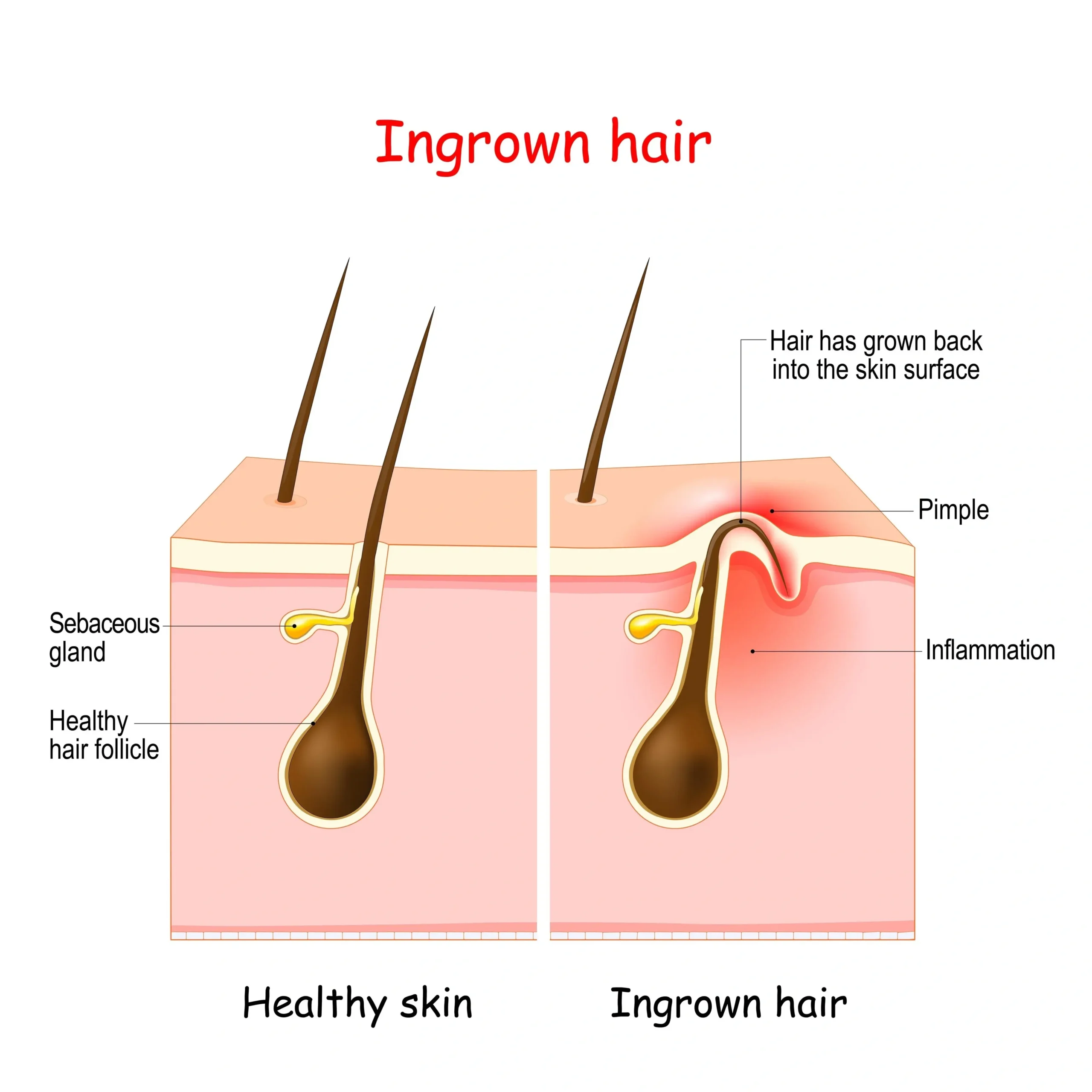
Ingrown hairs occur through two distinct pathways. Extra-epidermal penetration happens when a hair grows out of the follicle, curls backward like a U-turn, and pierces back into adjacent skin tissue. Trans-epidermal penetration occurs when hair is cut below the skin surface (sub-dermal cutting); as it grows, its sharp sliced tip pierces the wall of the hair follicle before ever reaching the surface.
2. The Foreign-Body Inflammatory Cascade
When a sharp hair tip penetrates the dermis, your immune system identifies keratin—a protein normally confined outside the skin barrier—as an invading foreign object. It dispatches neutrophils and macrophages, triggering localized tissue inflammation, redness, throbbing pain, and pus filled papules.
3. The Hysteresis Fallacy (“Lift and Cut”)
Multi-blade cartridge razors rely on mechanical hysteresis: Blade #1 grabs and lifts the hair shaft out of the follicle, while Blades #2 through #5 cut it off before it retracts. The hair snapped back inside beneath the pore level—creating a high probability of trans-epidermal ingrown hair formation.
Diagnostic Guide: Razor Bumps vs. Other Scalp Conditions
Before treating your head, verify that you are actually dealing with PFB and not a bacterial infection or acne condition that requires prescription medication.
| Condition | Primary Cause | Visual Symptoms | Key Solution |
|---|---|---|---|
| Razor Bumps (PFB) | Trapped cut hair re-entering skin | Red papules centered directly around hair follicles | Single-blade shaving, BHA chemical exfoliants |
| Bacterial Folliculitis | Staphylococcus aureus infection in pores | Clusters of yellow, pus-filled pustules that itch or burn | Antibacterial washes (Benzoyl Peroxide), topical antibiotics |
| Scalp Acne | Excess sebum & clogged pores | Comedones and deep comedonal cysts across oil zones | Non-comedogenic balms, Salicylic Acid, Zinc PCA |
Selecting Your Hardware: The Blade Matrix
Your choice of shaving hardware determines 80% of your skin outcome. Here is how standard tools break down for scalp health.
| Razor Category | Bump Risk | Closeness Level | Verdict for Sensitive Scalps |
|---|---|---|---|
| Multi-Blade Cartridges (3-5 Blades) | EXTREME HIGH | 10 / 10 | Avoid completely if prone to PFB. Causes severe sub-dermal ingrowns. |
| Double-Edge (DE) Safety Razor | VERY LOW | 9 / 10 | Gold Standard. Cuts strictly level with the skin surface without tugging. |
| Rotary Electric Shaver | LOWEST | 8 / 10 | Best for daily maintenance & highly reactive skin. Screen blocks direct blade contact. |
| Electric Foil Shaver | MODERATE | 9.5 / 10 | Great closeness, but require straight strokes which can be tricky on rounded skulls. |
Phase 1: Pre-Shave Protocols (Bulletproof Your Foundation)
Razor bump prevention begins minutes before steel touches skin. Skipping preparation forces the blade to shear dry, rigid keratin hairs, creating jagged tips that curl into the dermis.
1. Thermal Softening (Hydrate Keratin Shafts)
Dry hair exhibits a tensile strength similar to copper wire of equivalent diameter. Exposing hair to warm water (around 105°F / 40°C) for 3 to 5 minutes swells the hair shaft by up to 34% and reduces the force needed to cut it by over 65%. Always shave immediately after a warm shower.
2. Chemical Exfoliation via BHA (Salicylic Acid)
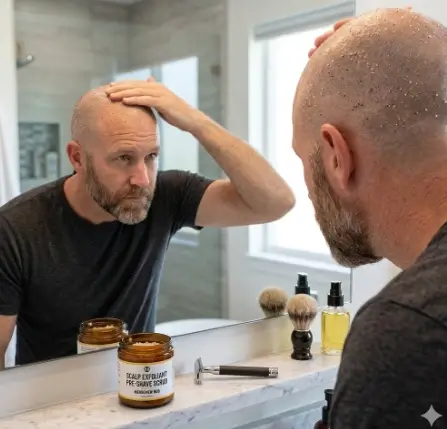
Ditch aggressive physical scrubs containing walnut shells or plastic microbeads—they create microscopic skin tears that harbor bacteria. Use a face/scalp wash with 1% to 2% Salicylic Acid (BHA). As an oil-soluble acid, Salicylic Acid penetrates deep inside lipid-filled pores to dissolve dead skin cells blocking follicle exits.
3. Hydrophobic Barrier (Pre-Shave Oil Layer)
Massage 4 to 6 drops of natural pre-shave oil (look for Jojoba, Grapeseed, or Castor oil base) into your wet scalp. This forms a microscopic slick barrier that allows razor blades to glide seamlessly without dragging or skipping across dry spots.
4. Glycerin-Rich Traditional Lather
Throw away pressurized aerosol shaving cans containing Isobutane and Propellant alcohols that freeze moisture out of your scalp. Use a traditional shaving soap or cream rich in Vegetable Glycerin. Apply with a synthetic shaving brush to build a warm, dense lather that holds hairs upright away from the skin surface.
Phase 2: The Tactical Shave (Biomechanical Execution)
Even perfect pre-shave prep cannot save you from poor blade handling. Follow these strict biomechanical rules.
1. Mapping Your Scalp Grain (Grain Directional Control)
Hair on the scalp does not grow downward in a uniform line. It whorls in circular patterns at the crown and changes direction near the gape of the neck. Allow 2 days of stubble growth, rub your hand across your skull, and note which directions produce resistance. Your initial pass must always follow the direction of growth (With The Grain – WTG).
2. The Strict 30-Degree Blade Angle Rule
When using a single-blade safety razor, maintain a fixed 30-degree angle relative to the scalp surface. Shallow angles (under 20°) cause blade scraping and burning; steep angles (over 45°) dig blade edges into hair follicles, creating micro-gaps and deep ingrown points.
3. Zero-Pressure Weight Management
Unlike modern plastic cartridge razors that require manual pushing against the head, high-quality safety razors are weighted with stainless steel or brass handles. Let the natural gravitational mass of the razor handle supply cutting pressure. Pressing down depresses the skin around hair follicles, inviting uneven cuts.
4. Short, Non-Overlapping Strokes (1-2 Inches)
Never take sweeping 6-inch strokes down your head. Take controlled, 1 to 2-inch strokes. Rinse your razor blade in warm running water every two strokes to clear accumulated lather and hair debris from clogging blade gaps.
Phase 3: Post-Shave Lockdown (Barrier Repair)
Once the blade finishes its job, your scalp is missing microscopic layers of epidermis. Immediate chemical sterilization and barrier sealing are mandatory.
- Vascular Thermal Shock: Immediately douse your scalp with ice-cold water. Cold water triggers rapid vasoconstriction, shutting down micro-bleeding, constricting inflamed pores, and calming nerve endings instantly.
- Natural Hemostatic & Antiseptic Block: Wet a block of natural Potassium Alum (Alum Block) and gently glide it across your wet head. Alum provides mild astringent qualities, sterilizes micro-cuts, and instantly signals areas where technique was too aggressive through a mild tingle.
- Astringent Tone without Denatured Alcohol: Apply an alcohol-free Witch Hazel toner containing Niacinamide or Aloe Vera. Witch hazel calms epidermal erythema without stripping natural oils like cheap alcohol splashes do.
- Non-Comedogenic Barrier Balm: Lock in hydration using a lightweight balm containing Tea Tree Essential Oil (natural antimicrobial), Willow Bark Extract, or Shea Butter. Ensure the product is explicitly labeled non-comedogenic to avoid clogging open pore channels.
- Post-Shave Environmental Quarantine: Refrain from putting on tight caps, hard hats, or engaging in heavy cardiovascular exercise for at least 2 to 3 hours post-shave. Sweat contains salt and bacteria that easily trigger pustules on open hair follicles.
The 48-Hour Emergency Recovery Protocol
Already dealing with an angry, swollen outbreak of razor bumps on your head? Do not shave over them! Follow this immediate rescue routine.
Step 1: Immediate Shaving Cessation
Enforce an absolute 72-hour blade embargo. Dragging a sharp blade across pre-existing papules clips off skin caps, introduces surface bacteria directly into blood channels, and leads to permanent scarring.
Step 2: Hydrocortisone + Tea Tree Spot Treatment
Apply a thin layer of 1% OTC Hydrocortisone cream directly to inflamed bumps twice daily for no longer than 3 days. This quickly suppresses the body’s immune cascade and reduces localized swelling.
Step 3: Sterile Warm Compress Liberation
Press a clean washcloth soaked in warm water against infected bump clusters for 5 minutes. Warmth softens the outer epidermis, encouraging trapped hair tips to spring out naturally without mechanical digging.
The Pro Arsenal: Reviewed Scalp Tools
We tested the leading head-shaving tools across key metrics: skin safety, cutting efficiency, build quality, and value. Here are our top verified picks.
| Category | Our Top Pick | Why it Wins |
|---|---|---|
| The Precision King | Merkur 34C Safety Razor | A single, ultra-sharp blade that cuts strictly at the skin level. The gold standard to prevent ingrown hairs. |
| The Speed Demon | Freebird Flex Series | Best rotary electric option. Its flexing contour tech hugs the skull geometry, minimizing micro-cuts. |
| The Modern Hybrid | The Leaf Shaver | Pivoting head like a standard cartridge, but utilizes independent single edges. Brilliant transitional tool. |
Frequently Asked Questions (Clinical Answers)
How long do razor bumps on the scalp last?
Typically, minor razor bumps resolve in 3 to 5 days if you refrain from shaving and allow the epidermal layer to heal. However, severe ingrown hairs causing deep papules can persist for 2 to 3 weeks and may require topical Salicylic Acid or Hydrocortisone treatment.
Can I shave my head every single day?
Unless your scalp skin is exceptionally resilient, daily shaving with a manual razor is strongly discouraged. Your stratum corneum needs 48 to 72 hours to rebuild its protective lipid barrier. If you must maintain a zero-stubble look daily, switch to a high-end rotary electric shaver.
Should I pick or pop razor bumps on my head?
Never pick, pop, or squeeze scalp razor bumps. Popping introduces bacteria (Staphylococcus aureus) deeper into the hair follicle, triggering secondary bacterial folliculitis, permanent hyperpigmentation, or severe keloidal scarring.
Is a safety razor or electric shaver better for sensitive scalps?
For active bump flare-ups, a rotary electric shaver is safer because its outer foil mesh shields the skin from direct blade contact. Once your scalp heals, a single-blade Double-Edge (DE) Safety Razor offers the cleanest cut with minimal irritation.
How do I know if I have razor bumps or folliculitis?
Razor bumps (PFB) are non-contagious foreign-body reactions caused by hair re-entering the skin. Folliculitis is a bacterial or fungal infection of the hair follicle characterized by pustules with yellow pus, spreading redness, and severe itching.
Does cold water close pores after shaving?
Pores do not open or close physically like doors because they lack muscle tissue. However, cold water constricts dermal blood vessels, shrinks surrounding swollen tissue, stops micro-bleeding, and reduces post-shave inflammation instantly.
The Final Word: Take Control of Your Scalp Health
You now possess the complete, clinically backed protocol to prevent razor bumps on your scalp permanently. Achieving a polished, healthy dome isn’t about luck or genetics—it’s about replacing bad habits with solid biomechanics and dermatological chemistry.
Ready to streamline your daily routine without blade cuts? Read our detailed roundup of the Best Electric Shavers for Bald Heads to discover which modern devices deliver surgical-grade closeness with maximum skin comfort.
Stop suffering through painful irritation. Upgrade your routine, treat your scalp right, and rock your bald look with 100% confidence.