
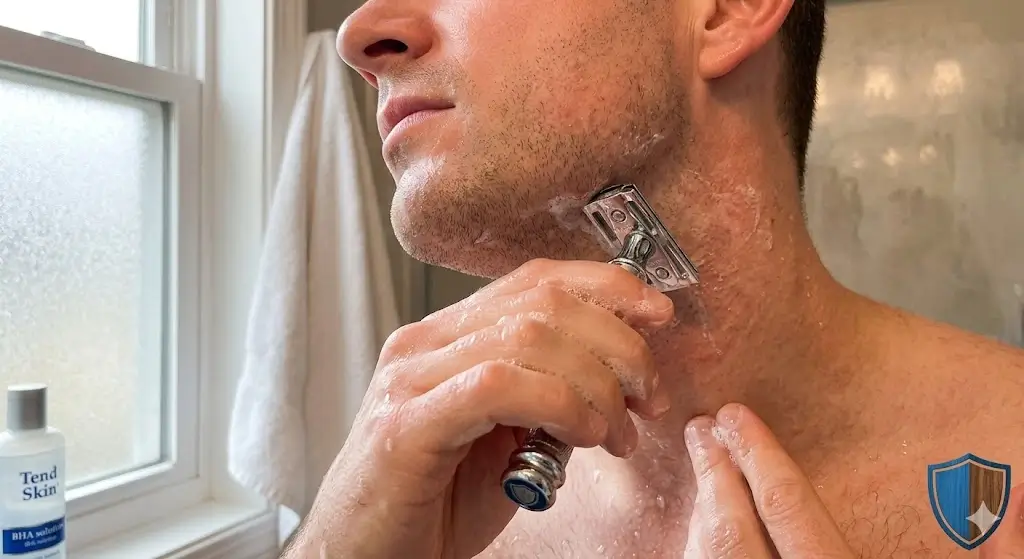
⚡ Quick Expert Summary: Razor Bump Prevention Protocol
- Step 1: Chemical Exfoliation: Apply a gentle 2% BHA (Salicylic Acid) liquid post-shave to actively dissolve dead keratin blocking your hair follicles.
- Step 2: Ditch the Cartridge: Switch to a single safety razor blade to stop cutting hair beneath the epidermal boundary.
- Step 3: Map Your Grain: Always shave strictly with the direction of hair growth on your first pass to prevent follicle wall trauma.
- Step 4: The Cold Seal: Finish with an ice-cold water rinse to calm the tissue and immediately close exposed pores.
Table of Contents
ToggleHow to Prevent Ingrown Hairs: The Ultimate Dermatologist Guide for Men
Most men have stood in front of the bathroom mirror, staring at their neck in frustration at the inflamed, painful razor bumps ruining their morning routine. For decades, multi-blade cartridge razors have been marketed as the gold standard, yet for men with coarse or curly facial hair, they are the primary trigger for chronic irritation.
Eliminating post-shave irritation requires understanding the mechanical science of your beard follicles. Shaving is a form of precise physical exfoliation. When a 5-blade razor uses a “lift-and-cut” motion, it stretches the hair shaft, cuts it below the skin line, and allows the sharp edge to snap back into the follicle. As the hair grows, it pierces the inner skin layer, triggering an inflammatory immune response.
This comprehensive guide breaks down the clinical science, tailored routines for every skin type, active ingredient analyses, and practical tools needed to restore clear, healthy skin using a modern dermatological protocol.
1. The Science of Pseudofolliculitis Barbae (PFB)
To successfully treat razor bumps, you must recognize that your body is reacting to internal skin trauma. In dermatology, chronic bump formation is known as Pseudofolliculitis Barbae (PFB), which occurs in two distinct mechanical forms:
- Extrafollicular Penetration (The Loop): The hair exits the follicle normally but, due to natural curl patterns, curves backwards and re-enters the epidermis from the outside.
- Transfollicular Penetration (The Submarine): Hair is trimmed below the follicular orifice. As dead skin cells seal the pore opening, the sharp hair tip pierces the sidewall of the follicle underground.
- The Inflammatory Cascade: Once keratin enters living tissue, immune cells treat it as a foreign body, causing papules, pustules, and hyperpigmentation.
💡 Clinical Insight:
Avoid aggressive physical scrubs on active bumps. Granular scrubs create micro-tears in damaged skin and spread follicular bacteria. Targeted chemical exfoliation is the safest method for clearing blocked pores.
2. Single-Blade Mechanics: Eliminating Follicular Trauma
Switching from a multi-blade cartridge to a single safety razor blade is one of the most effective steps to stop ingrown hairs permanently.

- Flush-Level Cutting: A Double-Edge (DE) safety razor cuts hair directly at skin level without pulling or stretching the follicle shaft.
- Hygienic Precision: Single blades are easy to clean and replace, preventing the accumulation of sebum and bacteria common in multi-blade cartridges.
3. Comparing Exfoliation & Cutting Methods
Understanding how different grooming methods impact the epidermal barrier is essential for maintaining clear skin:
| Method / Tool | Mechanism of Action | Impact on In-grown Hair Risk |
|---|---|---|
| 2% Salicylic Acid (BHA) | Oil-soluble acid penetrates lipid layers to dissolve dead keratin inside pores. | Lowers Risk (Optimal Choice) |
| Physical Scrubs | Abrasive particles strip surface skin cells manually. | Increases Inflammation Risk |
| Safety Razor (Single Blade) | Slices hair cleanly flush with the skin surface without skin retraction. | Prevents Trapped Hair |
| 5-Blade Cartridge | Hysteresis (“lift and cut”) mechanism clips hair underneath the pore surface. | Primary Cause of Submarine PFB |
4. The Active Ingredient Deep-Dive: What Works & What to Avoid
Skincare formulations can make or break your razor bump treatment. Not all exfoliating acids or soothing balms are created equal. Here is how key dermatological ingredients function on post-shave skin:
| Active Ingredient | Category / Function | Clinical Benefit | Recommendation |
|---|---|---|---|
| Salicylic Acid (2% BHA) | Beta-Hydroxy Acid | Lipid-soluble; penetrates deep into hair follicles to clear sebum and dead keratin cells. | Essential (Nightly) |
| Glycolic Acid (AHA) | Alpha-Hydroxy Acid | Water-soluble; exfoliates surface layer to fade post-inflammatory hyperpigmentation (dark spots). | Secondary (2x/week) |
| Niacinamide (3-5%) | Vitamin B3 / Antioxidant | Repairs lipid moisture barrier, reduces post-shave redness, and controls excess sebum. | Highly Recommended |
| Alcohol Denat / Isopropyl | Astringent Solvent | Strips natural lipid oils, dehydrates skin cells, and triggers rebound sebum production. | AVOID ABSOLUTELY |
| Synthetic Fragrance / Menthol | Sensitizing Additive | Gives a false cooling sensation while causing contact dermatitis and vascular swelling. | AVOID ON CUT SKIN |
5. Tailored Protocols by Skin & Beard Type
No two faces are anatomically identical. Your hair curl pattern and skin sensitivity dictate your ideal shaving approach:
Protocol A: Black Men & Coarse / Curly Hair Patterns (Fitzpatrick Types IV-VI)
Men with tightly coiled beard hair have curved hair follicles. When hair is cut flush, its natural trajectory causes it to curl sideways back into the skin (Extrafollicular PFB).
- Recommendation: Use a zero-gap T-blade electric trimmer (leaving 0.5mm stubble) instead of wet shaving down to the bare skin, or stick strictly to a mild safety razor with a single WTG pass.
- Key Product: Nightly 2% BHA combined with a 5% Niacinamide cream to minimize hyperpigmentation dark spots.
Protocol B: Sensitive & Acne-Prone Skin
If you experience immediate vascular redness (erythema) or acne breakouts alongside razor bumps, your moisture barrier is compromised.
- Recommendation: Wash face with warm water before shaving (never scalding hot). Use fragrance-free shaving creams rich in Colloidal Oatmeal or Aloe Vera.
- Key Product: Alcohol-free Witch Hazel toner followed by a Ceramide-based barrier repair balm.
Protocol C: Thick / Dense Beard Growth
Dense facial hair requires maximum softening before steel touches the skin to avoid hair pulling.
- Recommendation: Perform a 2-minute Hot Towel treatment pre-shave to hydrate keratin. Use a pre-shave oil containing Jojoba or Argan oil under your lather for blade slip.
6. The 4-Step Professional Shaving Routine
Step 1: Map Your Grain Direction
Facial hair growth patterns vary across the neck and jawline. Allow stubble to grow for 24–48 hours to identify growth directions. Always perform your initial shaving pass strictly With The Grain (WTG).
Step 2: Apply Light Technique
Avoid pressing the razor blade into the skin. Excessive pressure forces soft tissue into the blade gap, clipping hair too close and causing micro-cuts.
Step 3: Cool Water Rinse
Rinse thoroughly with cold water post-shave to soothe exposed skin, minimize vascular swelling, and calm irritation.
Step 4: Alcohol-Free Hydration
Avoid alcohol-heavy splash lotions that strip skin moisture. Apply a soothing Witch Hazel formula or a lightweight, non-comedogenic hydration balm.
7. First-Aid Troubleshooting: How to Treat Active Ingrowns
If you currently have painful, inflamed red bumps on your neck, follow this 24-hour emergency protocol before shaving again:
🚑 24-Hour Acute Care Protocol
- Warm Compress: Apply a clean washcloth soaked in warm water to the affected area for 10 minutes, three times daily. This softens surface skin and encourages trapped tips to surface naturally.
- Spot Treatment: Apply a dab of 2% Salicylic Acid solution directly onto the papule. Do not squeeze or pop the bump.
- Hydrocortisone (1% Over-the-Counter): For severe inflammation and itching, apply a tiny swab of 1% Hydrocortisone cream for no more than 3 consecutive days to reduce swelling.
- Sterile Extraction (Only if Loop is Visible): If a hair loop is completely visible above the surface, sanitize precision tweezers with 70% Isopropyl Alcohol. Gently hook the loop and pull it out. Do not pluck the root.
8. Dermatologist-Approved Product Recommendations
Building a bump-free grooming routine requires reliable gear. Here are our top editor picks tested for sensitive, PFB-prone skin:
Merkur 34C Heavy Duty
Features a closed-comb guard and optimal head angle, making it forgiving for beginners transitioning from cartridge razors.
Paula’s Choice 2% BHA Liquid
Gold standard Salicylic Acid fluid with Green Tea extract. Fluid texture absorbs quickly into skin pores without leaving residue.
Proraso After Shave Balm (White)
Formulated specifically for sensitive skin with Oatmeal Extract and Green Tea. Alcohol-free and non-comedogenic.
9. Frequently Asked Questions
Can I shave against the grain for a smoother finish?
If you are prone to razor bumps, avoid shaving Against The Grain (ATG). Cutting against growth lifts the hair shaft up before severing it, significantly increasing the likelihood of transfollicular ingrowns.
Is it safe to tweeze an existing ingrown hair?
Do not dig into the skin or pluck trapped hair roots. If a loop is visible above the surface, gently lift the tip using sterile tweezers, leaving the root intact to heal without scarring.
How long does it take for Pseudofolliculitis Barbae to clear?
With a strict 2% BHA exfoliation routine and single-blade technique, initial surface inflammation usually subsides within 10 to 14 days. Complete skin renewal and fading of dark spots takes 28 to 45 days.
Are electric shavers suitable for sensitive skin?
Foil electric shavers provide a physical barrier between the blade and skin, making them a safe alternative to traditional multi-blade razors for preventing skin irritation.